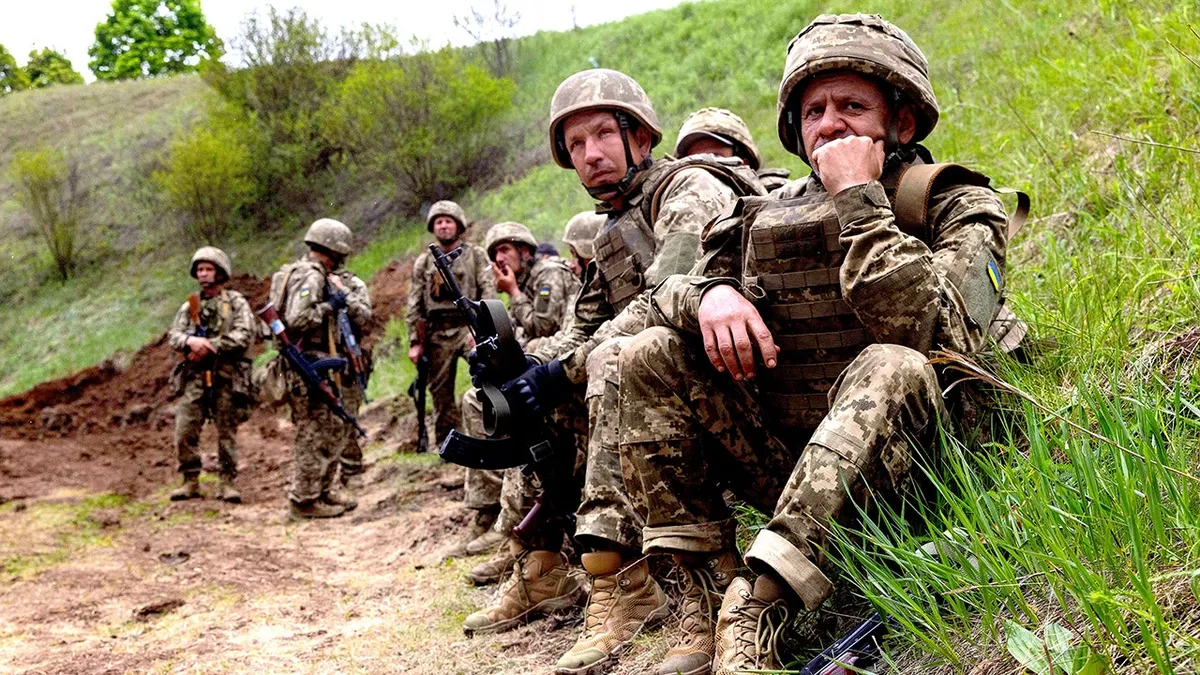
close Video Ukraine mayor says NATO needs Kyiv’s battle-tested army Lviv Mayor Andriy Sadovyi tells Fox News Digital that Ukraine’s battlefield experience, drone warfare innovation and wartime military adaptation are reshaping the future of NATO and European defense. This is part three of a series examining the challenges confronting the NATO alliance. Lviv, Ukraine — Four years into Russia’s invasion of Ukraine, officials across NATO’s eastern flank increasingly believe the alliance’s future is already being rewritten on Ukraine’s battlefield. From drone warfare and cyber defense to civilian resilience and large-scale military mobilization, Eastern European officials say Ukraine has become one of the world’s most battle-tested militaries, forcing NATO to rethink how future wars will be fought. This week, NATO Secretary-General Mark Rutte confirmed Ukrainian President Volodymyr Zelenskyy had been invited to attend the alliance’s annual summit in Ankara in July, underscoring how central Ukraine has become to NATO’s future despite not being a member of the alliance. 'A NEW KIND OF WAR': INSIDE Ukraine'S HIDDEN FACTORIES MASS-PRODUCING COMBAT DRONES Ukraine's President Volodymyr Zelenskyy speaks with the media as he arrives for a NATO summit in Vilnius, Lithuania, on July 12, 2023. (Mindaugas Kulbis/AP) "I think today the Ukrainian army is the number one army in Europe," Mayor of Lviv Andriy Sadovyi told Fox News Digital during an interview in the western Ukrainian city. "I think NATO needs the Ukrainian army," he added. The debate over NATO’s future intensified this week as alliance foreign ministers gathered in Sweden ahead of a major NATO summit in July, with Secretary of State Marco Rubio calling the upcoming meeting "one of the more important leaders’ summits in the history of NATO." Rubio warned NATO allies this week that the alliance lacks sufficient munitions production for future conflicts, a concern echoed by retired Lt. Gen. Richard Newton, who said the Pentagon is studying Ukraine’s rapid wartime industrial adaptation. Ukraine's President Volodymyr Zelenskyy and Secretary of State Marco Rubio shake hands at the Munich Security Conference in Germany, Feb. 14, 2026. (Ukrainian Presidential Press Service/Handout via Reuters) "A number of nations are taking a page out of Ukraine’s transformation of its defense industrial base, in terms of quality as well as the tremendous increase in quantity of arms to the frontlines as well," Newton said, adding, "The Pentagon is taking note and working to encourage the transformation of our own industrial base so we can drastically improve and more rapidly provide capabilities to our forces in the field, not in a matter of years but in months and perhaps even in weeks." Rubio also referenced President Donald Trump’s announcement that the U.S. would maintain troop deployments in Poland after concerns earlier this week about possible reductions on NATO’s eastern flank. AS TRUMP FORCES NATO TO PAY UP, ALLIANCE RACES TO CLOSE MILITARY GAP WITH US Ukrainian President Volodymyr Zelensky joins European and NATO officials at a press conference during a NATO summit in Vilnius, Lithuania, on June 2, 2025. (Petras Malukas/AFP) Speaking before the NATO meeting, Polish Foreign Minister Radosław Sikorski welcomed Trump’s announcement. "I want to thank President Trump for his announcement that the presence of American troops in Poland will be maintained more or less at previous levels," Sikorski said. Some note that the debate over NATO’s future comes with deep irony for Moscow. One of Russian President Vladimir Putin’s central grievances before the invasion was NATO’s eastward expansion and Ukraine’s growing ambitions to move closer to the alliance. Moscow repeatedly demanded NATO roll back its military footprint to pre-1997 levels and opposed any future Ukrainian membership. Instead, the invasion accelerated NATO’s expansion. Newly recruited soldiers of Ukraine’s 159th Separate Mechanized Brigade take part in military exercises at a training ground on May 14, 2026, in Kharkiv Oblast, Ukraine. (Yevhen Titov/Global Images Ukraine via Getty Images) Finland formally joined NATO in 2023, ending decades of military nonalignment, while Sweden joined in 2024 after Russia’s invasion dramatically reshaped security calculations across northern Europe. Finland alone added more than 800 miles of direct NATO border with Russia. Now officials in Poland and Ukraine say the war is not only expanding NATO geographically, but fundamentally transforming the alliance itself. "For decades, NATO focused largely on expeditionary wars and counterterrorism," said Polish Deputy Defense Minister Paweł Zalewski during an interview in Warsaw. "Modern warfare is mostly done by drones." "There is not a military in the world which is better than Ukraine" in understanding today’s battlefield realities, he added. US SCRAMBLES AS DRONES SHAPE THE LANDSCAPE OF WAR: 'THE FUTURE IS HERE' Russian President Vladimir Putin attends the Victory Day military parade marking the 77th anniversary of the end of World War II in Moscow, May 9, 2022. (Mikhail Metzel, Sputnik, Kremlin Pool Photo via AP) Retired Gen. Philip Breedlove, who served as NATO supreme allied commander Europe, said the war has fundamentally transformed how militaries around the world understand modern warfare. "The war in Ukraine has changed far more than just NATO’s understanding of modern warfare — it has changed the whole world’s understanding," Breedlove told Fox News Digital. Breedlove added that Ukraine’s military has evolved into "one of Europe’s most capable and formidable" forces after years of fighting Russia, despite having surrendered its Soviet-era nuclear arsenal under the 1994 Budapest Memorandum. Ukraine MAKES FASTEST GAINS IN YEARS AS Russia TALKS STALL, EXPLOITING CRACKS IN KREMLIN COMMAND A soldier launches an RQ-35 Heidrun drone used for reconnaissance and artillery fire correction in the Zaporizhzhia, Ukraine, on Feb. 22, 2026. (Dmytro Smolienko/Ukrinform/NurPhoto via Getty Images) "Today, most agree that Ukraine is not only fighting, but winning back land against one of the world’s most formidable forces," he said. That transformation is visible throughout Ukraine. Before Russia’s invasion, Ukraine had one of Eastern Europe’s largest IT sectors. Sadovyi said the war forced much of that technological ecosystem to pivot toward defense production. "Before the invasion, we had in Kyiv a huge IT cluster, 40,000 workers," Lviv’s mayor said. "During the war, we rebuilt the IT cluster to defend cluster." NATO ALLY POLAND WARNS Russia, BELARUS PUSHING ILLEGAL MIGRANTS TOWARD ALLIANCE — AND THE US Ukrainian-made drones are displayed at a military technology exhibition in western Ukraine. (Efrat Lachter/Fox News Digital) Ukraine now operates a rapidly expanding wartime innovation ecosystem focused on drones, anti-drone systems, battlefield communications and decentralized weapons production. NATO officials and European militaries are increasingly studying those lessons closely. Breedlove says the conflict exposed the limits of traditional air power and accelerated the rise of drone warfare. "It’s critical to remember that the war in Ukraine is being fundamentally fought without the support of modern air warfare because of the failures of the Russian Air Force," he said. "It’s why drone warfare has grown so exponentially, because neither side was able to marshal true modern air capabilities." The Polish defense official Zalewski told Fox News Digital the Pentagon is now promoting what Polish officials describe as "NATO 3.0," a model in which Europe assumes greater responsibility for conventional defense as the United States shifts more attention toward China and the Indo-Pacific. "The main assumption of this concept is that conventionally it would be Europe defending itself," he said. EUROPE STEPS UP TO FUND ITS OWN DEFENSE, PROVIDE SECURITY FOR Ukraine AFTER TRUMP THREATS Service members control an FPV drone with optical fibre guidance to deliver a parcel to frontline troops in Kostiantynivka, Donetsk region, Ukraine, on Feb. 17, 2026. (Iryna Rybakova/Press Service of the 93rd Kholodnyi Yar Separate Mechanized Brigade of the Ukrainian Armed Forces/Reuters) That shift comes as Poland dramatically increases military spending and positions itself as one of NATO’s leading military powers on the alliance’s eastern flank. Warsaw spent nearly 5% of GDP on defense this year, the highest level in NATO. Polish officials argue the war proved Eastern Europe was right to take Russia’s threat seriously long before many Western European countries did. "The eastern flank is much more powerful than even five years ago," Polish Deputy Foreign Minister Marcin Bosacki told Fox News Digital during reporting in Warsaw. "We were right about the nature of Putin’s regime and Russia’s aggressive strategy." Firefighters put out a fire in a multi-story apartment building following a Russian missile attack in Kharkiv, Ukraine, on Saturday, March 7, 2026. (Andrii Marienko/AP) Ukraine is not currently a NATO member, and the alliance has avoided offering Kyiv a concrete timeline for accession during the war out of concern it could trigger direct confrontation between NATO and Russia. But across Eastern Europe, officials increasingly argue the alliance’s future may depend on Ukraine regardless of formal membership. Efrat Lachter is a reporter for Fox News Digital covering international affairs and the United Nations. Follow her on X @efratlachter. Stories can be sent to efrat.lachter@fox.com.
SRCFox News - World
LANGEN
LEANCenter-Right
WORDS1 452
ENT12
SUN · 2026-05-24 · 18:35 GMTBRIEF NSR-2026-0524-78888
NSR-2026-0524-78888News Report·EN·Conflict
Ukraine’s battlefield is transforming the future of NATO
Officials on NATO's eastern flank believe Ukraine's battlefield experience is transforming the alliance's future, forcing a reevaluation of modern warfare tactics like drone combat and cyber defense. Ukraine's military is seen as highly battle-tested, leading to its invitation to the upcoming NATO summit in July.
Fox News - WorldFiled 2026-05-24 · 18:35 GMTLean · Center-RightRead · 6 min
Fox News - WorldFIG 01
Reading time
6min
Word count
1 452words
Sources cited
4cited
Entities identified
12entities
Quality score
100%
§ 01
Briefing Summary
AI-generatedNEWSAR · AI
Officials on NATO's eastern flank believe Ukraine's battlefield experience is transforming the alliance's future, forcing a reevaluation of modern warfare tactics like drone combat and cyber defense. Ukraine's military is seen as highly battle-tested, leading to its invitation to the upcoming NATO summit in July. The conflict has also accelerated NATO's geographical expansion with Finland and Sweden joining, and prompted discussions about increasing munitions production and adapting defense industrial bases. Poland, a key NATO member on the eastern flank, is increasing its defense spending significantly. While Ukraine is not a member, its role in shaping NATO's strategy and capabilities is increasingly recognized.
Confidence 0.90Sources 4Claims 5Entities 12
§ 02
Article analysis
Model · rule-basedFraming
Conflict
Political Strategy
Tone
Mixed Tone
AI-assessed
CalmNeutralAlarmist
Factuality
0.60 / 1.00
Mixed
LowHigh
Sources cited
4
Well sourced
FewMany
§ 03
Key claims
5 extracted01
Nations are taking a page out of Ukraine’s transformation of its defense industrial base in terms of quality and quantity of arms.
quoteRichard Newton
Confidence
0.90
02
NATO allies lack sufficient munitions production for future conflicts.
quoteMarco Rubio
Confidence
0.90
03
Ukraine's battlefield experience, drone warfare innovation, and wartime military adaptation are reshaping the future of NATO and European defense.
quoteLviv Mayor Andriy Sadovyi
Confidence
0.90
04
NATO needs the Ukrainian army.
quoteLviv Mayor Andriy Sadovyi
Confidence
0.80
05
The Ukrainian army is the number one army in Europe.
quoteLviv Mayor Andriy Sadovyi
Confidence
0.80
§ 04
Full report
6 min read · 1 452 words§ 05
Entities
12 identifiedKey playerOppositionContextPositiveNeutralNegative
People5
Organizations1
Locations5
§ 06
Keywords & salience
10 termsukraine
1.00
nato
1.00
drone warfare
0.90
military adaptation
0.80
battlefield experience
0.70
defense industrial base
0.60
european defense
0.50
munitions production
0.50
military mobilization
0.40
cyber defense
0.40
§ 07
Topic connections
Interactive graph Network visualization showing 51 related topics
View Full Graph Person Organization Location Event|Click node to navigate|Edge numbers = shared articles