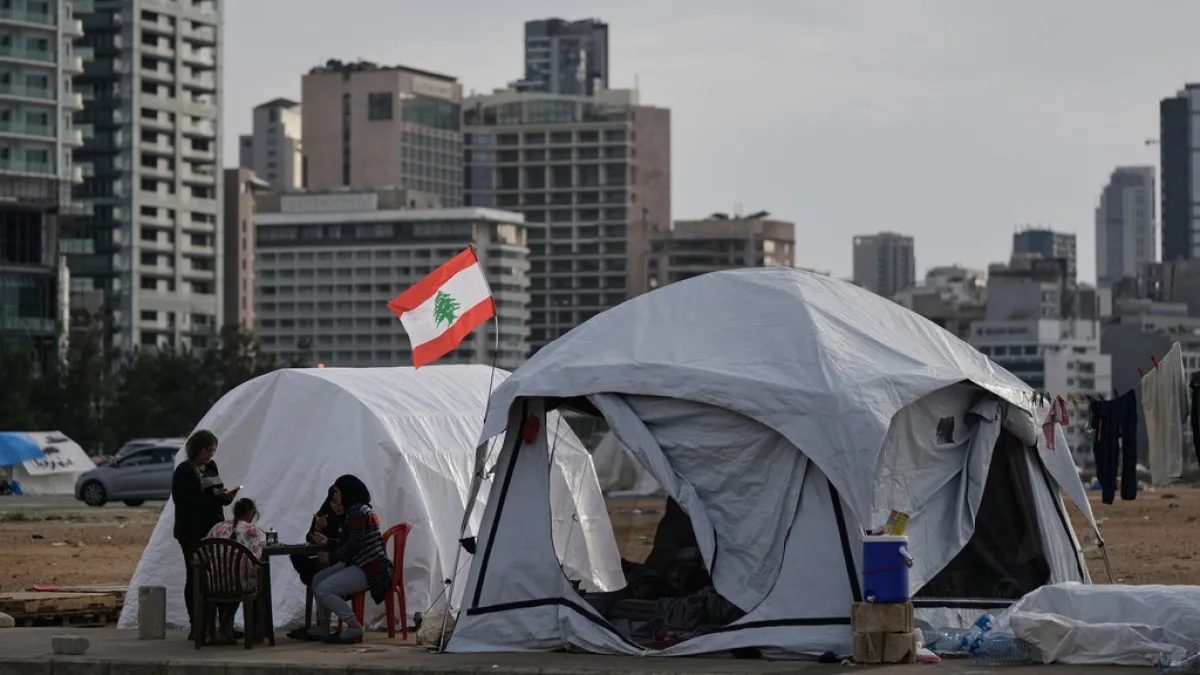
Twenty-six years after Israeli forces were driven out of Lebanon" class="entity-link entity-location" data-entity-id="6972" data-entity-type="location">Southern Lebanon, fears of a new occupation have emerged.Displaced people who fled Israeli strikes in Lebanon" class="entity-link entity-location" data-entity-id="6972" data-entity-type="location">Southern Lebanon sit outside shelter tents in Beirut, Lebanon, Friday, April 24, 2026 [Bilal Hussein/AP Photos]Published On 25 May 2026Beirut, Lebanon – On May 25, 2000, the last Israeli troops withdrew from Lebanon" class="entity-link entity-location" data-entity-id="6972" data-entity-type="location">Southern Lebanon ending their 18-year occupation.This expulsion of Israeli forces by an armed movement led by Hezbollah has been a cause of national celebration in Lebanon ever since, but this year, a new occupation in the south has dampened the mood.“Liberation Day is a sacred day for us,” Ali Saleh, 55, from Jwaya in Lebanon" class="entity-link entity-location" data-entity-id="6972" data-entity-type="location">Southern Lebanon told Al Jazeera. “It is a holiday of victory, pride and dignity.”Saleh said he would spend this Liberation Day at the Camille Chamoun Stadium on the southern periphery of Beirut, where he has lived with his wife and son after being displaced in March, when Israeli forces again invaded the south.He is one of more than 1.2 million people in Lebanon who have been displaced from their homes, predominantly from south Lebanon and Beirut’s southern suburbs, since then.In the past two years, Lebanon has been invaded twice by Israel. In early 2025, more than two months after a ceasefire was agreed, the Israeli military withdrew from all but five points in south Lebanon. This time, however, many Lebanese fear history is repeating itself, and that a protracted Israeli occupation of the the country has started again.“He who didn’t live in Lebanon" class="entity-link entity-location" data-entity-id="6972" data-entity-type="location">Southern Lebanon before 2000 didn’t know what it means to live under occupation,” Saleh said. “Liberation Day broke our shackles, freed the precious land, freed the plants, freed the butterflies, the birds, every grain of dust. It freed everything.”Conflicting speeches on LiberationDuring the Lebanese civil war (1975-1990), Israel twice invaded the country – in 1978 and 1982 – to eject the Palestine Liberation Organisation (PLO) from the country.Israeli forces reached as far as Beirut in 1982, forcing PLO fighters from Lebanon. But the Israelis continued to occupy large parts of Lebanon" class="entity-link entity-location" data-entity-id="6972" data-entity-type="location">Southern Lebanon, until they were driven out in 2000, following a persistent campaign by Hezbollah. The recent Israeli invasion brought back memories of those years of occupation for southerners.“There is a pain in my heart because this holiday is not complete,” Saleh said. “We are living in a body without a soul. Our soul is south and our body is here. I wish that this Eid we would be celebrating on our land.”In the early hours of March 2, Hezbollah fired rockets at Israeli targets for the first time in over a year in retaliation for the killing of Iran’s Supreme Leader, Ayatollah Ali Khamenei.Despite a November 2024 ceasefire, Israel had not stopped attacking Lebanon, but took advantage of the Hezbollah assault to launch a new wave of devastating attacks across the country and a ground invasion of the south.Since March 2, Israel has killed 3,151 people in Lebanon, according to Lebanon’s Ministry of Public Health.US President Donald Trump announced a ceasefire on April 16, and extended into early July. That has eased attacks on Beirut and its suburbs, but the assault on the south has continued, killing paramedics and civilians.On a daily basis, Israel has issued new forced evacuation orders for towns and villages in the south. Hezbollah has launched its own attacks on Israeli targets inside Lebanon, and in Israel, including using fibre optic drones which are immune to Israeli jamming.In a speech to mark Liberation Day on Monday, Lebanon’s President, Joseph Aoun, said that Lebanon" class="entity-link entity-location" data-entity-id="6972" data-entity-type="location">Southern Lebanon “wrote an unprecedented chapter when the Israeli occupation withdrew as a result of the steadfastness and sacrifices of the people of this land, making May 25 a day of national dignity”.Under Aoun’s command, Beirut is engaging in direct talks with Israel for the first time, and despite the controversial nature of the negotiations, he insists the government will not compromise on its goal of achieving a “full Israeli withdrawal” from Lebanon" class="entity-link entity-location" data-entity-id="6972" data-entity-type="location">Southern Lebanon.Prime Minister Nawaf Salam wrote on X that “we will not celebrate [the holiday] until the day of Israel’s complete withdrawal from our land and the safe and dignified return of our people”.Hezbollah responseHezbollah has repeatedly clashed with the government’s position, saying it rejects direct negotiations with Israel and prefers talks via intermediaries instead.In a televised address on Sunday, Hezbollah’s Secretary-General Naim Qassem repeated his rejection of direct negotiations: “Indirect negotiations are preferable. Return to national dialogue and internal solutions rather than aligning with the United States and Israel.”He also fueled controversy over increasing tensions inside Lebanon, for the first time suggesting that the Lebanese government should step down if it cannot fulfil its duties.“If this government cannot protect sovereignty, it should resign,” Qassem said.Qassem’s statement drew strong condemnation from the United States State Department.Iran has reportedly included a ceasefire in Lebanon as part of its conditions to end the war with the US and Israel. However, Israeli Prime Minister Benjamin Netanyahu is believed to be eager to continue the war, and has been urged by his right-wing ministers to resume attacks on Beirut, where drones buzzed low overhead all day Sunday and Monday.In search of “another victory”On Monday, as banks and offices closed for the annual Liberation Day holiday, Israeli air raids killed three people in Lebanon" class="entity-link entity-location" data-entity-id="6972" data-entity-type="location">Southern Lebanon and more evacuation orders were issued for 10 towns and villages.Homes near the port city of Tyre in Lebanon" class="entity-link entity-location" data-entity-id="6972" data-entity-type="location">Southern Lebanon were also struck, along with eight other towns in the south.“What are we supposed to do,” Hussein told Al Jazeera. He is from Qlayleh but displaced at a school in Tyre. “There are warnings [to evacuate homes] all over [the area].”Drones were reported flying over the Baalbek region in Lebanon’s east, another area that has come under sustained Israeli attacks since the ceasefire last month.Under such conditions, many in Lebanon feel that this Liberation Day, which is usually marked with celebrations, comes at a sombre moment for the country.Saleh, the man from Jwaya, said he had hoped to see Lebanon" class="entity-link entity-location" data-entity-id="6972" data-entity-type="location">Southern Lebanon liberated, and Lebanese citizens held in Israeli detention facilities released.Nabil, from Markaba, a border town largely destroyed since Israel set up a military outpost there, has been living in a school in the Ras Beirut neighbourhood since March 2, but remains hopeful and defiant.“We are very proud that it is Liberation Day and that we expelled the Israeli enemy from Lebanon,” he said. “We took our areas and took everything and our house in 2000, and God willing, there will be another victory.”
SRCAl Jazeera
LANGEN
LEANCenter
WORDS1 085
ENT10
MON · 2026-05-25 · 17:39 GMTBRIEF NSR-2026-0525-79078
NSR-2026-0525-79078News Report·EN·Conflict
Subdued Lebanon Liberation Day celebrations under new Israeli occupation
Lebanon's Liberation Day, commemorating the 2000 Israeli withdrawal, is subdued this year due to fears of a new Israeli occupation. Since March, over 1.2 million people have been displaced, primarily from southern Lebanon and Beirut's suburbs, following renewed Israeli invasions.
Justin SalhaniAl JazeeraFiled 2026-05-25 · 17:39 GMTLean · CenterRead · 5 min
Al JazeeraFIG 01
Reading time
5min
Word count
1 085words
Sources cited
1cited
Entities identified
10entities
Quality score
100%
§ 01
Briefing Summary
AI-generatedNEWSAR · AI
Lebanon's Liberation Day, commemorating the 2000 Israeli withdrawal, is subdued this year due to fears of a new Israeli occupation. Since March, over 1.2 million people have been displaced, primarily from southern Lebanon and Beirut's suburbs, following renewed Israeli invasions. Despite a ceasefire announced in April, assaults on the south continue, with daily evacuation orders issued. The Lebanese government, engaging in direct talks with Israel for the first time, insists on a full withdrawal, while Hezbollah rejects direct negotiations and suggests the government should resign if it cannot protect sovereignty.
Confidence 0.90Sources 1Claims 5Entities 10
§ 02
Article analysis
Model · rule-basedFraming
Conflict
Human Interest
Tone
Mixed Tone
AI-assessed
CalmNeutralAlarmist
Factuality
0.60 / 1.00
Mixed
LowHigh
Sources cited
1
Limited
FewMany
§ 03
Key claims
5 extracted01
Last Israeli troops withdrew from southern Lebanon on May 25, 2000, ending an 18-year occupation.
factual
Confidence
1.00
02
Hezbollah fired rockets at Israeli targets on March 2, in retaliation for the killing of Iran’s Supreme Leader, Ayatollah Ali Khamenei.
factual
Confidence
0.90
03
Lebanon has been invaded twice by Israel in the past two years.
factual
Confidence
0.90
04
Over 1.2 million people in Lebanon have been displaced from their homes, predominantly from south Lebanon and Beirut’s southern suburbs, since March.
statistic
Confidence
0.90
05
Since March 2, Israel has killed 3,151 people in Lebanon.
statistic
Confidence
0.80
§ 04
Full report
5 min read · 1 085 words§ 05
Entities
10 identifiedKey playerOppositionContextPositiveNeutralNegative
People1
Organizations2
Locations5
§ 06
Keywords & salience
8 termslebanon liberation day
1.00
israeli occupation
1.00
displaced people
0.90
hezbollah
0.80
southern lebanon
0.70
lebanese civil war
0.60
palestine liberation organisation
0.50
national celebration
0.40
§ 07
Topic connections
Interactive graph Network visualization showing 51 related topics
View Full Graph Person Organization Location Event|Click node to navigate|Edge numbers = shared articles