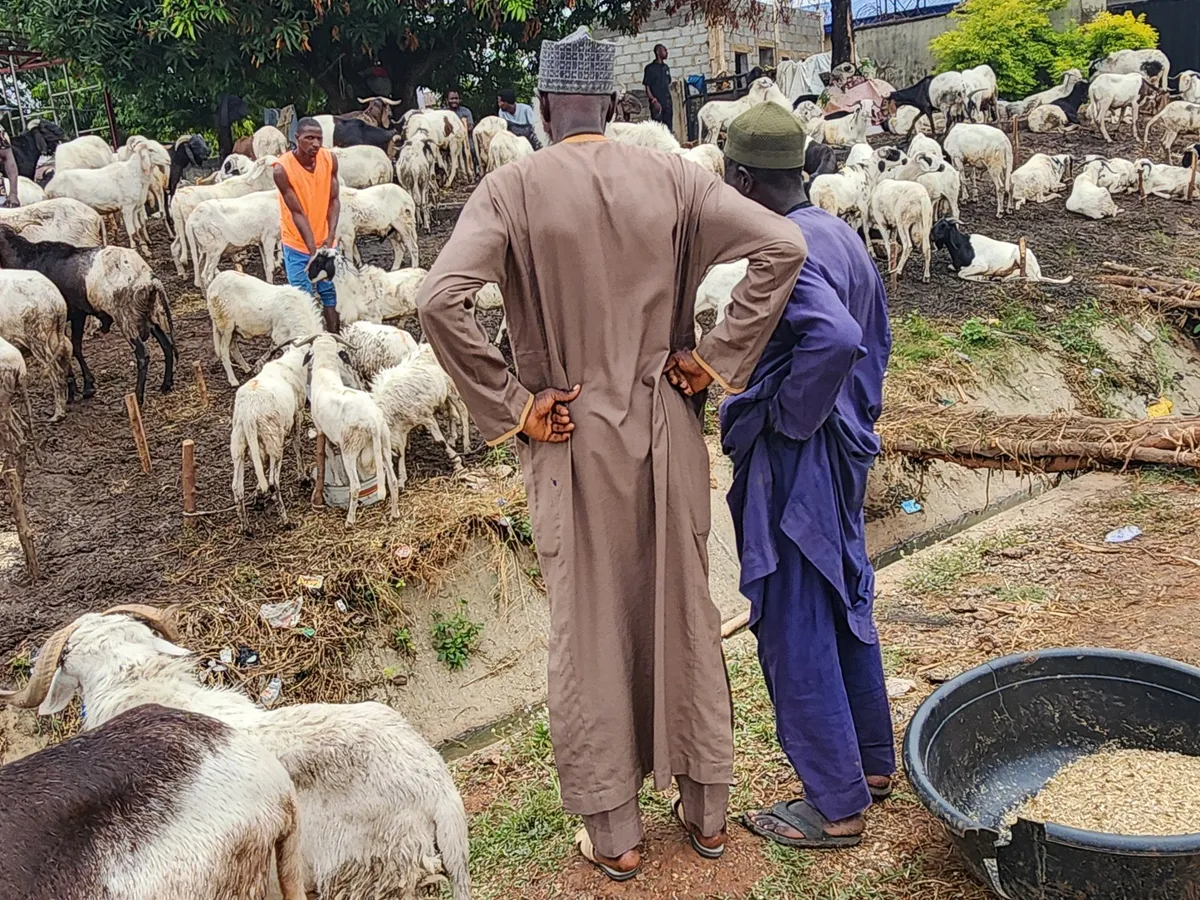
High costs in Nigeria are reshaping Eid preparations as families adjust spending and cut back on celebrations.Men gaze at a flock of sheep at the Kubwa Sallah market by the Federal Housing junction along the Dutse Road, in Abuja, Nigeria [Hussain Wahab/Al Jazeera]Published On 26 May 2026Abuja, Nigeria – Seated on a plastic chair inside his modest madrassa in Abuja, Yunus Akanji listened as children recited verses from the holy Quran in soft, rhythmic tones. Some sat on mats, others on long wooden benches.The Islamic teacher occasionally corrected a pronunciation or repeated a line, but his attention drifted.For years, Akanji, who teaches at the Nurul Bayan Islamic School, travelled with his wife and children to Saki in Oyo State to reunite with his extended family for Eid al-Adha, often called Sallah in Nigeria.When he did not make the trip, he would buy a ram for Eid and host a modest celebration with his family and students.This year, neither is happening.Yunus Akanji, an Islamic tutor at Nurul Bayan Islamic School, guides his students during recitation of the Quran [Hussain Wahab/Al Jazeera]“I have concluded that we will just celebrate with whatever we have,” he told Al Jazeera.The annual Muslim festival, marked by communal prayers and the ritual sacrifice of animals, is approaching amid deep economic strain in Nigeria.In Abuja, rising food and transport costs are quietly changing how many families are preparing for Eid.No travel homeAkanji said even parents and community members who usually support his madrassa are struggling.“Most of them have not even paid,” he said, referring to tuition fees that help keep the school and his household running.The pressure is not confined to the classroom. It shows up in bus stations, in markets, and in the small calculations people make before deciding whether to travel or stay.Nafisa Ibrahim from Ogun, currently in Abuja doing a mandatory one-year programme for graduates under the National Youth Service Corps, said she has dropped her plan to go home for Eid. Transport costs alone made it impossible.There is also no guarantee her family will even be able to slaughter an animal this year.“Transportation is about 35,000 naira [about $26], compared to the 15,000 naira [about $11] I paid when I came to Abuja in February,” she said.Opeyemi Ibrahim, a fashion designer based in Byazhin district, said customer patronage has dropped sharply despite the approaching festivities.Opeyemi Ibrahim at his fashion shop in Byazhin, where he says business has slowed [Hussain Wahab/Al Jazeera]He said rising fuel costs and erratic electricity supply have pushed up his operating expenses.“When there is no electricity, we have to run the generator,” he said. “Filling it costs about 10,000 naira [$7].But without it, the shop becomes too hot, and we still need power to iron customers’ clothes.”Inside Kubwa livestock marketAt a livestock market in Kubwa, visited by Al Jazeera ahead of Eid, the strain is obvious before anyone even speaks. Men stand beside rams tied to wooden posts. Buyers move from one animal to another, ask a few questions, then drift away.Malam Ibrahim, a livestock seller who has been in the trade for years, sat near the feed, watching most of his customers leave empty-handed.“People come, ask for prices, and walk away,” he said.Malam Ibrahim, a livestock seller at Kubwa market, rests during a slow sales day [Hussain Wahab/Al Jazeera]He pointed to a ram nearby, with black-and-white markings on its body.“This ram is selling for 600,000 naira [about $438],” he said. “Last year, the same size was below 350,000 naira [$255].”Getting animals down from northern Nigeria, Sokoto, Kaduna and beyond, has become more expensive. Fuel prices, transport fares, everything feeds into the final cost.“Even the sellers are suffering,” Ibrahim said. If sales stay slow, he worries the animals will remain unsold after Eid, when their value drops further. “We do not pray to take them back home, but with the looks of things, I fear so,” he said.Eid cutbacksOne woman who had come to buy two rams left with only one.Buhari Yishau, a fruit seller, works at Kubwa village market, where sales have slowed ahead of Eid [Hussain Wahab/Al Jazeera]Inflation has been steady in Nigeria for years now, but what people feel most is the gap between rising prices and stagnant incomes. The naira may look more stable against the United States dollar than last year, traders say, but moving goods across the country still costs more every month.At Kubwa village market, buyers kept moving, but few stopped to buy.Vendors selling tomatoes, onions, rice and cooking oil said sales were slower than usual, with many families cutting back even on basic festive food.“We used to celebrate Eid with joy,” one trader said quietly. “Now we just calculate what we can afford.”
SRCAl Jazeera
LANGEN
LEANCenter
WORDS780
ENT12
TUE · 2026-05-26 · 02:44 GMTBRIEF NSR-2026-0526-79183
NSR-2026-0526-79183News Report·EN·Economic Impact
Cost of living crisis reshapes Eid spending in Nigeria
Nigeria's cost of living crisis is significantly altering Eid al-Adha preparations this year. Families are cutting back on celebrations and adjusting spending due to rising food and transport costs.
By Hussain WahabAl JazeeraFiled 2026-05-26 · 02:44 GMTLean · CenterRead · 4 min
Al JazeeraFIG 01
Reading time
4min
Word count
780words
Sources cited
3cited
Entities identified
12entities
Quality score
100%
§ 01
Briefing Summary
AI-generatedNEWSAR · AI
Nigeria's cost of living crisis is significantly altering Eid al-Adha preparations this year. Families are cutting back on celebrations and adjusting spending due to rising food and transport costs. Many, like Islamic tutor Yunus Akanji, are foregoing traditional family visits or animal sacrifices. Students like Nafisa Ibrahim are canceling travel plans due to doubled transport fares. Fashion designer Opeyemi Ibrahim reports decreased customer patronage and increased operating expenses due to fuel costs and unreliable electricity. Livestock sellers at Kubwa market are experiencing slow sales, with ram prices nearly doubling compared to last year, making the ritual sacrifice unaffordable for many. Traders in markets also note slower sales of basic festive foods, as families prioritize affordability over traditional celebrations.
Confidence 0.90Sources 3Claims 5Entities 12
§ 02
Article analysis
Model · rule-basedFraming
Economic Impact
Human Interest
Tone
Measured
AI-assessed
CalmNeutralAlarmist
Factuality
0.70 / 1.00
Factual
LowHigh
Sources cited
3
Well sourced
FewMany
§ 03
Key claims
5 extracted01
Running a generator for a fashion shop costs about 10,000 naira per fill-up.
statisticOpeyemi Ibrahim
Confidence
1.00
02
Transport costs from Abuja to Ogun have increased from 15,000 naira to 35,000 naira.
statisticNafisa Ibrahim
Confidence
1.00
03
Yunus Akanji, an Islamic teacher, will not travel to visit family or buy a ram for Eid this year due to economic strain.
quoteYunus Akanji
Confidence
1.00
04
Customer patronage has dropped sharply for a fashion designer in Abuja due to rising fuel costs and erratic electricity supply.
factualOpeyemi Ibrahim
Confidence
0.90
05
High costs in Nigeria are reshaping Eid preparations as families adjust spending and cut back on celebrations.
factual
Confidence
0.90
§ 04
Full report
4 min read · 780 words§ 05
Entities
12 identifiedKey playerOppositionContextPositiveNeutralNegative
People3
Organizations2
Locations4
§ 06
Keywords & salience
9 termseid spending
1.00
cost of living crisis
1.00
nigeria
0.90
economic strain
0.80
spending adjustments
0.70
transport costs
0.60
eid al-adha
0.50
sallah
0.50
food costs
0.40
§ 07
Topic connections
Interactive graph Network visualization showing 51 related topics
View Full Graph Person Organization Location Event|Click node to navigate|Edge numbers = shared articles