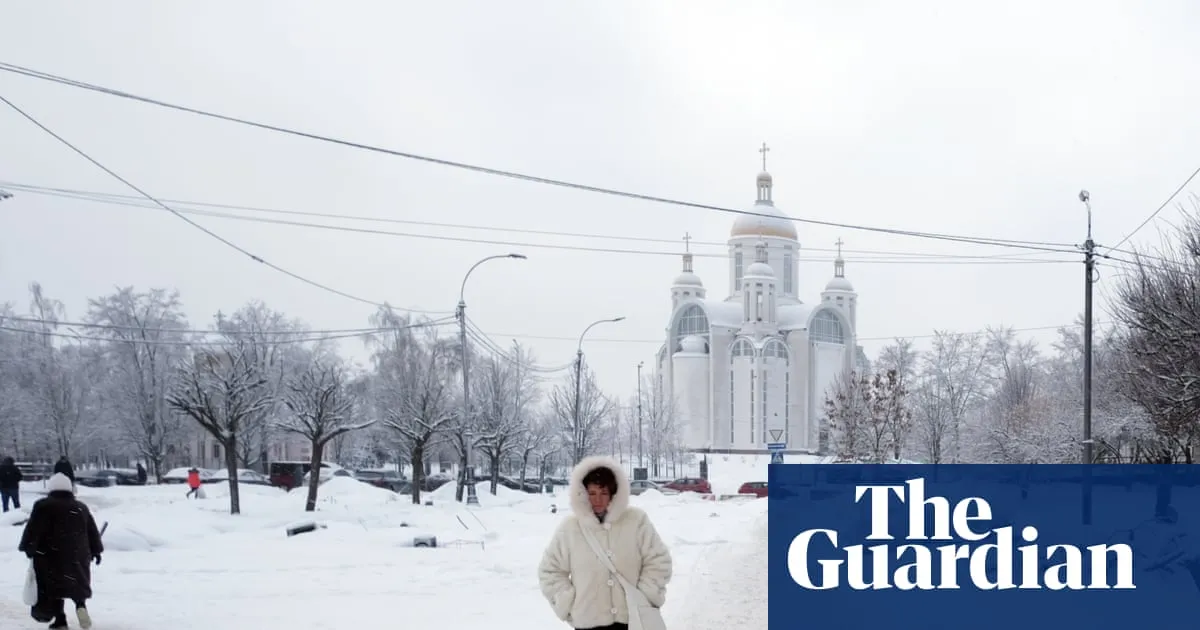
Outside the main pumping station for Bucha, three engineers, bundled up in parkas, are working on the emergency generator keeping the Ukrainian city supplied with water.One holds a heat gun to the generator’s filter in an effort to unfreeze it, his face reddened by blowing snow and a daytime temperature of -12C (10.4F). Watching attentively is the city’s mayor, Anatolii Fedoruk. The generator in his office is also frozen when the Guardian visits and he apologises for the lack of coffee.Four years ago, in the first days of Russia’s invasion of Ukraine, Bucha and the neighbouring city of Irpinbecame emblematic of the brutality of Moscow’s brief occupation of this area amid the murder of civilians.Anatolli Fedoruk, the mayor of Bucha, stands in front an emergency generator as the temperature hits -12C. Photograph: Peter Beaumont/The GuardianMap of Bucha, Irpin and north-west Kyiv.Bucha and Irpin were briefly occupied by Russia at the start of the invasion.While the buildings in Bucha have largely been repaired, and the Russians pushed away long ago, Ukraine’s long war is still very much being felt here – most profoundly after Russia attacked energy infrastructure as temperatures dropped to almost -20C and a national state of emergency was declared.And while energy rationing was already in force in Bucha this winter, the latest attacks have exacerbated an already difficult situation. Arriving in the city on a day of harsh cold and falling snow, traffic lights are dark and residential blocks and many shops unlit due to the latest rolling power outage.In the Battkava cafe, Oleksandr Bartkov, 28, wearing a hoodie pulled up over his head and a ski jacket, is waiting for the generator to warm up before turning on the espresso machine to serve his first customer.“Recently, in the eight or nine hours we are usually open, we have three to four hours of electricity,” he says. “It’s being going on all winter. But after the last big attack [on 9 January] things have got worse. Then we had a day without any power at all. I don’t think it is even the worst place in Ukraine. Everyone is struggling.“For small businesses the situation isn’t good. A lot have closed. I think more [will] shut even if it is only until the end of February.”Oleksandr Bartkov waits for the generator to warm up before serving his first customer. Photograph: Peter Beaumont/The GuardianA short walk away, Fedoruk is in his office in the municipal headquarters. While he admits Bucha is unable to keep to the power rationing schedule of three hours on and six off, he believes the situation is better than in some areas of Ukraine’s capital, Kyiv.“My children live in a tall tower block without power. They have been asking to come and stay with me,” he says.One issue, Fedoruk explains, is that in the more recently developed conurbations such as Bucha, cities have developed a distributed power supply system that is more resilient to Russian attacks.“The power systems in the cities were built during the old Soviet system with big power plants on which cities rely,” he says. A secondary issue, says Fedoruk, is that if they were built in the Soviet era, Moscow knows exactly where they are.“We’ve had issues with power throughout the war, but in the massive attack on 9 January, the Russians knew that a period of severe frost was coming and they wanted to hit the power plants,” he says.An elderly man pulls a shopping cart through a frozen street in Bucha. Photograph: Peter Beaumont/The GuardianRussia’s weaponisation of Ukraine’s winter against its own people – being repaid in kind by Kyiv’s strikes on Russian energy infrastructure – has meant some of the best-laid preparations have fallen short.In a prefabricated building constructed with the help of the Polish government to house displaced families, the heating is dependent on electric storages heaters. The fridges, cookers and hotplates in the communal kitchen all run on electricity. The walls are not thick enough to protect against a sudden loss of power amid the biting cold.It is warm during the Guardian’s visit, but the building’s manager, Vitalina Tsisar, 31, who was herself displaced from Kramatorsk, describes the fallout of a Russian air raid that cut mains power on 13 January.“It was one in the morning and there was an attack in the area. The electricity was turned off immediately. Within two hours it was freezing cold in here. It got down to 6C,” Tsisar says.Tetiana Kharkivska serves stew to her seven-year-old son, Roman, in temporary housing for displaced people in Bucha. Photograph: Peter Beaumont/The Guardian“The generator only has enough power to warm one radiator in the communal room. So at 6.30am we tried starting it but it was frozen because it was -20C. Finally we managed to get it going at 9am, but just to heat one room.“In the meantime, people came to sit with their kids in here; kids wearing their hats and coats. It made people afraid and panic-buy at the supermarket. If it is summer it’s a different situation, but when it is this cold outside you feel yourself freezing.”In the kitchen, Tetiana Kharkivska serves her seven-year-old son, Roman, some stew. Was he frightened? “I wasn’t scared,” he says. “But I was really cold.”As Russian drones and missiles continue to attack energy infrastructure, the government warned on Friday it had 20 days left of energy reserves, with officials ordered to seek more electricity imports.“This is an attempt to break people,” said Oleksandr Kharchenko, the director of the Kyiv-based Energy Industry Research Center in an interview this week with Agence France-Presse, adding that Moscow wanted to turn “a man-made disaster into an absolute crisis”.Ukraine’s state security service, the SBU, has called the continued Russian attacks on power and thermal heating plants “crimes against humanity”.The depth of the crisis has prompted Ukrainian citizens to criticise municipal authorities and recriminations among the political elite about the lack of preparedness for such a situation that had long been expected as Russia escalated its attacks on energy infrastructure.A tent is set up in a Kyiv neighbourhood where people can warm up after Russian air attacks. Photograph: Vladyslav Musiienko/APEven as Volodymyr Zelenskyy announced a state of emergency, he blamed Kyiv’s civic administration, led by his political rival Vitali Klitschko, for allowing the capital to freeze under Russian bombardment.In a video address on Wednesday, Ukraine’s president said: “Far too little has been done in the capital.”In Bucha, the mayor has already witnessed his city weather one terrible crisis and is confident it can survive the latest. “Four years ago, Russia said it would take Kyiv in three days and failed,” says Fedorov. “That’s when they realised the war would continue for a long time as they prepared to exhaust us. But we’re standing. We are still defending.”
SRCThe Guardian - World News
LANGEN
LEANCenter-Left
WORDS1 127
ENT5
FRI · 2026-01-16 · 12:30 GMTBRIEF NSR-2026-0116-7927
NSR-2026-0116-7927News Report·EN·Human Interest
‘An attempt to break people’: Bucha holds out amid Russia’s weaponisation of winter
Bucha, Ukraine, a city previously emblematic of Russian brutality, is now struggling with the effects of Russia's attacks on energy infrastructure during the winter. The city is experiencing rolling power outages, with temperatures dropping to -20C, impacting residents and businesses.
Peter Beaumont in BuchaThe Guardian - World NewsFiled 2026-01-16 · 12:30 GMTLean · Center-LeftRead · 5 min
The Guardian - World NewsFIG 01
Reading time
5min
Word count
1 127words
Sources cited
3cited
Entities identified
5entities
Quality score
100%
§ 01
Briefing Summary
AI-generatedNEWSAR · AI
Bucha, Ukraine, a city previously emblematic of Russian brutality, is now struggling with the effects of Russia's attacks on energy infrastructure during the winter. The city is experiencing rolling power outages, with temperatures dropping to -20C, impacting residents and businesses. Engineers are working to maintain the water supply using emergency generators, while businesses like the Battkava cafe face reduced operating hours due to limited electricity. The mayor, Anatolii Fedoruk, acknowledges the difficult situation, with many businesses already closed and more potentially shutting down due to the ongoing energy crisis. The attacks are exacerbating existing energy rationing measures implemented earlier in the winter.
Confidence 0.90Sources 3Claims 5Entities 5
§ 02
Article analysis
Model · rule-basedFraming
Human Interest
Conflict
Tone
Measured
AI-assessed
CalmNeutralAlarmist
Factuality
0.80 / 1.00
Factual
LowHigh
Sources cited
3
Well sourced
FewMany
§ 03
Key claims
5 extracted01
Bucha is unable to keep to the power rationing schedule of three hours on and six off.
factualFedoruk
Confidence
1.00
02
The latest attacks [on 9 January] have made the power situation worse.
quoteOleksandr Bartkov
Confidence
1.00
03
Recently, the cafe has only 3-4 hours of electricity during their 8-9 hour opening time.
quoteOleksandr Bartkov
Confidence
1.00
04
Russia attacked energy infrastructure, exacerbating an already difficult situation in Bucha.
factual
Confidence
1.00
05
Bucha is being supplied with water by an emergency generator.
factual
Confidence
1.00
§ 04
Full report
5 min read · 1 127 words§ 05
Entities
5 identifiedKey playerOppositionContextPositiveNeutralNegative
§ 06
Keywords & salience
10 termsrussia's weaponisation of winter
0.90
power outages
0.80
energy infrastructure attacks
0.80
emergency generator
0.70
bucha
0.70
energy rationing
0.60
winter
0.60
russian invasion of ukraine
0.50
small businesses
0.50
anatolii fedoruk
0.40
§ 07
Topic connections
Interactive graph Network visualization showing 10 related topics
View Full Graph Person Organization Location Event|Click node to navigate|Edge numbers = shared articles