Huawei’s new chip scaling law aims to sidestep ASML chokepoint but hurdles remain: analystsIf proven, the innovation marks a significant milestone for Huawei, which has been cut off from advanced semiconductor technology since 20193-MIN READ3-MIN8ListenPublished: 10:00pm, 26 May 2026Updated: 10:52pm, 26 May 2026Huawei Technologies has engineered a workaround to one of China’s most crippling chipmaking bottlenecks, but analysts warn that the nation’s path to semiconductor independence is still constrained by manufacturing challenges.The US-sanctioned tech giant on Monday introduced a new scaling law and a chip architecture designed to deliver products equivalent to an advanced 1.4-nanometre processing node by 2031.If true, the innovation marks a significant milestone for Huawei, which has been cut off from advanced semiconductors, leading lithography machines from Dutch supplier ASML, and cutting-edge electronic design automation (EDA) tools since 2019.Select VoiceSelect Speed0.8x0.9x1.0x1.1x1.2x1.5x1.75x00:0000:001.00x
SRCSouth China Morning Post
LANGEN
LEANCenter-Right
WORDS134
ENT9
TUE · 2026-05-26 · 14:00 GMTBRIEF NSR-2026-0526-79345
NSR-2026-0526-79345News Report·EN·Technology
Huawei’s new chip scaling law aims to sidestep ASML chokepoint but hurdles remain: analysts
Huawei Technologies has developed a new scaling law and chip architecture intended to achieve performance equivalent to a 1.4-nanometre processing node by 2031. This innovation aims to circumvent the reliance on advanced semiconductor technology, including lithography machines from ASML, from which Huawei has been cut off since 2019 due to US sanctions.
Coco Feng,Ann Cao,Iris DengSouth China Morning PostFiled 2026-05-26 · 14:00 GMTLean · Center-RightRead · 1 min
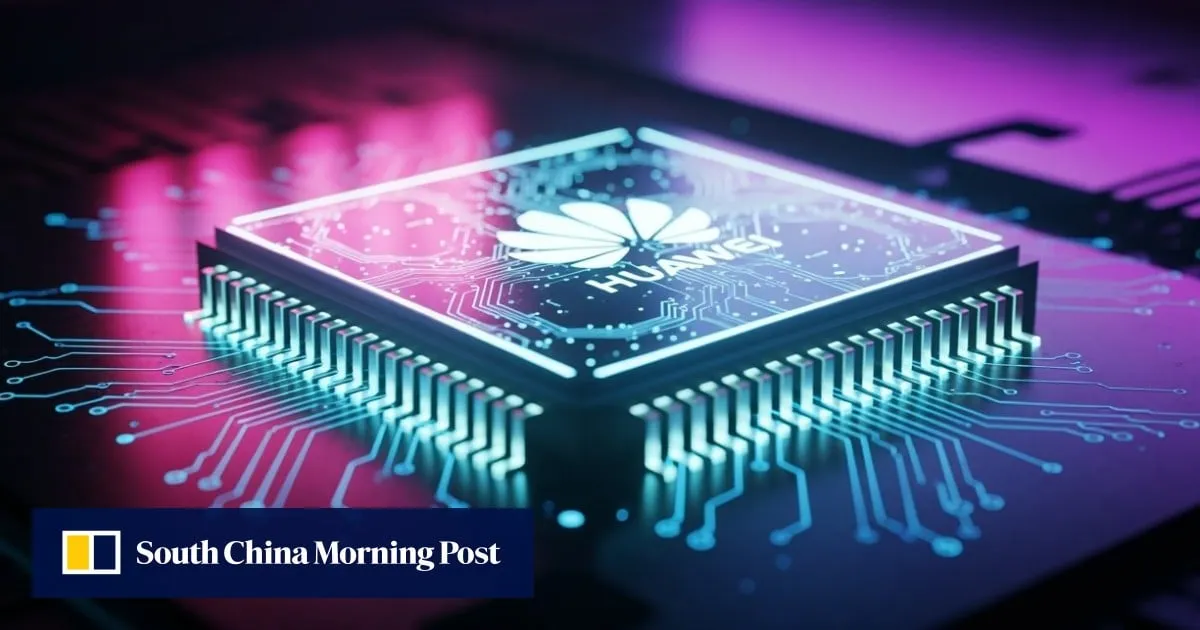
South China Morning PostFIG 01
Reading time
1min
Word count
134words
Sources cited
2cited
Entities identified
9entities
Quality score
100%
§ 01
Briefing Summary
AI-generatedNEWSAR · AI
Huawei Technologies has developed a new scaling law and chip architecture intended to achieve performance equivalent to a 1.4-nanometre processing node by 2031. This innovation aims to circumvent the reliance on advanced semiconductor technology, including lithography machines from ASML, from which Huawei has been cut off since 2019 due to US sanctions. While this represents a significant potential milestone for Huawei's pursuit of semiconductor independence, analysts caution that manufacturing challenges still pose considerable hurdles for China's broader semiconductor goals. The company introduced these developments on Monday.
Confidence 0.90Sources 2Claims 5Entities 9
§ 02
Article analysis
Model · rule-basedFraming
Technology
National Security
Tone
Measured
AI-assessed
CalmNeutralAlarmist
Factuality
0.60 / 1.00
Mixed
LowHigh
Sources cited
2
Limited
FewMany
§ 03
Key claims
5 extracted01
Huawei has been cut off from advanced semiconductors, ASML lithography machines, and EDA tools since 2019.
factual
Confidence
1.00
02
Analysts warn that China's path to semiconductor independence is still constrained by manufacturing challenges.
factualanalysts
Confidence
0.90
03
Huawei introduced a new scaling law and chip architecture aiming for 1.4nm processing node equivalence by 2031.
factualHuawei Technologies
Confidence
0.80
04
Huawei has engineered a workaround to a critical chipmaking bottleneck.
factualHuawei Technologies
Confidence
0.80
05
This innovation, if proven, marks a significant milestone for Huawei after being cut off from advanced semiconductors since 2019.
factualanalysts
Confidence
0.70
§ 04
Full report
1 min read · 134 words§ 05
Entities
9 identifiedKey playerOppositionContextPositiveNeutralNegative
§ 06
Keywords & salience
10 termssemiconductor independence
1.00
chipmaking bottlenecks
0.90
asml
0.80
huawei
0.80
chip scaling law
0.70
advanced semiconductors
0.70
lithography machines
0.60
manufacturing challenges
0.50
1.4-nanometre processing node
0.50
eda tools
0.40
§ 07
Topic connections
Interactive graph Network visualization showing 21 related topics
View Full Graph Person Organization Location Event|Click node to navigate|Edge numbers = shared articles