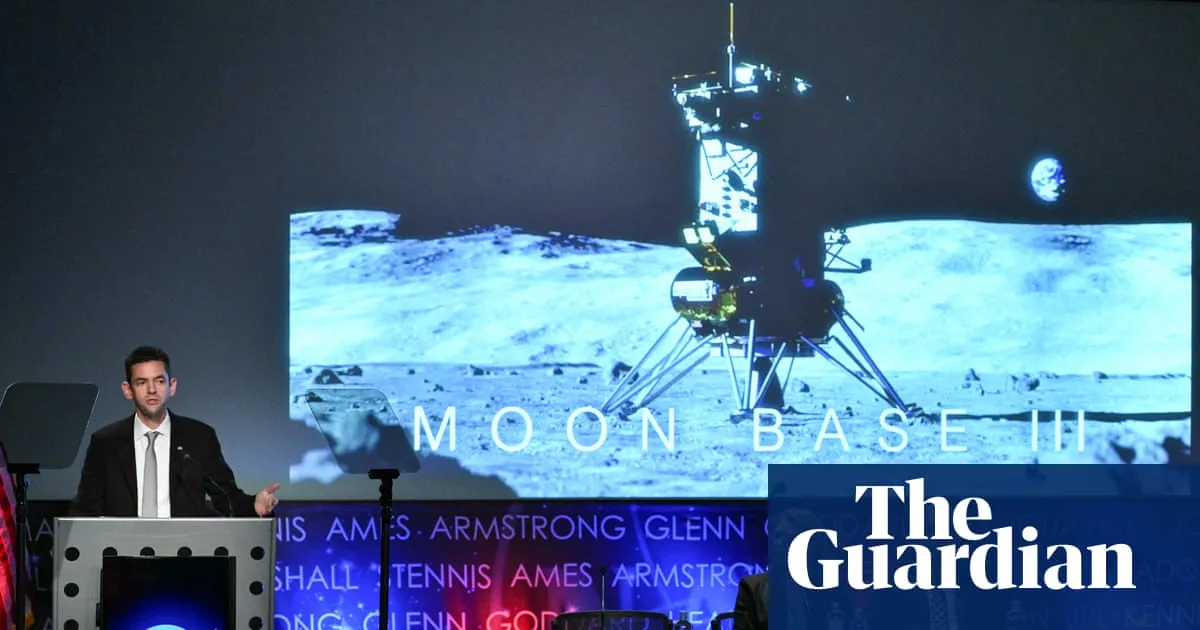
NASA announced on Tuesday ambitious plans for three uncrewed lunar missions this year to kickstart construction of a $20bn Moon-base" class="entity-link entity-topic" data-entity-id="134667" data-entity-type="topic">Moon base, and said it had chosen the Amazon founder Jeff Bezos’s Blue Origin, ahead of Elon Musk’s SpaceX, to conduct the first.The revelation by NASA’s administrator, Jared Isaacman, at a press conference in Washington DC marked the first detailed public explanation of how and when the Moon-base" class="entity-link entity-topic" data-entity-id="134667" data-entity-type="topic">Moon base will be built.He said the three missions planned for 2026 would be followed by “more than a dozen” more in the coming years to test systems and equipment. He said the highly successful Artemis II mission last month that sent four astronauts around the Moon for the first time since 1972 had been both a catalyst and incentive to advance the Moon-base" class="entity-link entity-topic" data-entity-id="134667" data-entity-type="topic">Moon base plan.“People are looking up again, believing in big things again, and paying attention as America returns to the Moon again, and this time to stay,” he said.He added, without mentioning any names, that the agency had been “having the tough conversations with those failing to meet expectations” since the Artemis splashdown on 10 April.“We are not jumping right into the glass dome Moon-base" class="entity-link entity-topic" data-entity-id="134667" data-entity-type="topic">Moon base. We intend to take an iterative approach, sending a demand signal to industry for a lot of landers and rovers and tech demonstrations, and all the scientific payloads these missions can accommodate,” Isaacman said.“We are leveraging the NASA playbook from the 1960s, figuring out what works and what doesn’t in this epic science of survival, because the Moon-base" class="entity-link entity-topic" data-entity-id="134667" data-entity-type="topic">Moon base is as beautiful as it is hostile.”The headline announcement was the selection of Bezos’s Blue Origin company to conduct the first mission, as early as fall. It has been awarded $230.4m to support each of its first two Moon-base" class="entity-link entity-topic" data-entity-id="134667" data-entity-type="topic">Moon base missions, NASA said, but will largely fund the operation itself.“Moon-base" class="entity-link entity-topic" data-entity-id="134667" data-entity-type="topic">Moon base One will be the first privately funded lunar lander mission in history,” Isaacman said. It will take Endurance, Blue Origin’s cryogenically propelled cargo lander, holding multiple scientific payloads from NASA and private partners, to the Shackleton de Gerlache Ridge area of the Moon’s south pole.Isaacman said the objective was to “demonstrate critical capabilities that reduce risk for the human landing system missions”, and that Bezos’s company was picked “because of the role Blue Origin plays in the Artemis Program”.Blue Origin is competing with SpaceX to provide crew landers for an upcoming sequence of Artemis missions, including the planned 2028 return of humans to the Moon on Artemis IV. NASA will evaluate the SpaceX Starship Human Landing System (HLS) and Blue Origin’s Blue Moon lander during next year’s Artemis III test mission in lower Earth orbit and decide thereafter.Blue Origin suffered a setback last month when a payload from the third flight of its heavy-lift New Glenn rocket ended up in the wrong orbit, but was cleared to return to flight by the Federal Aviation Administration last week.Both companies have built large new facilities in or close to Cape Canaveral’s Kennedy Space Center to support crewed and cargo missions in partnership with NASA.As well as awarding Blue Origin the first Moon-base" class="entity-link entity-topic" data-entity-id="134667" data-entity-type="topic">Moon base mission, NASA announced a series of smaller contracts with private companies involved in the agency’s Moon-to-Mars projects. They include Lunar Outpost, which has been working on lunar rovers, and Firefly Aerospace, which in March last year became the first private operator to make a successful Moon touchdown with its Blue Ghost lander.The agency’s “blueprint for an enduring lunar presence” is also laid out on a new NASA moonbase website launched on Wednesday, which gives a timeframe between 2029 and 2032 for establishing a base with “operating capability”. A “semi-permanent presence” will follow in 2032 or beyond, it said.The Moon-base" class="entity-link entity-topic" data-entity-id="134667" data-entity-type="topic">Moon base project forms part of Donald Trump’s national space policy, including directing NASA to accelerate the Artemis Program to achieve the next human Moon landing ahead of China, establish a permanently habitable lunar base and develop a nuclear space reactor.Partnerships with private operators, NASA has said, can significantly reduce the cost to taxpayers, and create a thriving space economy providing thousands of new jobs while conducting inspiring missions of science and discovery.Isaacman, who has attempted to align the Trump administration’s planned budget cuts to NASA with the president’s ambitious vision, said the world had “paused to take notice” during Artemis II. He said he hoped that mission, along with Moon-base" class="entity-link entity-topic" data-entity-id="134667" data-entity-type="topic">Moon base plans and other Moon-aligned projects, would inspire what he called a “golden age of exploration”.“I’m often asked why we send our astronauts into such harsh and dangerous and unforgiving environment of space or the lunar surface, and at such great cost,” he said.“We go for the technology we will pioneer to get there, the science, and all that we will learn that will make life better here on Earth, to advance humankind on this great adventure, to inspire the next generation to do it better than we can, and, to be very clear, to master the skills for where we will inevitably go next.”
SRCThe Guardian - World News
LANGEN
LEANCenter-Left
WORDS830
ENT12
TUE · 2026-05-26 · 20:14 GMTBRIEF NSR-2026-0526-79425
NSR-2026-0526-79425News Report·EN·Technology
Nasa selects Jeff Bezos’s Blue Origin for first of three uncrewed lunar missions
NASA has announced plans for three uncrewed lunar missions in 2026 to begin constructing a $20 billion moon base. Blue Origin, founded by Jeff Bezos, has been selected to conduct the first mission, receiving $230.4 million for its first two missions.
Richard LuscombeThe Guardian - World NewsFiled 2026-05-26 · 20:14 GMTLean · Center-LeftRead · 4 min
The Guardian - World NewsFIG 01
Reading time
4min
Word count
830words
Sources cited
2cited
Entities identified
12entities
Quality score
100%
§ 01
Briefing Summary
AI-generatedNEWSAR · AI
NASA has announced plans for three uncrewed lunar missions in 2026 to begin constructing a $20 billion moon base. Blue Origin, founded by Jeff Bezos, has been selected to conduct the first mission, receiving $230.4 million for its first two missions. This privately funded mission will utilize Blue Origin's Endurance lander to deliver scientific payloads to the moon's south pole. These missions are part of a broader strategy to establish an enduring lunar presence, with a base expected to have operating capability between 2029 and 2032. The initiative aims to leverage private partnerships to reduce costs and foster a space economy.
Confidence 0.90Sources 2Claims 5Entities 12
§ 02
Article analysis
Model · rule-basedFraming
Technology
Human Interest
Tone
Measured
AI-assessed
CalmNeutralAlarmist
Factuality
0.80 / 1.00
Factual
LowHigh
Sources cited
2
Limited
FewMany
§ 03
Key claims
5 extracted01
Blue Origin is competing with SpaceX to provide crew landers for upcoming Artemis missions, with a decision to be made after the Artemis III test mission.
factualNasa
Confidence
1.00
02
Moon Base One will be the first privately funded lunar lander mission in history.
factualJared Isaacman
Confidence
1.00
03
Nasa has selected Blue Origin to conduct the first of three uncrewed lunar missions to kickstart construction of a $20bn moon base.
factualNasa
Confidence
1.00
04
The first mission, using Blue Origin's Endurance lander, is planned for as early as fall and has been awarded $230.4m for its first two missions.
factualNasa
Confidence
1.00
05
The three missions planned for 2026 will be followed by more than a dozen more in the coming years to test systems and equipment.
predictionJared Isaacman
Confidence
0.90
§ 04
Full report
4 min read · 830 words§ 05
Entities
12 identifiedKey playerOppositionContextPositiveNeutralNegative
People3
§ 06
Keywords & salience
10 termsblue origin
1.00
moon base construction
1.00
nasa lunar missions
0.90
artemis program
0.80
uncrewed lunar missions
0.70
jeff bezos
0.60
lunar lander
0.50
spacex
0.50
scientific payloads
0.40
iterative approach
0.40
§ 07
Topic connections
Interactive graph Network visualization showing 9 related topics
View Full Graph Person Organization Location Event|Click node to navigate|Edge numbers = shared articles