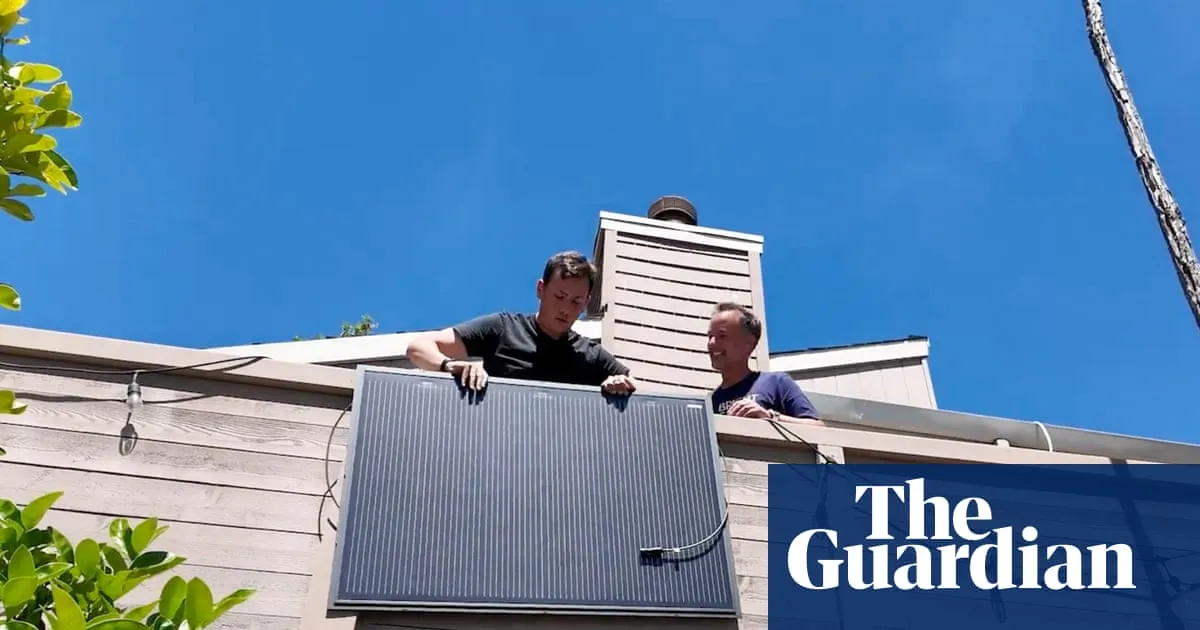
If you feel like your electricity bill just keeps climbing, you aren’t imagining it. Since 2020, US residential energy prices have surged by about 30%, making power the largest household energy expense behind gasoline, according to the US Energy Information Administration.But for residents like Alex Curtis, the days of feeling powerless against rising costs are coming to an end. Curtis is waging a war on his electric bill, and his new weapon of choice is a lightweight, thin-film solar panel.“Oh, it’s super light too,” Curtis said as he unboxed the kit on the balcony of his condo in Sunnyvale, California. It weighs just about 10lbs.The ‘plug-and-play’ revolutionUnlike traditional rooftop solar, which requires thousands of dollars in upfront costs, specialized mounting hardware and professional electricians, this system is designed for the everyday consumer. It’s a $400 kit from Bright Saver, a non-profit advocating for “plug-and-play” solar that works for renters and homeowners alike.The setup is deceptively simple: you hang the panel on a balcony or prop it up in a back yard and plug it directly into a standard wall outlet.“I did some rough math and this might save me like $30 to $50 a month,” Curtis said.The magic happens behind the scenes. Once plugged in, a small inverter syncs the solar energy with the home’s existing electrical infrastructure. It took about 15 minutes to get it all set up. Bright Saver’s Rupert Mayer then pointed to a light on the inverter: “Ah here it is, it’s blue.”“This is it. Easy,” Curtis replied. Within minutes, he was generating his own clean energy. He estimates it will be enough to power an appliance like his refrigerator.Cora Stryker, co-founder of Bright Saver, believes this technology is key to democratizing the green energy transition. It not only cuts an individual’s planet-warming pollution but also their electric bill.“Clean energy actually is the cheapest form of energy around,” Stryker said, “and we the consumers should be benefiting from that.”While these panels won’t take a home entirely off the grid, Stryker says the units can trim monthly costs by 10% to 25% depending on how many panels a user installs. More savings can be had if the panels are paired with batteries that can store excess solar energy.“They cover a part of your energy bill and then you do need to draw the rest from the grid as you do now,” Stryker said.While the technology is just gaining a foothold in the US, it is already a cultural phenomenon in Europe. In Germany, these systems are so common they have a specific name: Balkonkraftwerk, or “balcony power plant”.An estimated 4m balcony solar units are installed in Germany. The US, however, has been slower to adopt the tech, largely due to a patchwork of utility regulations and bureaucratic red tape. Utilities in some states have pushed back against the use of these systems, citing potential hazards to the safety of the grid and line workers.“And that is patently ridiculous for these little systems,” Stryker said. “Those laws were intended for rooftop systems five to 20 times as large.”A changing legal landscapeThe tide is quickly turning. In 2025, Utah became the first state to officially authorize plug-in solar. Overall, 34 states and Washington DC have introduced legislation to allow for the use of the technology. It has passed in Colorado, Connecticut, Maine, Maryland, New Hampshire and Virginia.For advocates like Stryker, it’s a matter of personal liberty: “It’s kind of like ‘don’t tell me what to do in my own back yard and on my own balcony’.”As for Curtis, he knows his Sunnyvale neighbors might have questions when they see the sleek panel hanging from his railing, but he’s focused on his newfound taste of energy independence.“I think that’s what gets me excited,” Curtis said. “Being able to power my own stuff and be self-sufficient like in baby steps, which is pretty cool.”Climate Central is an independent group of scientists and communicators who research and report the facts about our changing climate and how it affects people’s lives.
SRCThe Guardian - World News
LANGEN
LEANCenter-Left
WORDS668
ENT12
WED · 2026-05-27 · 11:30 GMTBRIEF NSR-2026-0527-79574
NSR-2026-0527-79574News Report·EN·Economic Impact
Power to the people: how ‘balcony solar’ could help fight rising US utility costs
Rising US residential energy prices, up about 30% since 2020, are prompting Americans to adopt "balcony solar" systems. These lightweight, plug-and-play solar kits, like those from Bright Saver, allow individuals to generate their own clean energy by plugging panels directly into wall outlets.
Ben Tracy of Climate CentralThe Guardian - World NewsFiled 2026-05-27 · 11:30 GMTLean · Center-LeftRead · 3 min
The Guardian - World NewsFIG 01
Reading time
3min
Word count
668words
Sources cited
3cited
Entities identified
12entities
Quality score
100%
§ 01
Briefing Summary
AI-generatedNEWSAR · AI
Rising US residential energy prices, up about 30% since 2020, are prompting Americans to adopt "balcony solar" systems. These lightweight, plug-and-play solar kits, like those from Bright Saver, allow individuals to generate their own clean energy by plugging panels directly into wall outlets. While not eliminating grid reliance, these systems can reduce monthly electricity bills by 10% to 25%. Although the technology is popular in Europe, its adoption in the US has been slowed by utility regulations, though a growing number of states are now introducing legislation to authorize their use. This shift aims to democratize clean energy access and provide consumers with more control over their energy costs.
Confidence 0.90Sources 3Claims 5Entities 12
§ 02
Article analysis
Model · rule-basedFraming
Economic Impact
Technology
Tone
Measured
AI-assessed
CalmNeutralAlarmist
Factuality
0.70 / 1.00
Factual
LowHigh
Sources cited
3
Well sourced
FewMany
§ 03
Key claims
5 extracted01
US residential energy prices have surged by about 30% since 2020.
statisticUS Energy Information Administration
Confidence
1.00
02
Utilities in some US states have pushed back against balcony solar systems, citing potential hazards.
factualArticle
Confidence
0.90
03
An estimated 4 million balcony solar units are installed in Germany.
statisticArticle
Confidence
0.90
04
A $400 'plug-and-play' solar kit can be set up in about 15 minutes.
factualBright Saver / Alex Curtis
Confidence
0.90
05
These balcony solar units can trim monthly electricity costs by 10% to 25%.
predictionCora Stryker (Bright Saver)
Confidence
0.80
§ 04
Full report
3 min read · 668 words§ 05
Entities
12 identifiedKey playerOppositionContextPositiveNeutralNegative
People3
§ 06
Keywords & salience
8 termsbalcony solar
1.00
rising utility costs
0.90
plug-and-play solar
0.80
residential energy prices
0.70
clean energy
0.70
solar panel
0.60
electric bill
0.50
bright saver
0.40
§ 07
Topic connections
Interactive graph Network visualization showing 51 related topics
View Full Graph Person Organization Location Event|Click node to navigate|Edge numbers = shared articles