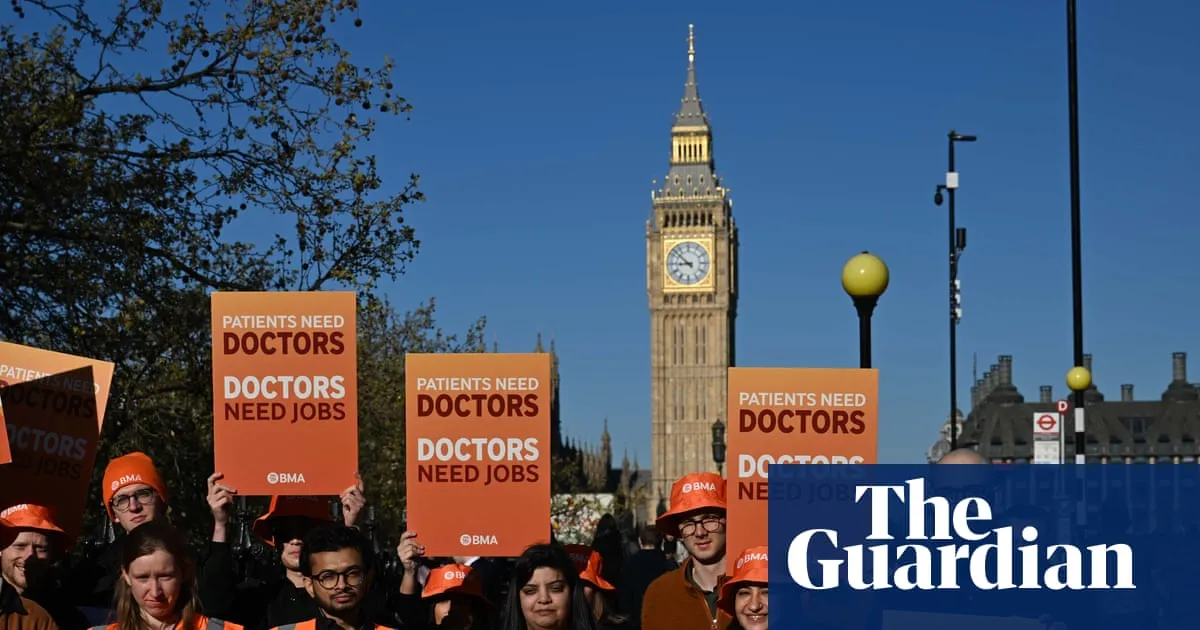
resident doctors in England will next month stage the 16th strike in their long-running jobs and pay dispute, and have blamed the new health secretary for their decision.They will strike for four days from 7am on Monday 15 June until 6.59am on Friday 19 June. Announcing the move, the British Medical Association warned that resident doctors would mount a further stoppage in July unless progress towards meeting their demands was made.Next month’s 96-hour action will be the 16th that resident – formerly junior – doctors have undertaken since their first stoppage in March 2023. It will disrupt NHS care and force hospitals to rearrange tens of thousands of diagnostic tests, outpatient appointments and operations.The BMA wants England’s 75,000 resident doctors to be given a pay increase that will make up for what they say is the 26% loss in the real-terms value of their salaries since 2008-09.The doctors’ union and professional body is also urging the NHS to hugely expand the number of training places for resident doctors to pursue careers in medical specialties. The BMA represents about 55,000 of those 75,000 medics.However, hopes of a resolution to the dispute look as far away as ever. James Murray, who succeeded Wes Streeting as health secretary on 14 May, dismissed their pay claim as “unrealistic, unaffordable, and unsustainable”.James Murray, the new health secretary, said the BMA’s demands were ‘simply not grounds for more strike action’. Photograph: Wiktor Szymanowicz/Anadolu/Getty Images“I’m disappointed that the BMA have refused to consider further discussions about how to strengthen the deal on the table and have instead rushed once again to unnecessary and unreasonable strike action,” said Murray, who met BMA representatives earlier on Wednesday.“I was clear with the BMA that after a 33.4% pay rise for resident doctors over the last four years – the highest anywhere across the public sector – the BMA’s demands for further substantial pay increases this year are unrealistic, unaffordable, and unsustainable.“These are simply not grounds for yet more strike action, which patients do not support, puts further pressure on other staff and costs the NHS hundreds of millions of pounds.”The strike will force hospitals to rearrange thousands of diagnostic tests, outpatient appointments and operations, and cost the NHS an estimated £50m a day to manage.Dr Jack Fletcher, the chair of the BMA’s resident doctors committee, blamed Murray’s alleged intransigence during recent talks for the latest walkout and warned that further talks seemed pointless.“We had hoped that a change in leadership at the Department of Health and Social Care [DHSC] would lead to a change in approach. Sadly, we have run up against the same unwillingness to move we encountered under Mr Streeting,” Fletcher said.“We were prepared to give Mr Murray time to settle into his role before completing the work his predecessor left unfinished – to both make a fair and meaningful pay offer and make concrete commitments to end the jobs bottleneck throttling the careers of our colleagues. He had a genuine opportunity to break this logjam with fresh energy and ambition.“He has not taken it. Instead, we are hearing the same tired line: vagueness on new jobs and no further money on the table. We cannot be asked to negotiate in good faith for weeks, only to be told there is nothing left to negotiate about on pay and no further details at this stage on jobs.”The NHS Alliance, which represents NHS trusts, criticised the latest strike.“This decision to strike yet again is rash and wholly irresponsible and will leave patients paying the price,” said Matthew Hopkins, the interim director of its acute and ambulance network. “Health leaders and their teams will be deeply concerned about the threat of this fresh walkout by resident doctors, given the additional pressure it would place on already stretched clinical and administrative colleagues.”Meanwhile, the BMA’s GPs committee plans to ballot family doctors in England about the possibility of surgeries starting to offer patients much more private care. If it happens, GP practices would become much more like dental surgeries and could bring in means-tested, subscription-based services.The ballot follows many months of wrangling between the BMA and the DHSC over the annual contract that GPs work under and family doctors’ heavy workloads.
SRCThe Guardian - World News
LANGEN
LEANCenter-Left
WORDS699
ENT12
WED · 2026-05-27 · 20:09 GMTBRIEF NSR-2026-0527-79736
NSR-2026-0527-79736News Report·EN·Public Health
Resident doctors in England to stage four-day strike in June
Resident doctors in England will strike for four days from June 15th to June 19th, marking their 16th industrial action in a dispute over pay and jobs. The British Medical Association (BMA) blames the new Health Secretary, James Murray, for the decision, stating he has shown an unwillingness to negotiate.
Denis Campbell Health policy editorThe Guardian - World NewsFiled 2026-05-27 · 20:09 GMTLean · Center-LeftRead · 3 min
The Guardian - World NewsFIG 01
Reading time
3min
Word count
699words
Sources cited
3cited
Entities identified
12entities
Quality score
100%
§ 01
Briefing Summary
AI-generatedNEWSAR · AI
Resident doctors in England will strike for four days from June 15th to June 19th, marking their 16th industrial action in a dispute over pay and jobs. The British Medical Association (BMA) blames the new Health Secretary, James Murray, for the decision, stating he has shown an unwillingness to negotiate. The BMA is demanding a pay rise to compensate for a 26% loss in real-terms salary value since 2008-09 and an expansion of training places. Murray has dismissed the pay claim as unrealistic and unsustainable, highlighting a previous 33.4% pay rise for resident doctors. This strike is expected to disrupt NHS care, forcing the rearrangement of thousands of appointments and tests, and costing the NHS an estimated £50 million daily.
Confidence 0.90Sources 3Claims 5Entities 12
§ 02
Article analysis
Model · rule-basedFraming
Public Health
Economic Impact
Tone
Measured
AI-assessed
CalmNeutralAlarmist
Factuality
0.70 / 1.00
Factual
LowHigh
Sources cited
3
Well sourced
FewMany
§ 03
Key claims
5 extracted01
Health Secretary James Murray stated the BMA's pay demands are 'unrealistic, unaffordable, and unsustainable'.
quoteJames Murray
Confidence
1.00
02
The British Medical Association (BMA) demands a 26% pay increase for resident doctors to compensate for real-terms salary loss since 2008-09.
factualBritish Medical Association
Confidence
1.00
03
Resident doctors in England will stage a four-day strike from June 15 to June 19.
factual
Confidence
1.00
04
The strike action is expected to disrupt NHS care and force hospitals to rearrange tens of thousands of appointments and operations.
factual
Confidence
0.90
05
The strike is estimated to cost the NHS £50m a day.
statistic
Confidence
0.80
§ 04
Full report
3 min read · 699 words§ 05
Entities
12 identifiedKey playerOppositionContextPositiveNeutralNegative
People5
Locations1
§ 06
Keywords & salience
8 termsresident doctors strike
1.00
pay dispute
0.90
nhs
0.80
british medical association
0.70
health secretary
0.60
pay increase
0.50
training places
0.40
real-terms value
0.40
§ 07
Topic connections
Interactive graph No topic relationship data available yet. This graph will appear once topic relationships have been computed.