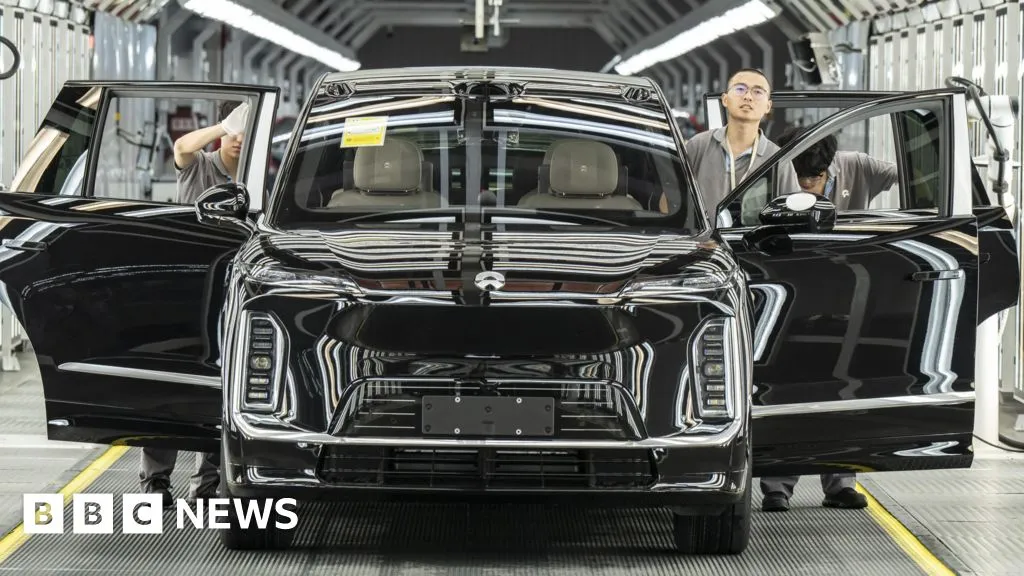
It makes the most exports in more than 315 product categories, up from 163 in 2016, according to a report by Rhodium Group. Many of these are linked to electric vehicle (EV) supply chains, including batteries, components and manufacturing machinery.The International Energy Agency estimates it is at least 30% cheaper to produce a small electric SUV in China than in more advanced economies, largely because of lower battery costs and elaborate supply chains.That advantage was built through years of state support. Rhodium estimates China has channelled tens of billions of dollars into EV and battery manufacturing in recent years alone. Those subsidies, heavily criticised in the EU and US for distorting markets, have helped companies expand rapidly and cut prices. Getty ImagesXpeng told the BBC it is now prioritising the development of robots and flying cars Competition inside China has also sped up innovation. Tech giants like Xiaomi, Huawei and Alibaba are now making EVs, bringing consumer technology into the car industry. "They're not racing the West anymore," says Russo. "They're racing each other."As cars increasingly rely on software, from driver assistance to entertainment systems, these companies are giving Chinese carmakers yet another edge. Stellantis will also bring Dongfeng's Voyah electric brand into Europe, and has said it is exploring producing Chinese-designed vehicles at a plant in France.Volkswagen is paying $700m for access to Xpeng's software architecture and autonomous driving systems to develop its next generation of EVs - technology it has acknowledged it could not develop fast enough at home.Xpeng's He says the relationship is two-way: "We study each other, so we trust each other, so we help each other."Toyota, Hyundai, Ford and Nissan are also expanding research operations in China or exploring production of Chinese-designed vehicles in overseas factories - using local talent and knowledge for development rather than simply manufacturing.Not every strategy is working though.Audi has had to offer heavy discounts on its E5 model, which it had specifically made for China, after weaker-than-expected demand.GM has written down billions of dollars from its China operations and reported a more than 21% decline in sales in the first three months of this year. Japanese manufacturers have been slower to shift towards fully electric vehicles, leaving them vulnerable in China and, increasingly, in South East Asia, where Chinese brands are rapidly gaining market share.In early 2026, Volkswagen briefly regained the position of the top-selling car brand in China, but that may have been because of the end of Beijing's EV subsidies, which, in turn, weakened domestic rivals.The BBC visited EV factories in China which were highly automatedChina's domestic market is cooling more broadly too. Growth has slowed after years of expansion, while overcapacity and an intense price war are squeezing profits across the industry. That is partly why Chinese manufacturers are expanding abroad. Brands such as BYD, Chery and SAIC are pushing into Europe and emerging markets despite tariffs of up to 45% in the EU. Chery's Jaecoo 7 became one of the UK's best-selling new models within 14 months of its launch. But tariffs of more than 100% have effectively locked Chinese brands out of the US market.Experts warn that as more vehicle production, battery technology and software development shifts towards China, manufacturing hubs in South East Asia and Europe could suffer, affecting jobs and local economies.Tariffs will not necessarily protect them, says consultant James Pearson: "If you lock them out of one market, they will just find another." Bill Russo says the industry's centre of gravity has already shifted.
SRCBBC News - World
LANGEN
LEANCenter
WORDS582
ENT12
WED · 2026-05-27 · 22:00 GMTBRIEF NSR-2026-0528-79751
NSR-2026-0528-79751News Report·EN·Economic Impact
The world's carmakers are struggling to compete with China
Chinese electric vehicle (EV) manufacturers are increasingly dominating the global auto industry, driven by state support, lower production costs, and intense domestic competition that fuels rapid innovation. China's advantage stems from significant government investment in EV and battery manufacturing, making production in China at least 30% cheaper than in advanced economies.
BBC News - WorldFiled 2026-05-27 · 22:00 GMTLean · CenterRead · 3 min
BBC News - WorldFIG 01
Reading time
3min
Word count
582words
Sources cited
5cited
Entities identified
12entities
Quality score
100%
§ 01
Briefing Summary
AI-generatedNEWSAR · AI
Chinese electric vehicle (EV) manufacturers are increasingly dominating the global auto industry, driven by state support, lower production costs, and intense domestic competition that fuels rapid innovation. China's advantage stems from significant government investment in EV and battery manufacturing, making production in China at least 30% cheaper than in advanced economies. Tech giants entering the EV market further accelerate innovation, particularly in software. This has led global carmakers like Volkswagen and Stellantis to partner with Chinese companies for technology and software access. While some Western and Japanese manufacturers struggle in China and emerging markets, Chinese brands are aggressively expanding overseas, facing challenges like tariffs but finding new markets. Experts warn this shift could impact manufacturing hubs globally.
Confidence 0.90Sources 5Claims 5Entities 12
§ 02
Article analysis
Model · rule-basedFraming
Economic Impact
Technology
Tone
Measured
AI-assessed
CalmNeutralAlarmist
Factuality
0.80 / 1.00
Factual
LowHigh
Sources cited
5
Well sourced
FewMany
§ 03
Key claims
5 extracted01
GM reported a more than 21% decline in sales in China in the first three months of this year.
statistic
Confidence
1.00
02
Volkswagen is paying $700m for access to XPeng's software architecture and autonomous driving systems.
factual
Confidence
1.00
03
China has channelled tens of billions of dollars into EV and battery manufacturing in recent years.
statisticRhodium Group
Confidence
1.00
04
It is at least 30% cheaper to produce a small electric SUV in China than in advanced economies.
statisticInternational Energy Agency
Confidence
1.00
05
China exports in over 315 product categories, up from 163 in 2016, many linked to EV supply chains.
statisticRhodium Group
Confidence
1.00
§ 04
Full report
3 min read · 582 words§ 05
Entities
12 identifiedKey playerOppositionContextPositiveNeutralNegative
Organizations9
§ 06
Keywords & salience
10 termschina automotive industry
1.00
electric vehicles
1.00
ev supply chains
0.90
manufacturing costs
0.80
government subsidies
0.80
automotive innovation
0.70
software in cars
0.60
international competition
0.50
autonomous driving
0.40
market share
0.40
§ 07
Topic connections
Interactive graph Network visualization showing 51 related topics
View Full Graph Person Organization Location Event|Click node to navigate|Edge numbers = shared articles