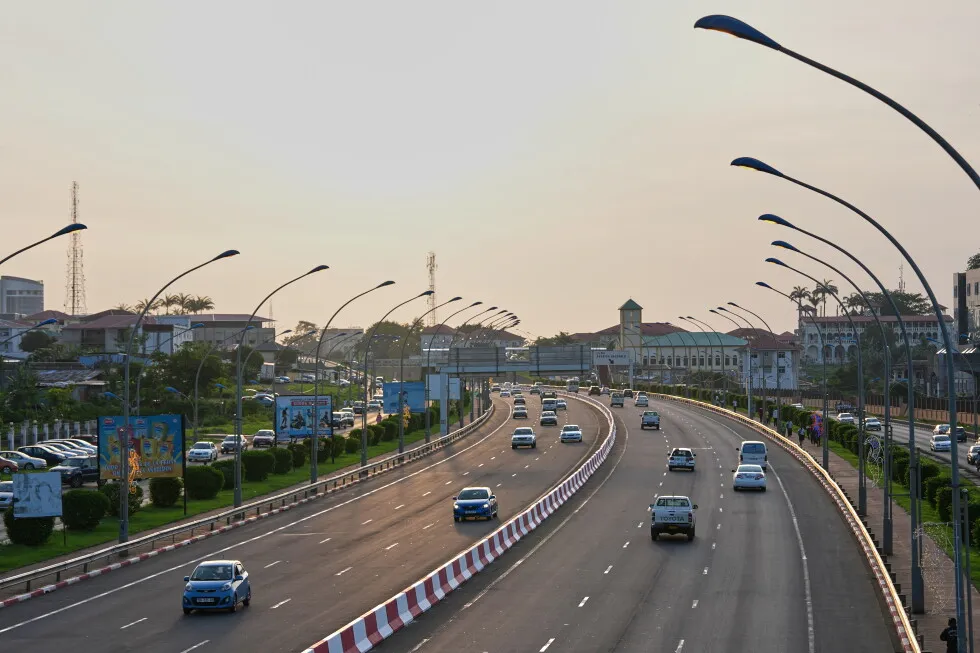
Inside an African hotel where asylum seekers deported by the US are imprisoned 1 of 6 | Under an opaque $7.5 million deal with the Trump administration, Equatorial Guinea’s all-powerful president has turned a hotel owned by his family into a prison for asylum seekers deported from the United States. 2 of 6 | A street scene in Malabo, Equatorial Guinea, Saturday, April 25, 2026. (AP Photo/Misper Apawu) 3 of 6 | Framed portraits of Equatorial Guinea President, Teodoro Obiang Nguema Mbasogo, displayed in an office setting in Malabo, Equatorial Guinea, Friday, April 24, 2026. (AP Photo/Misper Apawu) 4 of 6 | Front row, from left, Equatorial Guinea President Teodoro Obiang Nguema Mbasogo, first lady Constancia Mangue Nsue Okomo, and Equatorial Guinea Vice President Teodoro Nguema Obiang attend a Holy Mass with Pope Leo XIV at the Malabo Stadium in Malabo, Equatorial Guinea, Thursday, April 23, 2026. (AP Photo/Misper Apawu) 5 of 6 | A drilling rig in Luba, Equatorial Guinea, Saturday, April 25, 2026. (AP Photo/Misper Apawu) 6 of 6 | A view of Bamy Hotel where migrants are held in Malabo, Equatorial Guinea, Wednesday, May 13, 2026. (AP Photo/Monika Pronczuk) 1 of 6 Under an opaque $7.5 million deal with the Trump administration, Equatorial Guinea’s all-powerful president has turned a hotel owned by his family into a prison for asylum seekers deported from the United States. Add AP News on Google Add AP News as your preferred source to see more of our stories on Google. Share 2 of 6 | A street scene in Malabo, Equatorial Guinea, Saturday, April 25, 2026. (AP Photo/Misper Apawu) 2 of 6 A street scene in Malabo, Equatorial Guinea, Saturday, April 25, 2026. (AP Photo/Misper Apawu) Add AP News on Google Add AP News as your preferred source to see more of our stories on Google. Share 3 of 6 | Framed portraits of Equatorial Guinea President, Teodoro Obiang Nguema Mbasogo, displayed in an office setting in Malabo, Equatorial Guinea, Friday, April 24, 2026. (AP Photo/Misper Apawu) 3 of 6 Framed portraits of Equatorial Guinea President, Teodoro Obiang Nguema Mbasogo, displayed in an office setting in Malabo, Equatorial Guinea, Friday, April 24, 2026. (AP Photo/Misper Apawu) Add AP News on Google Add AP News as your preferred source to see more of our stories on Google. Share 4 of 6 | Front row, from left, Equatorial Guinea President Teodoro Obiang Nguema Mbasogo, first lady Constancia Mangue Nsue Okomo, and Equatorial Guinea Vice President Teodoro Nguema Obiang attend a Holy Mass with Pope Leo XIV at the Malabo Stadium in Malabo, Equatorial Guinea, Thursday, April 23, 2026. (AP Photo/Misper Apawu) 4 of 6 Front row, from left, Equatorial Guinea President Teodoro Obiang Nguema Mbasogo, first lady Constancia Mangue Nsue Okomo, and Equatorial Guinea Vice President Teodoro Nguema Obiang attend a Holy Mass with Pope Leo XIV at the Malabo Stadium in Malabo, Equatorial Guinea, Thursday, April 23, 2026. (AP Photo/Misper Apawu) Add AP News on Google Add AP News as your preferred source to see more of our stories on Google. Share 5 of 6 | A drilling rig in Luba, Equatorial Guinea, Saturday, April 25, 2026. (AP Photo/Misper Apawu) 5 of 6 A drilling rig in Luba, Equatorial Guinea, Saturday, April 25, 2026. (AP Photo/Misper Apawu) Add AP News on Google Add AP News as your preferred source to see more of our stories on Google. Share 6 of 6 | A view of Bamy Hotel where migrants are held in Malabo, Equatorial Guinea, Wednesday, May 13, 2026. (AP Photo/Monika Pronczuk) 6 of 6 A view of Bamy Hotel where migrants are held in Malabo, Equatorial Guinea, Wednesday, May 13, 2026. (AP Photo/Monika Pronczuk) Add AP News on Google Add AP News as your preferred source to see more of our stories on Google. Share Updated [hour]:[minute] [AMPM] [timezone], [monthFull] [day], [year] Malabo, Equatorial Guinea (AP) — At first glance, the hotel looks like any other on this tropical island off the Central African coast, with its palm tree-lined driveway, marble-floored foyer and portrait of the oil-rich country’s president hanging behind a mahogany reception desk.Yet the eerily empty Bamy Hotel is not a refuge for adventure-seeking tourists or international business travelers these days. Since late last year, only a small number of people have been staying there, and they aren’t on vacation. They are being held against their will.Under an opaque $7.5 million deal with the Trump administration, Equatorial Guinea’s all-powerful president, Teodoro Obiang Nguema Mbasogo, has turned this hotel owned by his family into a prison for asylum seekers deported from the United States.The hotel is just a way station, though. Of the at least 32 people imprisoned there since November — all of whom had previously been granted protection from U.S. judges, their lawyers said — 25 have been forced to go back to home countries across Africa where their lives might be in danger. The rest face pressure from authorities to leave. “Government people would come all the time and say: Where is your passport? You need to go back to your own country,” said a 26-year-old man from an East African country imprisoned at the hotel. Out of fear of retaliation, he spoke on condition of anonymity, as did two other deportees interviewed by The Associated Press. 6 MIN READ 4 MIN READ 5 MIN READ The Trump administration uses deportations to third countries as a legal loophole, immigration lawyers say, to indirectly force asylum seekers back to their home countries. Because Equatorial Guinea is run by an authoritarian government — as are some other countries that have signed similar deals — it is difficult for foreign journalists to visit and report directly on conditions there. AP traveled to the island of Bioko as part of a recent visit by the first American pope, and is the only international news organization to visit the hotel detaining migrants. Pressured to return to countries they fearTrapped for now in a country many had never heard of before arriving, men and women from Angola, Eritrea, Ethiopia and Mauritania wander the hotel’s long corridors and gaze out the windows at the shimmering pool they are not allowed to use.They haven’t faced any physical abuse, but they feel intense psychological pressure knowing they are likely headed back to home countries they fear. “I am scared and depressed,” said the East African man.Because of his ethnicity and the fact he fled his home country, he said he would be imprisoned or killed if forced to return. All of the asylum seekers at the hotel face a high risk of persecution back home, human rights experts say. Under a series of murky and often-secret agreements, the Trump administration has deported thousands of people to nearly two dozen countries that are not their own, advocates say, all part of the broad U.S. crackdown on immigration. The countries with agreements are mostly in the developing world, according to the group Third Country deportation Watch, including roughly a dozen in Africa. Experts say countries accepting the deportees may be doing so to earn goodwill in negotiations with the U.S. over trade, migration or aid. The Trump administration declined to comment on the details of its deal with Equatorial Guinea. A State Department spokesperson said, “we remain unwavering in our commitment to end illegal and mass immigration.”The Obiang administration did not respond to a request seeking comment.Trapped in the surreal and the mundaneAs the man from East Africa at the Bamy Hotel recounted his journey, a government minder who spoke little English sat nearby, scrolling on his phone in an otherwise empty conference room.After traveling from Africa to Brazil, the man said, he arrived in August 2024 at the U.S. border, where he was detained. He then was shuffled between immigration centers in California, Arizona and Louisiana — before landing in Equatorial Guinea almost six months ago.The deportees’ daily routines at the hotel are mundane, though the setting makes it all seem surreal, he said. They sleep in fancy rooms that rarely get cleaned, he said, and they are served rice and meat at white cloth tables set up inside the hotel’s restaurant. After being sickened by the food several times, the East African man said he eats the bare minimum. A local lawyer brings new toothbrushes, cellphone SIM cards, and, for women, sanitary products.Medical care has been uneven. The East African man was driven to the hospital right away after complaining of an eye problem. But when he came down with malaria and typhoid, he was not taken to a hospital until his condition had greatly deteriorated, requiring an IV. Other detainees have had similar experiences, he said.Recently, the East African man complained to a police officer about his situation. The officer responded by saying his problems would go away if he went to the hotel’s fourth floor and jumped out the window.“What can I do now? It’s become worse,” he said, his frail body shaking. “I started losing my mind.” The US has strong ties to, and criticisms of, Equatorial GuineaEquatorial Guinea is one of the richest countries in Africa thanks to its oil resources. It is also rife with corruption and human rights abuses, according to U.S. officials.A former Spanish colony, the country fell into economic despair after gaining independence in 1968. Its fate shifted in the 1990s when U.S. companies started drilling for oil along its vast coastline. The subsequent boom transformed the economy, yet over half the population still lives in poverty. The country’s oil-fueled wealth has been largely pocketed by Obiang and his family, according to rights groups. Obiang’s 57-year-old son and heir apparent, Teodoro “Teodorin” Obiang Nguema, chronicles his lavish lifestyle on TikTok — soaking in infinity pools, feasting on lobster, traveling on private jets — even as citizens of Equatorial Guinea are banned from the platform.The younger Obiang, who serves as vice president, has faced international sanctions because of corruption across his father’s administration. But the U.S. lifted sanctions, allowing the younger Obiang to travel to a high-level U.N. meeting in New York last September, just weeks before the deportations to Equatorial Guinea began.There are virtually no critical voices in Equatorial Guinea, where the government has been accused by rights groups and the U.S. State Department of detaining, torturing and even killing those that dare to speak out. Despite that, its largest foreign investors are U.S. businesses, and its military receives funding for training from the U.S. government.East African migrant awaits his fateThe deportees still at the Bamy Hotel know they can be sent home any day.Representatives of the U.N.'s International Organization for Migration, and its refugee agency, visited the hotel in November, and promised the deportees they would come back. They never did.The East African man is the only one among them that has been allowed to see a lawyer, though it’s not clear why.While Equatorial Guinea has no asylum policy, his lawyer made a formal request with the prime minister’s office — a long shot worth taking if there was any chance of being released from the hotel. He was told to plead for mercy with the country’s vice president, but his asylum claim was rejected. The next morning, authorities deported five other people, leaving him anguished as he awaits his fate. He was told he would be next.___Associated Press writer Tim Sullivan in Minneapolis contributed to this report. Pronczuk covers 22 countries across Central and West Africa for The Associated Press. She is based in Dakar, Senegal.
SRCAssociated Press (AP)
LANGEN
LEANCenter
WORDS1 909
ENT12
THU · 2026-05-28 · 07:53 GMTBRIEF NSR-2026-0528-79823
NSR-2026-0528-79823News Report·EN·Human Rights
Inside an African hotel where asylum seekers deported by the US are imprisoned
Under a $7.5 million deal with the Trump administration, Equatorial Guinea's President Teodoro Obiang Nguema Mbasogo has transformed a family-owned hotel in Malabo into a detention facility for asylum seekers deported from the United States. Since late last year, at least 32 individuals, who had previously received protection from U.S.
By
MONIKA PRONCZUKAssociated Press (AP)Filed 2026-05-28 · 07:53 GMTLean · CenterRead · 8 min
Associated Press (AP)FIG 01
Reading time
8min
Word count
1 909words
Sources cited
0cited
Entities identified
12entities
Quality score
100%
§ 01
Briefing Summary
AI-generatedNEWSAR · AI
Under a $7.5 million deal with the Trump administration, Equatorial Guinea's President Teodoro Obiang Nguema Mbasogo has transformed a family-owned hotel in Malabo into a detention facility for asylum seekers deported from the United States. Since late last year, at least 32 individuals, who had previously received protection from U.S. judges, have been held against their will at the Bamy Hotel. Of these, 25 have been forced to return to their home countries in Africa, where their lives may be in danger, while the remaining face pressure to leave. This practice is part of a broader U.S. immigration crackdown, utilizing third-country deportations as a loophole. The asylum seekers report psychological pressure and fear of persecution if returned to their home countries.
Confidence 0.90Claims 4Entities 12
§ 02
Article analysis
Model · rule-basedFraming
Human Rights
Political Strategy
Tone
Mixed Tone
AI-assessed
CalmNeutralAlarmist
Factuality
0.70 / 1.00
Factual
LowHigh
Sources cited
0
No named sources
FewMany
§ 03
Key claims
4 extracted01
Framed portraits of Equatorial Guinea President Teodoro Obiang Nguema Mbasogo are displayed in an office.
factual
Confidence
0.90
02
The hotel used for detention is named Bamy Hotel in Malabo, Equatorial Guinea.
factual
Confidence
0.90
03
Equatorial Guinea's president owns the hotel used to imprison asylum seekers.
factual
Confidence
0.90
04
An opaque $7.5 million deal between the Trump administration and Equatorial Guinea led to asylum seekers deported from the US being imprisoned in a hotel.
factual
Confidence
0.90
§ 04
Full report
8 min read · 1 909 words§ 05
Entities
12 identifiedKey playerOppositionContextPositiveNeutralNegative
People4
Organizations1
Locations5
§ 06
Keywords & salience
9 termsequatorial guinea
1.00
asylum seekers
1.00
deportation
0.90
trump administration
0.80
hotel prison
0.80
us deportation deal
0.70
human rights
0.60
teodoro obiang nguema mbasogo
0.50
malabo
0.40
§ 07
Topic connections
Interactive graph Network visualization showing 17 related topics
View Full Graph Person Organization Location Event|Click node to navigate|Edge numbers = shared articles