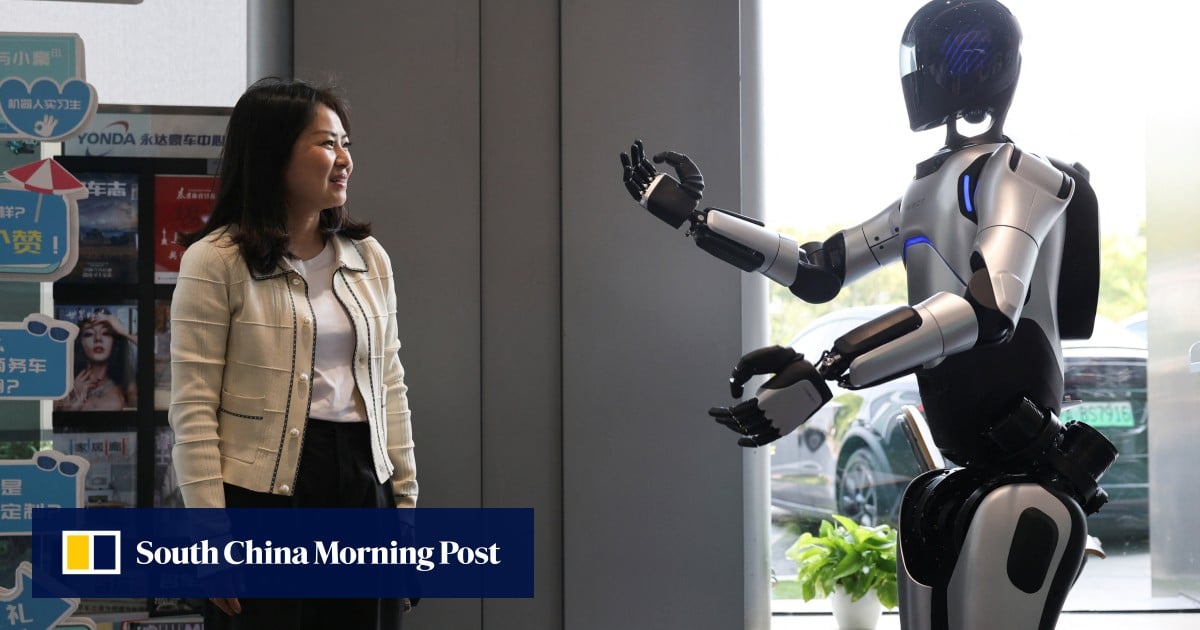
Chinese tech companies are racing to deploy Artificial Intelligence models into robots, shifting the battleground for Generative AI from digital chatbots to physical autonomous systems.Alibaba Group Holding’s Qwen3.7-Max model, launched last week, features “tool-calling” capabilities that allow the AI model to act as a digital brain to trigger external software and hardware components. The company said the model could be used to control robots by orchestrating physical actions like navigation, obstacle avoidance and task planning.The tech giant has also released a suite of supporting AI models for Robotics, including a robotic gripper agent, a navigation model and a vision-language system designed for physical-world interaction. Alibaba owns the China-morning-post" class="entity-link entity-organization" data-entity-id="12558" data-entity-type="organization">South China Morning Post.
SRCSouth China Morning Post
LANGEN
LEANCenter-Right
WORDS111
ENT8
THU · 2026-05-28 · 11:00 GMTBRIEF NSR-2026-0528-79871
NSR-2026-0528-79871News Report·EN·Technology
Alibaba, Tencent lead pivot from chatbots to embodied AI for robotics
Chinese tech giants Alibaba and Tencent are shifting their generative AI focus from chatbots to embodied AI for robotics. Alibaba recently launched its Qwen3.7-Max model, which includes "tool-calling" capabilities enabling the AI to control external software and hardware.
Minxiao ChangSouth China Morning PostFiled 2026-05-28 · 11:00 GMTLean · Center-RightRead · 1 min
South China Morning PostFIG 01
Reading time
1min
Word count
111words
Sources cited
1cited
Entities identified
8entities
Quality score
100%
§ 01
Briefing Summary
AI-generatedNEWSAR · AI
Chinese tech giants Alibaba and Tencent are shifting their generative AI focus from chatbots to embodied AI for robotics. Alibaba recently launched its Qwen3.7-Max model, which includes "tool-calling" capabilities enabling the AI to control external software and hardware. This allows the model to function as a digital brain for robots, orchestrating actions like navigation, obstacle avoidance, and task planning. Alibaba has also released supporting AI models for robotics, such as a robotic gripper agent, a navigation model, and a vision-language system for physical-world interaction. This pivot signifies a move towards deploying AI in physical autonomous systems.
Confidence 0.85Sources 1Claims 4Entities 8
§ 02
Article analysis
Model · rule-basedFraming
Technology
Economic Impact
Tone
Measured
AI-assessed
CalmNeutralAlarmist
Factuality
0.80 / 1.00
Factual
LowHigh
Sources cited
1
Limited
FewMany
§ 03
Key claims
4 extracted01
Alibaba released supporting AI models for robotics, including a gripper agent, navigation model, and vision-language system.
factualAlibaba Group Holding
Confidence
1.00
02
Alibaba's Qwen3.7-Max model can be used to control robots by orchestrating physical actions.
factualAlibaba Group Holding
Confidence
1.00
03
Alibaba's Qwen3.7-Max model has 'tool-calling' capabilities to trigger external software and hardware.
factualAlibaba Group Holding
Confidence
1.00
04
Chinese tech companies are shifting generative AI focus from chatbots to physical autonomous systems like robots.
factual
Confidence
1.00
§ 04
Full report
1 min read · 111 words§ 05
Entities
8 identifiedKey playerOppositionContextPositiveNeutralNegative
Organizations3
Locations1
§ 06
Keywords & salience
9 termsembodied ai
1.00
robotics
0.90
generative ai
0.90
alibaba
0.80
autonomous systems
0.70
tencent
0.70
tool-calling
0.60
ai models
0.50
physical-world interaction
0.40
§ 07
Topic connections
Interactive graph Network visualization showing 51 related topics
View Full Graph Person Organization Location Event|Click node to navigate|Edge numbers = shared articles