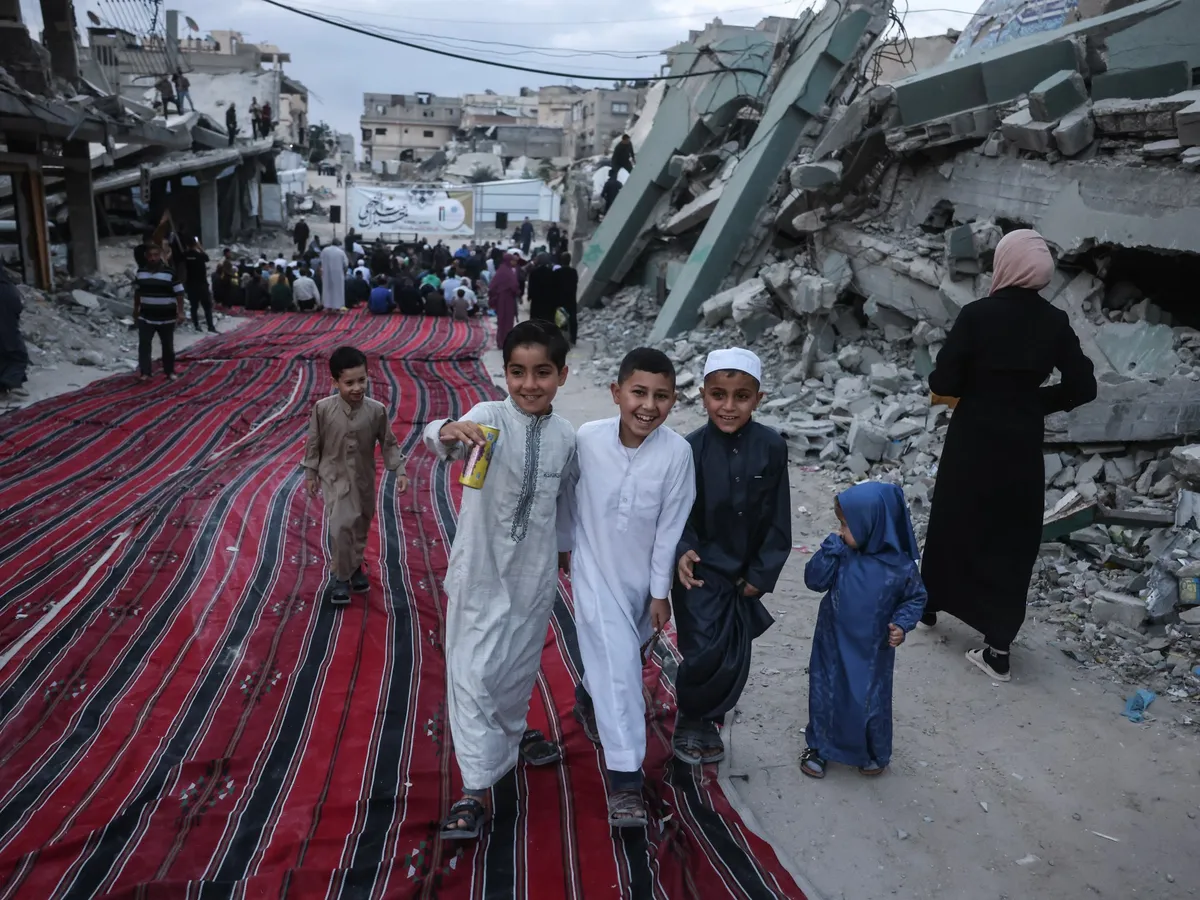
Six were killed in Remal on Eid night. Minutes later, the stalls reopened.Writer based in Gaza.Published On 28 May 2026Young Palestinians share a laugh as worshippers gather on a heavily damaged street to perform morning prayers marking the start of Eid al-Adha, the Feast of Sacrifice, in Khan Yunis in the southern Gaza Strip on May 27, 2026 [AFP]This is my third consecutive Eid al-Adha spent displaced, far from my home in Jabalia, in an area that has been designated a “red zone” under Israeli control.During the war, livestock farms – of cattle, sheep, and goats – were largely destroyed. Only a very small number of sheep survived. Because of the Israeli blockade, the entry of livestock into the Gaza Strip has been prohibited since October 2023. As a result, prices have increased roughly tenfold, with a single sheep now reaching approximately $6,000. This sharp rise has deprived many families of the joy of Eid and the ability to perform the ritual sacrifice, which is one of the most important religious traditions.The impact of the blockade was not limited to livestock. It also pushed up the cost of goods associated with Eid, such as chocolates and nuts. The price of a kilogram (2.2lb) of chocolate reached about $30, nearly four times its pre-war price. This rise has significantly dampened the festive atmosphere for many families.Despite the blockade, the destruction, and the overwhelming sadness affecting hundreds of thousands of families in Gaza, people continue to hold on to life and try to create happiness from the simplest things.On the night before Eid, I stood by the window of the house we rented in the Remal area of Gaza, overlooking Kazem ice-cream shop, one of the most famous and oldest in the city. The street was brightly lit, crowded with shoppers, and filled with stalls selling chocolates, fruits, and biscuits. For a moment, I stood there watching the people before deciding to go downstairs, have ice cream, and share in their joy. I had not experienced Eid night celebrations for three years because of the war.I went down with my mother and my sister Zina, leaving my younger sister Tuline asleep, holding her Eid clothes in her arms. We walked into the street, bought ice cream, and moved through the crowds. The street was extremely crowded – Remal is one of the most densely populated areas in Gaza, especially on Eid nights, when movement becomes almost impossible because of the sheer number of people and stalls.The sound of aircraft overhead was extremely loud, and planes were flying intensively. I found myself hoping that, this time, civilians would be spared, even though the fear of another massacre had become painfully familiar.My smile was suddenly interrupted by the sound of rockets hitting the very street where I was standing. When I heard the first explosion, I put my hand on my head and my mother held me. We heard about four rockets in total.We were terrified. I was shocked by the sight of shoppers running while carrying their bags. I saw a mother embracing her child and screaming that the building that had been struck contained her husband and children. Glass, debris, dust, and smoke filled the area.The ice cream fell from my hand as I grabbed my phone, trying to check on my brothers, who were also in Remal, shopping. Their phones were off. I ran back home, calling them repeatedly along the way, overwhelmed with fear. When I arrived, I received a call from my brother Adi telling me he was safe, and that the strikes had landed only a few metres (feet) away from him and my brother Ziad.I felt relieved and stood by my window again, looking out over Remal. It was a strange but powerful scene: Shoppers – especially women and children – running back home, while others continued their shopping, as if sending a message that they could not be broken or have their joy taken away.A second round of explosions occurred only minutes later, a short distance from the first. Once again, people fled the market in panic, screaming as fear took over their faces. Some were crying heavily.According to sources cited by Al Jazeera, six people were killed and 20 were injured in Israeli attacks on the Remal neighbourhood.After confirming that the attacks had ended, I returned to the window, watching the movement of shoppers and trying to steal moments of joy. Only minutes after the attacks and the panic that had filled the streets, people returned to shop. The stores and stalls remained open until 4am. Despite the blockade and high prices, the streets were still full of people – many of whom could not afford to buy what they needed, yet still came to experience the atmosphere and hold on to fragments of joy.Truly, we are a people who love life.On the morning of Eid, like most families in Gaza, we placed sweets and nuts on the table and greeted each other, hoping for an end to our suffering and for Gaza to be protected. We ate frozen liver for breakfast.When my father had asked what we wanted to eat on Eid morning, I said we wanted liver. Since childhood, we have been used to sacrificing animals on Eid and delaying breakfast until after the sacrifice, eating liver as the first meal of the day. I wanted to relive that memory and feel a sense of Eid again.At about 1pm, after the call to prayer, we heard people chanting, “There is no god but Allah, and the martyr is beloved to Allah.” We looked at each other, and my younger sister asked, “Who has been martyred, father?”He replied that these were the funerals of the previous night’s martyrs from Remal.They had been preparing for Eid, but the occupation took away their joy and their lives, turning Eid from a day of celebration and visits into a day of mourning.A source from Middle East Eye reported that on the first day of Eid al-Adha, 15 people were buried after they were killed in attacks on Eid night across the Gaza Strip, including commander Mohammed Awda, his wife, and three of their children.We do not celebrate Eid because we are well – we celebrate because we are still alive. And we believe that our celebration itself is a form of resistance.The views expressed in this article are the author’s own and do not necessarily reflect Al Jazeera’s editorial stance.
SRCAl Jazeera
LANGEN
LEANCenter
WORDS1 073
ENT10
THU · 2026-05-28 · 11:18 GMTBRIEF NSR-2026-0528-79885
NSR-2026-0528-79885Opinion·EN·Human Interest
For Gaza, Eid joy is now a form of resistance
Despite ongoing conflict and a severe blockade, Gazans are finding ways to celebrate Eid al-Adha. On Eid night in the Remal area, Israeli attacks killed six people and injured twenty, yet stalls and shops reopened minutes later.
Ohood NassarAl JazeeraFiled 2026-05-28 · 11:18 GMTLean · CenterRead · 5 min
Al JazeeraFIG 01
Reading time
5min
Word count
1 073words
Sources cited
0cited
Entities identified
10entities
Quality score
100%
§ 01
Briefing Summary
AI-generatedNEWSAR · AI
Despite ongoing conflict and a severe blockade, Gazans are finding ways to celebrate Eid al-Adha. On Eid night in the Remal area, Israeli attacks killed six people and injured twenty, yet stalls and shops reopened minutes later. The blockade has drastically increased prices for essential Eid items like livestock and chocolates, making traditional sacrifices and celebrations unaffordable for many. Nevertheless, residents continue to gather, shop, and seek moments of joy amidst destruction and fear. This resilience is described as a form of resistance, demonstrating a strong love for life and a refusal to have their spirit broken.
Confidence 0.90Claims 5Entities 10
§ 02
Article analysis
Model · rule-basedFraming
Human Interest
Economic Impact
Tone
Mixed Tone
AI-assessed
CalmNeutralAlarmist
Factuality
0.30 / 1.00
Opinion-Heavy
LowHigh
Sources cited
0
No named sources
FewMany
§ 03
Key claims
5 extracted01
Despite destruction and sadness, people in Gaza continue to hold on to life and try to create happiness.
factual
Confidence
0.95
02
Livestock farms in Gaza were largely destroyed during the war.
factual
Confidence
0.90
03
The price of a kilogram of chocolate reached about $30, nearly four times its pre-war price.
statistic
Confidence
0.85
04
The price of a single sheep has increased tenfold to approximately $6,000 due to the Israeli blockade.
statistic
Confidence
0.85
05
Six people were killed in Remal on Eid night.
factual
Confidence
0.80
§ 04
Full report
5 min read · 1 073 words§ 05
Entities
10 identifiedKey playerOppositionContextPositiveNeutralNegative
Locations5
§ 06
Keywords & salience
10 termsgaza
1.00
eid al-adha
1.00
resistance
0.90
blockade
0.90
ritual sacrifice
0.80
economic impact
0.70
displacement
0.70
festive atmosphere
0.60
israeli control
0.50
destruction
0.40
§ 07
Topic connections
Interactive graph Network visualization showing 51 related topics
View Full Graph Person Organization Location Event|Click node to navigate|Edge numbers = shared articles