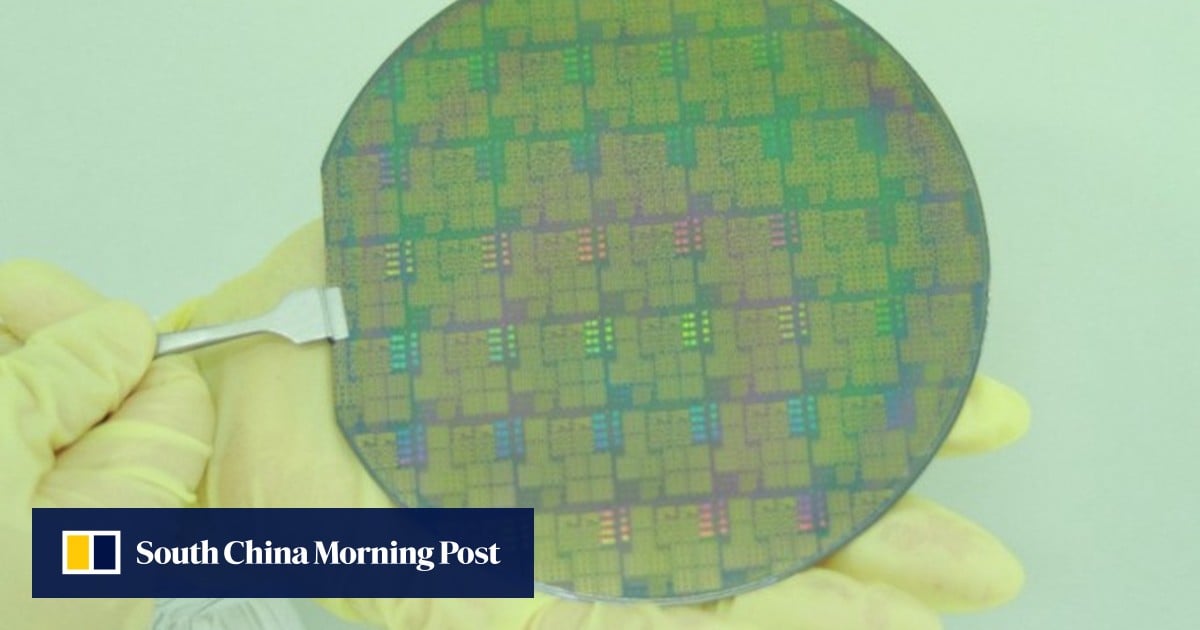
Chinese researchers, in collaboration with Huawei Technologies, have built the world’s first parallel processor using a two-dimensional (2D) semiconductor.As silicon devices approach their physical size limits, Moore’s Law – the observation that computing power doubles roughly every two years, while the cost of computers is cut in half – is hitting a wall.But two-dimensional materials such as molybdenum disulfide are naturally atom-thin, allowing electrons to move stably and efficiently and making them strong candidates to sustain Moore’s Law.
SRCSouth China Morning Post
LANGEN
LEANCenter-Right
WORDS78
ENT7
THU · 2026-05-28 · 13:00 GMTBRIEF NSR-2026-0528-79914
NSR-2026-0528-79914News Report·EN·Technology
Huawei and scientists build 2D parallel computing chip that rewrites Moore’s Law
Chinese researchers, in collaboration with Huawei Technologies, have developed the world's first parallel processor utilizing a two-dimensional (2D) semiconductor. This innovation addresses the challenges posed by silicon devices nearing their physical size limits, which are impacting the continuation of Moore's Law.
Zhang TongSouth China Morning PostFiled 2026-05-28 · 13:00 GMTLean · Center-RightRead · 1 min
South China Morning PostFIG 01
Reading time
1min
Word count
78words
Sources cited
0cited
Entities identified
7entities
Quality score
100%
§ 01
Briefing Summary
AI-generatedNEWSAR · AI
Chinese researchers, in collaboration with Huawei Technologies, have developed the world's first parallel processor utilizing a two-dimensional (2D) semiconductor. This innovation addresses the challenges posed by silicon devices nearing their physical size limits, which are impacting the continuation of Moore's Law. The new processor employs 2D materials like molybdenum disulfide, which are inherently atom-thin. This characteristic enables stable and efficient electron movement, making these materials promising for sustaining the advancements predicted by Moore's Law.
Confidence 0.85Claims 4Entities 7
§ 02
Article analysis
Model · rule-basedFraming
Technology
Economic Impact
Tone
Measured
AI-assessed
CalmNeutralAlarmist
Factuality
0.80 / 1.00
Factual
LowHigh
Sources cited
0
No named sources
FewMany
§ 03
Key claims
4 extracted01
Two-dimensional materials such as molybdenum disulfide are naturally atom-thin, allowing electrons to move stably and efficiently.
factualarticle
Confidence
0.90
02
Moore’s Law is hitting a wall as silicon devices approach their physical size limits.
factualarticle
Confidence
0.90
03
Chinese researchers, in collaboration with Huawei Technologies, have built the world’s first parallel processor using a two-dimensional (2D) semiconductor.
factualarticle
Confidence
0.90
04
Two-dimensional materials are strong candidates to sustain Moore’s Law.
predictionarticle
Confidence
0.70
§ 04
Full report
1 min read · 78 words§ 05
Entities
7 identifiedKey playerOppositionContextPositiveNeutralNegative
Organizations1
Locations1
§ 06
Keywords & salience
8 termsmoore's law
1.00
parallel computing chip
1.00
2d semiconductor
0.90
huawei
0.80
two-dimensional materials
0.70
molybdenum disulfide
0.60
computing power
0.50
semiconductor
0.40
§ 07
Topic connections
Interactive graph Network visualization showing 18 related topics
View Full Graph Person Organization Location Event|Click node to navigate|Edge numbers = shared articles