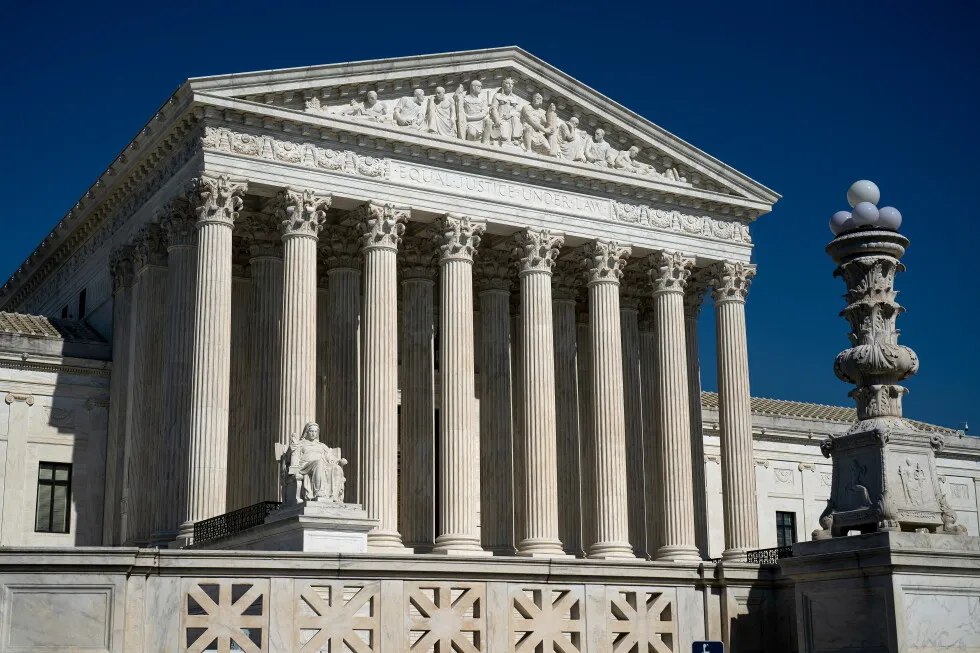
The Supreme Court is seen in Washington, Monday, May 18, 2026. (AP Photo/J. Scott Applewhite) Updated [hour]:[minute] [AMPM] [timezone], [monthFull] [day], [year] WASHINGTON (AP) — The Supreme Court on Thursday ruled for a Black death row inmate from Mississippi who claims there was racial bias in the makeup of the jury that convicted him. By a 5-4 vote, the justices sided with Terry Pitchford, who was sentenced to death for his role in the killing of a grocery store owner.“In this case, whether due to confusion, oversight, an overly hurried jury selection process, or some other cause, things broke down,” Justice Brett Kavanaugh wrote for the court. Chief Justice John Roberts and the court’s three liberal justices joined with Kavanaugh.There were 11 white jurors and one Black juror in a trial with similarities to that of another Black man on Mississippi’s death row, whose conviction the high court overturned seven years ago.It’s unclear what happens next in Pitchford’s case. Justice Neil Gorsuch, who dissented, suggested the state still could argue Pitchford’s conviction should be sustained. If his conviction is overturned, the state could seek to retry him. “Mr. Pitchford is now entitled to a fair trial in the state court,” Joseph Perkovich, who argued the case for Pitchford at the Supreme Court, wrote in an email. 1 MIN READ 1 MIN READ 2 MIN READ Doug Evans, a now-retired prosecutor with a history of dismissing Black jurors for discriminatory reasons, had excused four other Black people at Pitchford’s trial. Black people make up more than 37% of Mississippi’s population. The Supreme Court ruled 40 years ago in Batson v. Kentucky that jurors could not be excused from service because of their race and set up a system by which trial judges could evaluate claims of discrimination and the race-neutral explanations by prosecutors.Pitchford’s case focused on whether his lawyers did enough to object to Judge Joseph Loper’s rulings and whether the state Supreme Court acted reasonably in ruling they had not.Pitchford’s lawyers made the necessary arguments and the state high court acted unreasonably, Kavanaugh wrote. In dissent, Gorsuch wrote that Pitchford had to show that no fair-minded judge could rule as the Mississippi court did and that the record in the case was crystal-clear in his favor.“As I see things, Mr. Pitchford has failed to satisfy either of these standards,” Gorsuch wrote, joined by Justices Samuel Alito, Amy Coney Barrett and Clarence Thomas.In 2019, the Supreme Court overturned the death sentence and conviction of Curtis Flowers, because of what Kavanaugh then described as a “relentless, determined effort to rid the jury of Black individuals.” Evans was the prosecutor in that case, and Loper presided over the final two of Flowers’ six trials. Curtis Flowers speaks with reporters as he exits the Winston-Choctaw Regional Correctional Facility in Louisville, Miss, Dec. 16, 2019. (AP Photo/Rogelio V. Solis, File) Curtis Flowers speaks with reporters as he exits the Winston-Choctaw Regional Correctional Facility in Louisville, Miss, Dec. 16, 2019. (AP Photo/Rogelio V. Solis, File) Add AP News on Google Add AP News as your preferred source to see more of our stories on Google. Share Pitchford, now 40, was 18 when he and a friend decided to rob the Crossroads Grocery, just outside Grenada in northern Mississippi. The friend shot store owner Reuben Britt three times, fatally wounding him, but was ineligible for the death penalty because he was younger than 18. Pitchford was tried for capital murder and was sentenced to death.The case has been making its way through the court system for 20 years. In 2023, U.S District Judge Michael P. Mills overturned Pitchford’s conviction, holding that the trial judge did not give Pitchford’s lawyers enough of a chance to argue that the prosecution was improperly dismissing Black jurors. Mills wrote that his ruling was partially motivated by Evans’ actions in prior cases. A unanimous panel of the 5th U.S. Circuit Court of Appeals reversed the ruling.Evans did not respond to The Associated Press’ attempt to reach him for comment when he retired. Sherman has covered the Supreme Court for The Associated Press since 2006. His journalism career spans five decades. He is based in Washington, D.C., and previously lived in New York, Paris and Atlanta.
SRCAssociated Press (AP)
LANGEN
LEANCenter
WORDS703
ENT12
THU · 2026-05-28 · 14:23 GMTBRIEF NSR-2026-0528-79967
NSR-2026-0528-79967News Report·EN·Social Justice
Supreme Court rules for Black death row inmate from Mississippi over racial bias in makeup of jury
The Supreme Court, in a 5-4 decision, ruled in favor of Terry Pitchford, a Black death row inmate from Mississippi, who alleged racial bias in his jury selection. The court found that Pitchford's lawyers did not have adequate opportunity to object to the dismissal of Black jurors by prosecutor Doug Evans, who has a history of such actions.
By
MARK SHERMANAssociated Press (AP)Filed 2026-05-28 · 14:23 GMTLean · CenterRead · 3 min
Associated Press (AP)FIG 01
Reading time
3min
Word count
703words
Sources cited
3cited
Entities identified
12entities
Quality score
100%
§ 01
Briefing Summary
AI-generatedNEWSAR · AI
The Supreme Court, in a 5-4 decision, ruled in favor of Terry Pitchford, a Black death row inmate from Mississippi, who alleged racial bias in his jury selection. The court found that Pitchford's lawyers did not have adequate opportunity to object to the dismissal of Black jurors by prosecutor Doug Evans, who has a history of such actions. Justice Brett Kavanaugh wrote that "things broke down" during the jury selection process, leading to only one Black juror in a trial where Black individuals constitute a significant portion of the population. This ruling echoes a previous Supreme Court decision that overturned the conviction of Curtis Flowers due to similar jury selection issues involving Evans and the same judge. Pitchford, now 40, was sentenced to death for his role in a 1997 robbery that resulted in a store owner's death.
Confidence 0.90Sources 3Claims 5Entities 12
§ 02
Article analysis
Model · rule-basedFraming
Social Justice
Legal & Judicial
Tone
Measured
AI-assessed
CalmNeutralAlarmist
Factuality
0.90 / 1.00
Factual
LowHigh
Sources cited
3
Well sourced
FewMany
§ 03
Key claims
5 extracted01
The Supreme Court ruled 40 years ago in Batson v. Kentucky that jurors could not be excused from service because of their race.
factual
Confidence
1.00
02
Doug Evans, a retired prosecutor, had a history of dismissing Black jurors for discriminatory reasons.
factual
Confidence
1.00
03
Justice Brett Kavanaugh wrote that 'things broke down' in the jury selection process, whether due to confusion, oversight, or haste.
quoteJustice Brett Kavanaugh
Confidence
1.00
04
The Supreme Court sided with Terry Pitchford, who was sentenced to death for his role in the killing of a grocery store owner, by a 5-4 vote.
factual
Confidence
1.00
05
The Supreme Court ruled for a Black death row inmate from Mississippi who claims racial bias in jury selection.
factual
Confidence
1.00
§ 04
Full report
3 min read · 703 words§ 05
Entities
12 identifiedKey playerOppositionContextPositiveNeutralNegative
People9
TP
Terry Pitchford
personKey Player
6x
90
NG
Neil Gorsuch
AcademicContext
3x
70
BK
Brett Kavanaugh
PoliticianContext
2x
70
DE
Doug Evans
PoliticianContext
50
JR
John Roberts
AcademicContext
50
JP
Joseph Perkovich
personContext
50
SA
Samuel Alito
PoliticianContext
40
AC
Amy Coney Barrett
PoliticianContext
40
JL
Joseph Loper
personContext
40
Organizations1
Locations1
§ 06
Keywords & salience
9 termssupreme court
1.00
racial bias
1.00
jury selection
0.90
death row inmate
0.80
batson v. kentucky
0.70
conviction overturned
0.60
mississippi
0.50
fair trial
0.50
discriminatory reasons
0.40
§ 07
Topic connections
Interactive graph No topic relationship data available yet. This graph will appear once topic relationships have been computed.