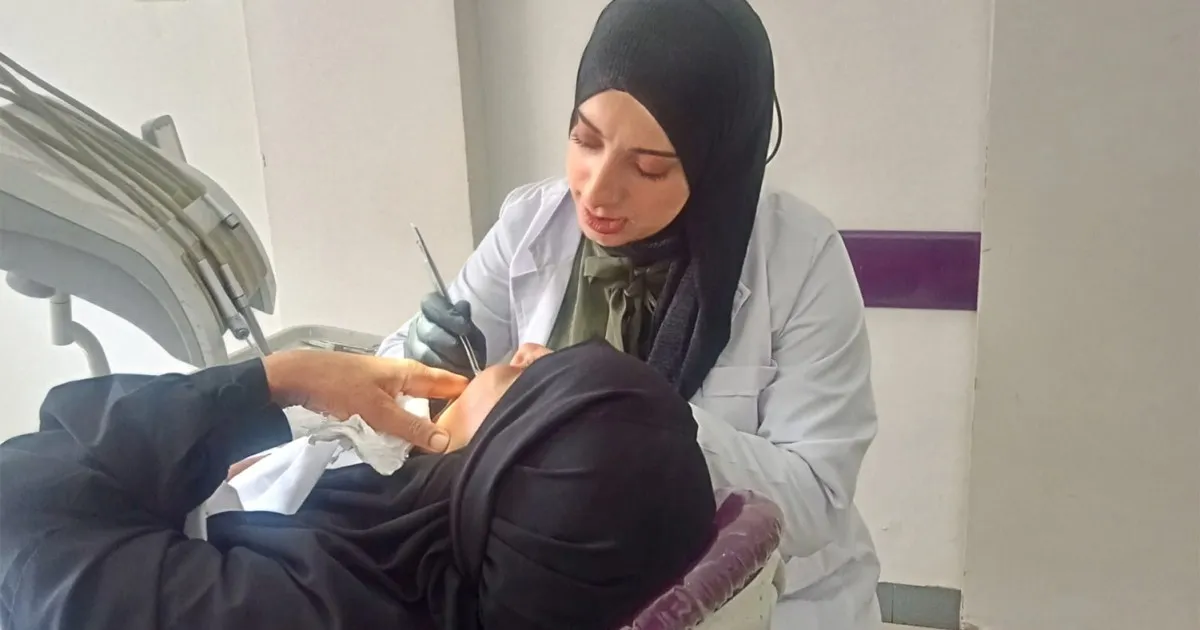
Many Palestinians in Gaza are forgoing expensive dental treatment, at a detriment to their health.Dentist Liza Hassouna with a patient in Gaza's Nuseirat refugee camp [Lina Abuzayed/Al Jazeera]Published On 29 May 2026Nuseirat, Gaza – Fifty-year-old Murad Haji sits in silence in a dentist’s chair among the rubble of Gaza’s Nuseirat refugee camp, hoping to find some relief from a pain that has plagued him for months.He holds his jaw, overwhelmed by a sharp throbbing ache. He had been given a quote of about 400 shekels ($142) for treatment – an amount that could feed his children for four or five days due to escalating food costs. But when the agonising pain spread from his tooth to his jaw, Haji was forced back to the dentist’s clinic to seek some relief.“I can no longer bear the pain… but I knew treatment was more expensive than I could afford,” he says. “Four hundred shekels is a lot… My children need it more.”His dentist, Liza Hassouna, explains how the Israeli siege on Gaza has led to severe shortages of dental materials, significantly driving up the price of treatment and meaning that surgeries can only work on teeth at vastly inflated prices.“Many patients come to us only after the infection has significantly worsened because they could not afford treatment earlier,” Hassouna says. “By then, what could have been a simple procedure becomes far more complicated, painful, and expensive.”Haji is one of many Palestinians whose limited financial resources mean that an already difficult life in Gaza is burdened by the added discomfort of a perpetual toothache.Prolonging treatment often leads to infections that spread to other parts of the body, possibly requiring surgery to deal with the problem, but due to financial constraints, many Palestinians have few options.This is what happened with Haji – what initially began as a simple procedure that could have been completed within two days became a more costly and extensive operation. The toothache had developed into a far more complicated case, leading to a swollen face, an inflamed tooth, pus accumulation, and severe pain.Many patients, such as Haji, require painkillers and antibiotics to control the infection before any dental intervention can be undertaken, again costing money.Haji’s case is not an isolated one, and Hassouna sees patients every day making a difficult choice between medical treatment and meeting their basic household needs. Some rely on painkillers or simply live with the pain until it becomes intolerable.The doctor says that under financial constraints, patients tend to suggest tooth extraction as a cheaper option. However, even the cost of this procedure has increased sharply.In Gaza, where the economy has been almost destroyed due to Israel’s genocidal war on the enclave, the procedure is unaffordable for most, and it may not be enough if the infection has already spread.Hassouna says her work is no longer limited to treatment but also involves a constant effort to balance medical requirements with very limited supplies.A key factor behind the sharp rise in prices in Gaza is tight Israeli restrictions on importing supplies, often classifying essential dental equipment and materials as “non-essential” or “cosmetic”.Nidal al-Sindi, a dentist in Gaza’s Nuseirat refugee camp [Lina Abuzayed/Al Jazeera]In this low supply-high demand dynamic, local suppliers have complete control over fixing prices, directly affecting clinics’ ability to provide consistent, affordable care.Clinic manager Dr Nidal al-Sindi also faces a daily struggle between his professional duties and the practical ability to sustain operations for his dental surgery. Rising costs of rental, medical supplies, and essential equipment have placed an increased financial burden on the clinic.For example, a box of anaesthetic has increased from about 150 shekels ($53) to about 500 shekels ($178), while “Zeta Plus”, used for dental impressions, has risen from about 150 shekels ($53) to between 5,000 and 6,000 shekels ($1,778-$2,133).Procedures that were relatively affordable before the war are now becoming a luxury for most. A simple tooth extraction used to cost between 30 and 150 shekels ($11-$53), while a surgical extraction ranged between 100 and 300 shekels ($36-$107).Today, these costs have increased significantly, and the growing reliance on single-use instruments means additional overheads for the clinic.Al-Sindi says he is saddened by every patient who leaves his surgery unable to afford treatment, but with his clinic’s own financial constraints, there is little he can do.“The hardest part is watching patients leave the clinic still in pain because they cannot afford treatment, while we ourselves are struggling with severe shortages and extremely high operating costs,” he says.The problems faced by the dental industry are indicative of the overall crisis engulfing Gaza’s healthcare sector.According to data from the World Health Organization (WHO), approximately 84 percent of healthcare facilities in Gaza have been damaged or destroyed since the beginning of Israel’s genocidal war on the enclave in October 2023.Waves of Israeli attacks and an ongoing siege have destroyed or damaged 1,800 healthcare facilities in Gaza.With so much of the healthcare system decimated, many medical providers have been forced to relocate to temporary clinics in tents or operate from spaces with only minimal levels of care. They lack proper sterilisation and equipment, but they are the only option open to most Palestinians in Gaza.Murad Haji’s dilemma is emblematic of the overall situation of the dental industry in Gaza, where essential procedures are delayed or disregarded.Elsewhere in Gaza, dental clinics continue to receive patients, each carrying their own story of pain, delay, and difficult calculations, in a landscape where Palestinians have few choices before them, even when they have long-term effects on their bodies.
SRCAl Jazeera
LANGEN
LEANCenter
WORDS916
ENT10
FRI · 2026-05-29 · 08:13 GMTBRIEF NSR-2026-0529-80142
NSR-2026-0529-80142News Report·EN·Economic Impact
Gaza parents brave dental dilemma: Costly treatment or food on the table?
Palestinians in Gaza are facing a severe dental dilemma, forced to choose between essential medical treatment and basic necessities due to escalating costs. Restrictions on importing dental supplies, coupled with high demand and limited local availability, have dramatically increased the price of procedures.
By Lina Abu ZayedAl JazeeraFiled 2026-05-29 · 08:13 GMTLean · CenterRead · 4 min
Al JazeeraFIG 01
Reading time
4min
Word count
916words
Sources cited
2cited
Entities identified
10entities
Quality score
100%
§ 01
Briefing Summary
AI-generatedNEWSAR · AI
Palestinians in Gaza are facing a severe dental dilemma, forced to choose between essential medical treatment and basic necessities due to escalating costs. Restrictions on importing dental supplies, coupled with high demand and limited local availability, have dramatically increased the price of procedures. Many, like Murad Haji, delay treatment for months due to unaffordable costs, leading to worsened infections and more complex, expensive interventions. Dentists Liza Hassouna and Nidal al-Sindi report patients often wait until pain is unbearable, opting for extractions as a cheaper alternative, though even these are now costly. This situation reflects a broader healthcare crisis in Gaza, where financial constraints prevent many from receiving necessary dental care.
Confidence 0.90Sources 2Claims 5Entities 10
§ 02
Article analysis
Model · rule-basedFraming
Economic Impact
Human Interest
Tone
Mixed Tone
AI-assessed
CalmNeutralAlarmist
Factuality
0.60 / 1.00
Mixed
LowHigh
Sources cited
2
Limited
FewMany
§ 03
Key claims
5 extracted01
Prolonging dental treatment often leads to infections that spread, requiring more complex and expensive interventions.
factualLiza Hassouna
Confidence
0.90
02
A dental treatment quote of 400 shekels ($142) is unaffordable for many in Gaza, equivalent to several days of food.
factualMurad Haji
Confidence
0.90
03
Many Palestinians in Gaza are forgoing expensive dental treatment due to cost, impacting their health.
factual
Confidence
0.90
04
The economy in Gaza has been almost destroyed due to Israel's war, making even tooth extraction unaffordable for most.
factualLiza Hassouna
Confidence
0.80
05
The Israeli siege on Gaza has led to shortages of dental materials, increasing treatment prices.
factualLiza Hassouna
Confidence
0.80
§ 04
Full report
4 min read · 916 words§ 05
Entities
10 identifiedKey playerOppositionContextPositiveNeutralNegative
Organizations1
Locations3
§ 06
Keywords & salience
9 termsgaza
1.00
dental treatment
1.00
financial constraints
0.90
food costs
0.80
health detriment
0.70
israeli siege
0.60
refugee camp
0.50
dental materials
0.40
painkillers
0.40
§ 07
Topic connections
Interactive graph Network visualization showing 51 related topics
View Full Graph Person Organization Location Event|Click node to navigate|Edge numbers = shared articles