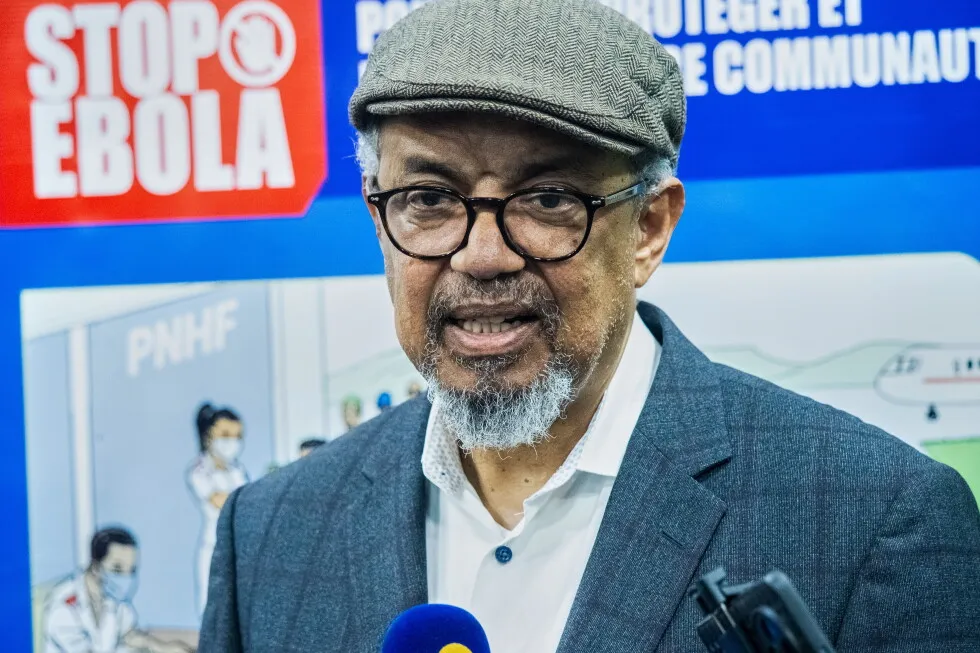
WHO chief lands in Congo to address rare Ebola outbreak amid distrust and insecurity 1 of 5 | Director-General of the World Health Organisation (WHO), Tedros Adhanom Ghebreyesus, speaks to the media upon his arrival at N’djili International Airport in Kinshasa, Congo, Thursday, May 28, 2026. (AP Photo/Samy Ntumba Shambuyi) 2 of 5 | Director General of the World Health Organisation (WHO), Tedros Adhanom Ghebreyesus, left, is welcomed by UK Foreign Secretary Yvette Cooper at N’djili International Airport in Kinshasa, Congo, Thursday, May 28, 2026. (AP Photo/Samy Ntumba Shambuyi) 3 of 5 | Director General of the World Health Organisation (WHO), Tedros Adhanom Ghebreyesus, left, is welcomed by UK Foreign Secretary Yvette Cooper at N’djili International Airport in Kinshasa, Congo, Thursday, May 28, 2026. (AP Photo/Samy Ntumba Shambuyi) 4 of 5 | Director General of the World Health Organisation (WHO), Tedros Adhanom Ghebreyesus, left, is welcomed by UK Foreign Secretary Yvette Cooper at N’djili International Airport in Kinshasa, Congo, Thursday, May 28, 2026. (AP Photo/Samy Ntumba Shambuyi) 5 of 5 | Director General of the World Health Organisation (WHO), Tedros Adhanom Ghebreyesus, arrives at N’djili International Airport in Kinshasa, Congo, Thursday, May 28, 2026. (AP Photo/Samy Ntumba Shambuyi) 1 of 5 | Director-General of the World Health Organisation (WHO), Tedros Adhanom Ghebreyesus, speaks to the media upon his arrival at N’djili International Airport in Kinshasa, Congo, Thursday, May 28, 2026. (AP Photo/Samy Ntumba Shambuyi) 1 of 5 Director-General of the World Health Organisation (WHO), Tedros Adhanom Ghebreyesus, speaks to the media upon his arrival at N’djili International Airport in Kinshasa, Congo, Thursday, May 28, 2026. (AP Photo/Samy Ntumba Shambuyi) Add AP News on Google Add AP News as your preferred source to see more of our stories on Google. Share 2 of 5 | Director General of the World Health Organisation (WHO), Tedros Adhanom Ghebreyesus, left, is welcomed by UK Foreign Secretary Yvette Cooper at N’djili International Airport in Kinshasa, Congo, Thursday, May 28, 2026. (AP Photo/Samy Ntumba Shambuyi) 2 of 5 Director General of the World Health Organisation (WHO), Tedros Adhanom Ghebreyesus, left, is welcomed by UK Foreign Secretary Yvette Cooper at N’djili International Airport in Kinshasa, Congo, Thursday, May 28, 2026. (AP Photo/Samy Ntumba Shambuyi) Add AP News on Google Add AP News as your preferred source to see more of our stories on Google. Share 3 of 5 | Director General of the World Health Organisation (WHO), Tedros Adhanom Ghebreyesus, left, is welcomed by UK Foreign Secretary Yvette Cooper at N’djili International Airport in Kinshasa, Congo, Thursday, May 28, 2026. (AP Photo/Samy Ntumba Shambuyi) 3 of 5 Director General of the World Health Organisation (WHO), Tedros Adhanom Ghebreyesus, left, is welcomed by UK Foreign Secretary Yvette Cooper at N’djili International Airport in Kinshasa, Congo, Thursday, May 28, 2026. (AP Photo/Samy Ntumba Shambuyi) Add AP News on Google Add AP News as your preferred source to see more of our stories on Google. Share 4 of 5 | Director General of the World Health Organisation (WHO), Tedros Adhanom Ghebreyesus, left, is welcomed by UK Foreign Secretary Yvette Cooper at N’djili International Airport in Kinshasa, Congo, Thursday, May 28, 2026. (AP Photo/Samy Ntumba Shambuyi) 4 of 5 Director General of the World Health Organisation (WHO), Tedros Adhanom Ghebreyesus, left, is welcomed by UK Foreign Secretary Yvette Cooper at N’djili International Airport in Kinshasa, Congo, Thursday, May 28, 2026. (AP Photo/Samy Ntumba Shambuyi) Add AP News on Google Add AP News as your preferred source to see more of our stories on Google. Share 5 of 5 | Director General of the World Health Organisation (WHO), Tedros Adhanom Ghebreyesus, arrives at N’djili International Airport in Kinshasa, Congo, Thursday, May 28, 2026. (AP Photo/Samy Ntumba Shambuyi) 5 of 5 Director General of the World Health Organisation (WHO), Tedros Adhanom Ghebreyesus, arrives at N’djili International Airport in Kinshasa, Congo, Thursday, May 28, 2026. (AP Photo/Samy Ntumba Shambuyi) Add AP News on Google Add AP News as your preferred source to see more of our stories on Google. Share Updated [hour]:[minute] [AMPM] [timezone], [monthFull] [day], [year] Kinshasa, Congo (AP) — The head of the World Health Organization arrived in Congo’s capital, Kinshasa, late Thursday to witness efforts against an outbreak of a rare type of Ebola virus, as medical personnel struggle with a lack of equipment, a distrustful population and armed groups in a volatile region.“To come here is to really show to the community that they’re not alone,” WHO Director-General Tedros Adhanom Ghebreyesus told reporters at the airport. “Pushing orders from my comfortable office in Geneva is easy, but I’m asking my colleagues to work with the community and I am asking communities to protect themselves,” he added.Medical aid donated by the European Union arrived in Ituri province, the heart of Congo’s Ebola outbreak, on Thursday. The United States announced the same day $80 million in additional aid, bringing its total commitment to more than $112 million. Health workers with scant supplies have been struggling to contain an outbreak of the Bundibugyo virus, a kind of Ebola that has no approved treatment or vaccine. In some areas, doctors have resorted to wearing expired medical masks while treating suspected patients. 2 MIN READ 3 MIN READ 5 MIN READ According to WHO, 1,077 suspected cases and 238 suspected deaths have been recorded as of Tuesday,Dangers faced by health workers have been heightened by anger among residents over the stringent medical protocols for dealing with the bodies of victims, which clash with local burial rites. Residents have launched at least three attacks against health centers. Tedros said other challenges are also complicating the containment of the outbreak, including the high number of people displaced by armed conflict in the region, and food insecurity.On Wednesday, he had called for a ceasefire in a region where armed groups have staged violent attacks for decades.“We cannot build community trust or isolate the sick while bombs are falling,” Tedros said. Tucked in the northeastern part of Congo close to the Ugandan border, Ituri province has been reeling from attacks by the Allied Democratic Force, a rebel group allied with the Islamic State group, and a coalition of ethnic militias. In early May, the ADF killed at least 40 people and burned several homes in Ituri.The illness also has been reported in the Congolese provinces of North Kivu and South Kivu, south of Ituri, where the Rwanda-backed M23 rebel group controls many key cities, including Goma and Bukavu. The rebels have reported two cases. The region’s main airport in Goma, which doubles as a staging ground for humanitarian efforts into the region, has been closed since January 2025, when M23 seized the city.The conflict has precipitated one of the world’s largest humanitarian crises, with at least 7 million people displaced in eastern Congo.The WHO chief said Thursday he discourages countries from imposing travel bans against nationals of countries affected by the outbreak.“There are ways to manage workers and to manage cases without having a strong, restricted travel ban and we don’t encourage that as WHO,” Tedros said. The Trump administration last week announced a temporary ban on the entry of people without U.S. passports, as well as U.S. green-card holders, who have visited Congo, Uganda or South Sudan in the past 21 days. It said Wednesday it plans to send Americans who are exposed to Ebola to a new facility in Kenya instead of flying them to the U.S. Congo’s neighbors, Uganda and Rwanda, recently closed their borders.Banchereau contributed from Dakar, Senegal. Banchereau covers 22 countries across West and Central Africa for The Associated Press. He is based in Dakar, Senegal.
SRCAssociated Press (AP)
LANGEN
LEANCenter
WORDS1 262
ENT9
FRI · 2026-05-29 · 09:23 GMTBRIEF NSR-2026-0529-80149
NSR-2026-0529-80149News Report·EN·Public Health
WHO chief lands in Congo to address rare Ebola outbreak amid distrust and insecurity
The head of the World Health Organization, Tedros Adhanom Ghebreyesus, arrived in Kinshasa, Congo, to address a rare Ebola outbreak. Medical workers are facing challenges including a lack of equipment, distrust from the local population, and the presence of armed groups in the volatile region.
By
JEAN-YVES KAMALE and MARK BANCHEREAUAssociated Press (AP)Filed 2026-05-29 · 09:23 GMTLean · CenterRead · 6 min
Associated Press (AP)FIG 01
Reading time
6min
Word count
1 262words
Sources cited
0cited
Entities identified
9entities
Quality score
100%
§ 01
Briefing Summary
AI-generatedNEWSAR · AI
The head of the World Health Organization, Tedros Adhanom Ghebreyesus, arrived in Kinshasa, Congo, to address a rare Ebola outbreak. Medical workers are facing challenges including a lack of equipment, distrust from the local population, and the presence of armed groups in the volatile region. The outbreak involves the Bundibugyo virus, which has no approved treatment or vaccine. Health workers have reported suspected cases and deaths, and have faced attacks from residents angered by burial protocols. International aid, including from the European Union and the United States, has been sent to the affected Ituri province. Tedros emphasized the need for community trust and protection, and called for a ceasefire in the region, stating that effective containment is impossible amidst ongoing conflict.
Confidence 0.90Claims 4Entities 9
§ 02
Article analysis
Model · rule-basedFraming
Public Health
Conflict
Tone
Measured
AI-assessed
CalmNeutralAlarmist
Factuality
0.80 / 1.00
Factual
LowHigh
Sources cited
0
No named sources
FewMany
§ 03
Key claims
4 extracted01
UK Foreign Secretary Yvette Cooper welcomed Tedros Adhanom Ghebreyesus.
factual
Confidence
1.00
02
Director-General of the World Health Organisation (WHO), Tedros Adhanom Ghebreyesus, arrived at N’djili International Airport in Kinshasa, Congo, on Thursday, May 28, 2026.
factual
Confidence
1.00
03
The Ebola outbreak in Congo is characterized by distrust and insecurity.
factual
Confidence
1.00
04
WHO chief Tedros Adhanom Ghebreyesus landed in Congo to address a rare Ebola outbreak.
factual
Confidence
1.00
§ 04
Full report
6 min read · 1 262 words§ 05
Entities
9 identifiedKey playerOppositionContextPositiveNeutralNegative
Locations4
Events1
§ 06
Keywords & salience
8 termsebola outbreak
1.00
world health organisation
0.90
congo
0.80
public health
0.70
distrust
0.60
insecurity
0.60
rare outbreak
0.50
international airport
0.40
§ 07
Topic connections
Interactive graph Network visualization showing 10 related topics
View Full Graph Person Organization Location Event|Click node to navigate|Edge numbers = shared articles