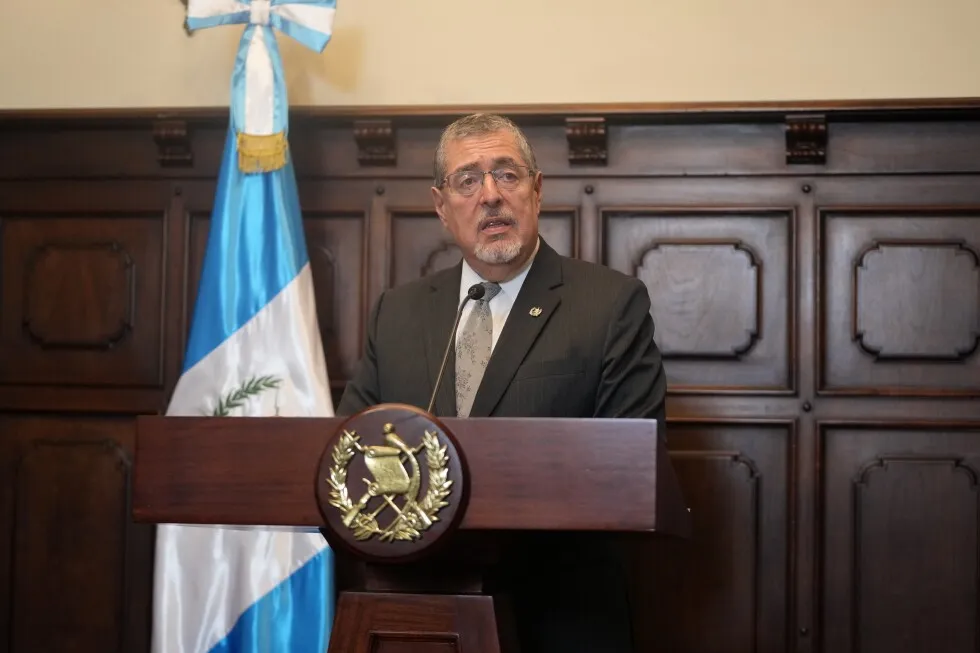
Guatemala’s president denies report of US deal on anti-drug trafficking strikes 1 of 2 | Guatemalan President Bernardo Arévalo on Thursday denied the existence of an agreement with the United States to conduct anti-drug trafficking operations on Guatemalan soil. 2 of 2 | Guatemalan President Bernardo Arevalo speaks to reporters in Guatemala-city" class="entity-link entity-location" data-entity-id="6273" data-entity-type="location">Guatemala City, March 5, 2026. (AP Photo/Moises Castillo, File) 1 of 2 Guatemalan President Bernardo Arévalo on Thursday denied the existence of an agreement with the United States to conduct anti-drug trafficking operations on Guatemalan soil. Add AP News on Google Add AP News as your preferred source to see more of our stories on Google. Share 2 of 2 | Guatemalan President Bernardo Arevalo speaks to reporters in Guatemala-city" class="entity-link entity-location" data-entity-id="6273" data-entity-type="location">Guatemala City, March 5, 2026. (AP Photo/Moises Castillo, File) 2 of 2 Guatemalan President Bernardo Arevalo speaks to reporters in Guatemala-city" class="entity-link entity-location" data-entity-id="6273" data-entity-type="location">Guatemala City, March 5, 2026. (AP Photo/Moises Castillo, File) Add AP News on Google Add AP News as your preferred source to see more of our stories on Google. Share Guatemala-city" class="entity-link entity-location" data-entity-id="6273" data-entity-type="location">Guatemala City (AP) — Guatemalan President Bernardo Arévalo on Thursday denied the existence of an agreement with the United States to conduct anti-drug trafficking operations on Guatemalan soil.The comments come after The New York Times reported that the Central American nation agreed to carry out joint strikes. The case is the latest in ongoing tensions between the Trump administration and Latin American governments that seek to strike a balance between bilateral cooperation to fight drug trafficking and maintaining sovereignty.“There is no agreement. There is a request that falls within the framework of existing agreements in several countries,” Arévalo said at a news conference.“What we are signing are types of collaboration that have been taking place in the past. We conduct maritime interdictions where the United States has been collaborating with training, capacity building and equipment,” Arévalo said. He said the government’s actions are in accordance with Guatemalan law and the Constitution.“The only body that can authorize operations involving soldiers on Guatemalan soil is the Congress of the Republic. The Guatemalan government is not requesting this cooperation and has no plans to do so,” the president said. 3 MIN READ 2 MIN READ 1 MIN READ When asked about the supposed agreement, acting Pentagon press secretary Joel Valdez said he cannot “speculate on future operations or discuss matters of operational security” but emphasized that the Department of War works with partners in the region to fight drug trafficking and other transnational threats. The Guatemalan government also published a press release and two letters in which its defense minister discusses combined military operations under pre-existing agreements with U.S. Secretary of War Pete Hegseth. The April deaths of two CIA agents in northern Mexico after an operation to destroy a drug lab highlighted the presence of U.S. agents in Latin America and raised questions about heightened U.S. involvement throughout the region. In the days following, Mexican officials offered contradictory accounts on how much information the country had regarding the CIA agents’ involvement.The Mexican government acknowledges the presence of U.S. agencies on Mexican territory but says that they cannot participate in on-the-ground operations.___Ben Finley in Washington D.C. contributed to this report.___Follow AP’s Latin America coverage at https://apnews.com/hub/latin-america
SRCAssociated Press (AP)
LANGEN
LEANCenter
WORDS533
ENT10
FRI · 2026-05-29 · 09:23 GMTBRIEF NSR-2026-0529-80150
NSR-2026-0529-80150News Report·EN·Diplomatic
Guatemala’s president denies report of US deal on anti-drug trafficking strikes
Guatemalan President Bernardo Arévalo denied reports of an agreement with the United States to conduct joint anti-drug trafficking operations on Guatemalan soil. The denial follows a New York Times report suggesting such a deal.
Updated [hour]:[minute] [AMPM] [timezone], [monthFull] [day], [year]Associated Press (AP)Filed 2026-05-29 · 09:23 GMTLean · CenterRead · 3 min
Associated Press (AP)FIG 01
Reading time
3min
Word count
533words
Sources cited
3cited
Entities identified
10entities
Quality score
100%
§ 01
Briefing Summary
AI-generatedNEWSAR · AI
Guatemalan President Bernardo Arévalo denied reports of an agreement with the United States to conduct joint anti-drug trafficking operations on Guatemalan soil. The denial follows a New York Times report suggesting such a deal. Arévalo stated that any collaboration falls within existing agreements and involves maritime interdictions with U.S. support for training and equipment, not on-the-ground strikes. He emphasized that only Guatemala's Congress can authorize operations involving soldiers on its territory, and the government has no plans to request such cooperation. The Pentagon acknowledged working with regional partners to combat drug trafficking but declined to comment on specific operations. This situation highlights ongoing tensions between the U.S. and Latin American governments regarding sovereignty and bilateral cooperation against drug trafficking.
Confidence 0.90Sources 3Claims 5Entities 10
§ 02
Article analysis
Model · rule-basedFraming
Diplomatic
National Security
Tone
Measured
AI-assessed
CalmNeutralAlarmist
Factuality
0.80 / 1.00
Factual
LowHigh
Sources cited
3
Well sourced
FewMany
§ 03
Key claims
5 extracted01
The Guatemalan government published a press release and two letters discussing combined military operations under pre-existing agreements with the US.
factualarticle
Confidence
1.00
02
The Guatemalan Congress is the only body that can authorize operations involving soldiers on Guatemalan soil.
quoteBernardo Arévalo
Confidence
1.00
03
Arévalo stated that Guatemala is signing collaboration types that have been taking place in the past, including maritime interdictions with US training, capacity building, and equipment.
quoteBernardo Arévalo
Confidence
1.00
04
The New York Times reported that Guatemala agreed to carry out joint anti-drug trafficking strikes with the US.
factualThe New York Times
Confidence
1.00
05
Guatemalan President Bernardo Arévalo denied the existence of an agreement with the United States for anti-drug trafficking operations on Guatemalan soil.
quoteBernardo Arévalo
Confidence
1.00
§ 04
Full report
3 min read · 533 words§ 05
Entities
10 identifiedKey playerOppositionContextPositiveNeutralNegative
Organizations4
Locations3
§ 06
Keywords & salience
9 termsguatemalan president
1.00
anti-drug trafficking
1.00
united states
0.90
sovereignty
0.80
drug trafficking operations
0.80
collaboration
0.70
guatemalan soil
0.60
existing agreements
0.50
congress of the republic
0.40
§ 07
Topic connections
Interactive graph No topic relationship data available yet. This graph will appear once topic relationships have been computed.