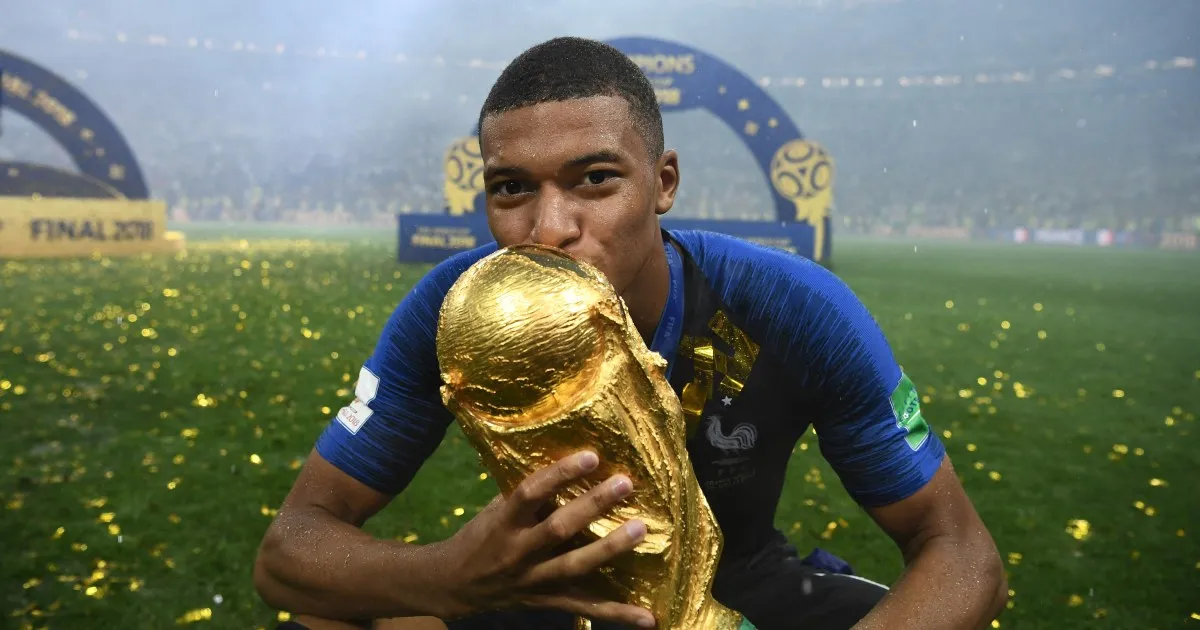
France overcame decades of underachievement to create a football talent system unmatched anywhere in the world.Kylian Mbappe kisses the 2018 World Cup trophy after France beat Croatia in the final [AFP]Published On 29 May 2026Belgian defender Thomas Meunier caused debate recently after saying that France has the footballing talent to put out three teams capable of winning the World Cup.Could Les Bleus, who are co-favourites with Spain in this summer’s World Cup, really lift the title with their second- or third-string team? Maybe not, but their talent is certainly Mariana Trench-deep.Recommended Stories list of 4 itemslist 1 of 4Germany’s Voeller urges players to avoid political statements at World Cuplist 2 of 4Neymar injury threatens Brazil forward’s World Cup as scans needed on calflist 3 of 4Two uncapped players named in South Africa’s World Cup squadlist 4 of 4FIFA subpoenaed by New York, New Jersey in World Cup ticket investigationend of listConsider this: According to transfermarkt.com, a lineup of French players that didn’t make the 26-man cut would rank in value among the top five teams – ahead of Portugal, Brazil, the Netherlands and reigning champions Argentina.Lucas Chevalier 30 million euros ($35m); Pierre Kalulu 32 million, Jeremy Jacquet 55 million, Leny Yoro 50 million, Adrien Truffert 25 million; Boubacar Kamara 40 million, Eduardo Camavinga 50 million; Dilani Bakwa 28 million, Senny Mayulu 40 million or Khephren Thuram 40 million, Mousa Diaby 28 million; Junior Kroupi 40 million. = 418 million [38 million average]So, how did Les Bleus get to this point?It started with frustration after French teams consistently fell short on the biggest stage from the 1930s to the 1970s. The solution, national team manager Georges Boulogne said in the early 1970s, would be for the French Football Federation to create training academies known as Centres de Formation.“France had not won any trophies, and it was decided they needed to create a new structure,” INF (Institut National du Football) Clairefontaine administrator Franck Bentolila told Al Jazeera.The government backed the programme, viewing it as promoting French ideals through sports, as well as a recipe for winning trophies.A total of 16 centres were set up, the first opening in 1974 with the main site in Vichy. It recruited widely, drawing young players from the entire country, plus overseas departments. The centres laid a foundation, preparing players for professional careers and the national team.The record was initially mixed. In the 1980s, France won the European Championship and Olympic Games titles (both in 1984) and reached two World Cup semifinals, but then failed to qualify for the 1990 and 1994 World Cups.But by 1998, everything fell into place, with the so-called “Black-Blanc-Beur” squad winning the World Cup at home. The multiethnic group represented the changing nature of French society, as well as validating the federation’s development programme. Bentolila said coach Aime Jacquet dedicated the victory to “all the amateur clubs and academies – it’s also your trophy”.“The [1980s] period with [Michel] Platini, [Alain] Giresse, [Jean] Tigana, had a lot of talent, but we don’t win a World Cup,” Bernard Lama, a goalkeeper who captained the national team in the 1990s, told Al Jazeera.“The difference with our generation, all the guys were from academies. And we were hungry to win a title. And, also, we had one exceptional talent with Zinedine Zidane.”France went on to lift the 2018 World Cup and were runners-up in 2006 and 2022.Zinedine Zidane lifts the trophy after France’s victory over Brazil in the 1998 World Cup Final [Ben Radford/Allsport via Getty]‘We have players who can make a difference’Lama traces France’s success to the combination of the centres, with the contribution of immigration.“You have people coming from overseas – Africa, French Guyana, Martinique – they give us two things, music and sports,” Lama said.“And, now, there is a sub-generation coming from overseas, and they are French. [Ousmane] Dembele, [Desire] Doue, they are French, they are not naturalised, they grew up in France, the majority around Paris.“And they are hungry, you understand, for a lot of reasons. But, also, it’s not only a question of work; the first thing is they have talent.”Lama sees a danger in football, more broadly, of players becoming overly drilled and “robotic”, but France has many exceptions who can give them an edge.“We are lucky to still have these players who are capable of making the difference,” Lama said. “Maybe that is why we are so good, we have players like [Kylian] Mbappe, Dembele, Doue. They hate to lose and, physically and technically, they can make the difference, individually.“And that is the force of the national team, and also PSG, our capacity to score. Today, we have maybe four or five guys – [Maghnes] Akliouche, [Rayan] Cherki, a different kind of talent. When you have that explosion of talent, it gives the coach more solutions, offensive solutions.”Most national team members, no matter their background, have gone through the academies, but their development starts long before that.“It’s cultural,” Bentolila said. “In America, when you are young, you have a basketball in your hands, or a football in your hands. In France, you have a football at your feet when you are a baby – and free access to facilities.”That part of the formula sounds similar to many countries. Is there a secret to French development, or are they just doing it better than most?“The secrets,” said longtime coach and scout Stephane Nado, “are a combination of hard work, structure and organisation.”Nado said: “The player is the centre, the heart, of the project. The player will receive education. And we will not take them away from their family. It is important for them to keep their roots, important psychologically. This is why France is one of the best in the world at developing players for export.”Training at Clairefontaine blends street game skills with organisation, including “lots of 1 vs 1, 2 vs 2”, Bentolila said. “You have to fight. You’re good at dribbling and first touch, now you organise possession, 5 vs 2. As soon as you get the ball, you have to have good control. We do that a lot.”Clairefontaine is now focusing on younger age groups, ceding responsibility for older players to clubs. And development is expanding beyond the centres and established club academies, Bentolila said.“Paris and Sao Paulo are the best areas in the world for talent,” Bentolila said. “Why? Private academies. It is an amazing situation. Kids, eight- and nine-year-olds, playing every day. Amateur coaches offer not a meal, but a snack at 4 o’clock. Then, they do homework and training sessions. When they are 12 years old, they play like Mbappe.“In Paris, you have amateur clubs nobody knows, and they can beat [the youth teams of] Barcelona and professional clubs. They are better than PSG, Paris FC. So many players – they play anywhere, any time, eight years old against 10 years old. They are like soldiers, they fight every day, and they are good because they play under pressure.”In the 1980s, Les Bleus were dubbed “The Brazilians of Europe”. It’s taken a while, but France appears to have lived up to the moniker. And they’ve gone about it their own way.“Brazilian coaches [used to] tell me, ‘In our country, we are poor, but we can succeed in football or music. So, we start the day with football,’” Bentolila said.“In France, we go to school, first, and, after, practise football. We do it every day and, like Brazil, we play a lot, and play well.”
SRCAl Jazeera
LANGEN
LEANCenter
WORDS1 240
ENT12
FRI · 2026-05-29 · 12:04 GMTBRIEF NSR-2026-0529-80210
NSR-2026-0529-80210Analysis·EN·Human Interest
World Cup 2026: How France created football’s deepest talent pool
France has developed an unparalleled football talent pool by establishing a comprehensive training academy system, known as Centres de Formation, starting in the 1970s. This initiative, driven by decades of underachievement, aimed to nurture young players from across the country and its overseas departments.
Frank Dell’ApaAl JazeeraFiled 2026-05-29 · 12:04 GMTLean · CenterRead · 5 min
Al JazeeraFIG 01
Reading time
5min
Word count
1 240words
Sources cited
2cited
Entities identified
12entities
Quality score
100%
§ 01
Briefing Summary
AI-generatedNEWSAR · AI
France has developed an unparalleled football talent pool by establishing a comprehensive training academy system, known as Centres de Formation, starting in the 1970s. This initiative, driven by decades of underachievement, aimed to nurture young players from across the country and its overseas departments. The program, backed by the government, has yielded significant success, including the 1998 World Cup victory with a multiethnic squad that validated the federation's development strategy. This system, combined with the contribution of players from diverse backgrounds, has created a deep reservoir of talent, with even French players not making the national squad valued among the world's top teams. This depth allows France to consistently produce exceptional individuals capable of making a difference on the field.
Confidence 0.90Sources 2Claims 5Entities 12
§ 02
Article analysis
Model · rule-basedFraming
Human Interest
Political Strategy
Tone
Mixed Tone
AI-assessed
CalmNeutralAlarmist
Factuality
0.70 / 1.00
Factual
LowHigh
Sources cited
2
Limited
FewMany
§ 03
Key claims
5 extracted01
The 1998 World Cup winning squad, known as the 'Black-Blanc-Beur' team, represented the changing nature of French society.
factualArticle's interpretation
Confidence
0.90
02
France established training academies (Centres de Formation) starting in the 1970s to improve national team performance.
factualGeorges Boulogne
Confidence
0.90
03
France has the footballing talent to put out three teams capable of winning the World Cup.
quoteThomas Meunier
Confidence
0.90
04
The French government supported the training academy program as a way to promote French ideals and win trophies.
factualFranck Bentolila
Confidence
0.80
05
A lineup of French players not making the 26-man cut would rank in value among the top five teams globally.
statistictransfermarkt.com
Confidence
0.80
§ 04
Full report
5 min read · 1 240 words§ 05
Entities
12 identifiedKey playerOppositionContextPositiveNeutralNegative
People4
Organizations1
Locations6
§ 06
Keywords & salience
8 termsfootball talent pool
1.00
world cup 2026
0.90
talent system
0.80
training academies
0.70
french football federation
0.60
player development
0.50
national team
0.40
professional careers
0.40
§ 07
Topic connections
Interactive graph Network visualization showing 51 related topics
View Full Graph Person Organization Location Event|Click node to navigate|Edge numbers = shared articles