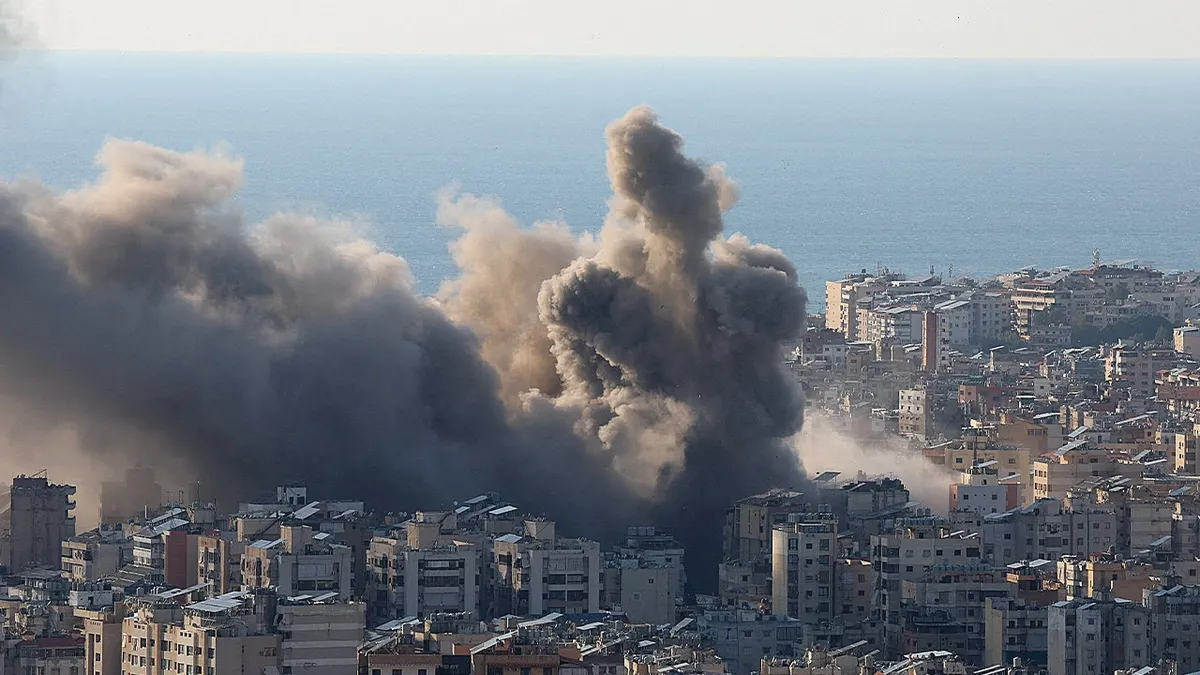
close Video Hezbollah remains biggest obstacle to Israel–Lebanon talks, analyst warns As Israeli and Lebanese military officials meet in Washington for rare Pentagon-mediated talks, Ahmed Sharawi of the Foundation for Defense of Democracies warns Hezbollah’s grip on Lebanon continues to undermine hopes for a broader agreement. NEWYou can now listen to Fox News articles! Hören Sie sich diesen Artikel an 6 Min Israeli and Lebanese military delegations opened Pentagon-mediated talks Friday morning in Washington, launching a new U.S.-brokered security coordination track aimed at preventing renewed escalation along the Israel–Lebanon border and shoring up a fragile ceasefire reached in mid-April. A State Department official told Fox News Digital that, "As we have continuously stated, the only path to lasting peace is through direct negotiations between the two sovereign governments." The discussions mark a shift from diplomatic negotiations into direct military coordination, with talks expected to focus on ceasefire enforcement, border stability, Israeli withdrawal from parts of southern Lebanon and the role of the Lebanese Armed Forces in containing Hezbollah. Israel MOVES TOWARDS ceasefire DEAL WITH Hezbollah: REPORTS Michael Needham, counselor for the U.S. Department of State, U.S. Ambassador to the United Nations Mike Waltz, Secretary of State Marco Rubio, U.S. Ambassador to Lebanon Michel Issa, Lebanese Ambassador to the U.S. Nada Hamadeh Moawad, and Israeli Ambassador to the U.S. Yechiel Leiter pose for a photo before a meeting at the State Department in Washington, D.C., on April 14, 2026. (Jacquelyn Martin/AP Photo) The talks come weeks after a U.S.-brokered ceasefire first reached during the broader regional conflict tied to the U.S.–Iran war. While large-scale fighting has eased, Israeli forces continue operating inside parts of southern Lebanon and Hezbollah maintains drone and rocket capabilities, keeping tensions high along the border. The ceasefire was extended on May 15 for another 45 days, creating pressure on both sides to show progress before the current arrangement expires. But analysts say the central question overshadowing the talks is whether Lebanon can realistically curb Hezbollah’s military power without risking internal collapse. "This will be the first meeting between representatives of the militaries since the start of the negotiation process between Lebanon and Israel," Ahmed Sharawi, a research analyst at the Foundation for Defense of Democracies think tank, told Fox News Digital. Representing Lebanon in the talks is Lebanese Armed Forces (LAF) commander Gen. Rodolphe Haykal, who previously served as commander of the Lebanese Armed Forces in southern Lebanon, an area where Hezbollah maintains a strong presence. Hezbollah is the Iran-backed Lebanese terrorist organization designated by the United States as a foreign terrorist organization. "What we should expect is talks regarding de-confliction and what the expectations are for the LAF in terms of the broader disarmament plan against Hezbollah’s weapons," he said. Sharawi said the chances of a broader breakthrough remain limited so long as Hezbollah remains heavily armed and politically entrenched inside Lebanon. "The biggest obstacle here is that the Lebanese state is yet to present a feasible plan to disarm Hezbollah," he said. LAWMAKERS QUESTION WHETHER US MOVING FAST ENOUGH TO CAPITALIZE ON Hezbollah'S WEAKENED STATE But analysts say the central question overshadowing the talks is whether Lebanon can realistically curb Hezbollah’s military power without risking internal collapse. (Ibrahim AMRO / AFP via Getty Images) He pointed to the terms of the November 2024 ceasefire agreement, which placed responsibility for disarming Hezbollah on the Lebanese state. "We are yet to see the confiscation of one single bullet from Hezbollah," Sharawi said. He also warned that Hezbollah’s deep support among Lebanon’s Shiite population complicates any attempt to move toward normalization with Israel. "There’s a fear of a civil war," he said. "That also accounts for the Lebanese state’s unwillingness to disarm Hezbollah." The talks opened as Prime Minister Benjamin Netanyahu signaled Israel intends to maintain military pressure on Hezbollah despite the negotiations. Sharawi argued the Trump administration nevertheless appears determined to push the process forward as part of a broader effort to weaken Iranian influence in the region. "The reason behind these meetings is that President Trump is really trying to push for a peace agreement between Israel and Lebanon," he said. "Peace between these two countries could really undermine Hezbollah and its influence in Lebanon." WALTZ SAYS TRUMP HAS CREATED 'BEST CHANCE IN OUR LIFETIME' TO BREAK Hezbollah’S GRIP ON Lebanon Churches in the southern Lebanese town of Rmeish remained standing throughout the conflict, as residents say the community resisted Hezbollah attempts to launch rockets from the area. (Jusoor News) Israeli analysts similarly described the talks less as a breakthrough and more as a strategic signal aimed at Hezbollah. "The war between us and Hezbollah is continuing," Yossi Kuperwasser, senior project manager at the Jerusalem Institute for Strategy and Security and former head of the Research Division of Israeli Military Intelligence, told Fox News Digital. "There is no doubt the Lebanese government does not have a monopoly on the use of force in Lebanon," he said. ‘OVERBLOWN’ REPORTS ON Israel–Lebanon NORMALIZATION RISK HINDERING BORDER TALKS BEFORE THEY BEGIN: OFFICIAL IDF troops discovered a Hezbollah weapons cache near a UNIFIL post in southern Lebanon in 2024. (IDF Spokesman's Unit) Kuperwasser said expectations for an immediate diplomatic breakthrough should remain low, but argued the talks themselves send an important political message. "The purpose of these talks is first and foremost to send a message to Hezbollah and also to the Americans," he said. "Both sides are prepared to sit together against Hezbollah and signal that they are moving, even if slowly, toward normalization between Israel and Lebanon." He argued Hezbollah has been weakened politically and militarily by the ongoing conflict and by growing frustration among Lebanese civilians displaced by the fighting. "For years Hezbollah portrayed itself as the defender of Lebanon," Kuperwasser said. "Now many Lebanese see Hezbollah as responsible for the suffering Lebanon is experiencing." Kuperwasser added that while Israel supports strengthening the Lebanese army, Beirut fears direct confrontation with Hezbollah could ignite another civil war. "The Lebanese government fears military action against Hezbollah would lead to civil war," he said. "That fear shapes everything." The talks also come amid mounting domestic pressure inside Israel, where critics of Netanyahu have accused the government of pursuing containment rather than decisive military victory against Hezbollah. Speaking Friday during a visit to Israel’s northern front, Netanyahu said Israeli forces had crossed the Litani River and were operating across multiple parts of Lebanon. "We are operating in Beirut, in the Bekaa Valley, across the entire front and striking Hezbollah hard," Netanyahu said. A woman holds her dog as she walks past burned cars a day after an Israeli airstrike in Beirut, Lebanon, on April 9, 2026. (Emilio Morenatti/AP) Meanwhile, Lebanon’s leadership is attempting to balance growing American pressure with fears of internal instability and renewed sectarian conflict. Neither the Israeli Embassy in Washington nor the Lebanese Embassy in Washington immediately responded to requests for comment. The Pentagon did not have anything to add when asked to comment. Efrat Lachter is a reporter for Fox News Digital covering international affairs and the United Nations. Follow her on X @efratlachter. Stories can be sent to efrat.lachter@fox.com.
SRCFox News - World
LANGEN
LEANCenter-Right
WORDS1 183
ENT12
FRI · 2026-05-29 · 18:15 GMTBRIEF NSR-2026-0529-80276
NSR-2026-0529-80276News Report·EN·Conflict
Pentagon hosts first-ever Israeli–Lebanese military talks aimed at curbing Hezbollah
The Pentagon hosted the first-ever Israeli-Lebanese military talks, mediated by the U.S., aimed at de-escalating tensions and shoring up a fragile ceasefire. The discussions, involving military delegations from both nations, focused on ceasefire enforcement, border stability, Israeli withdrawal from southern Lebanon, and the Lebanese Armed Forces' role in containing Hezbollah.
Fox News - WorldFiled 2026-05-29 · 18:15 GMTLean · Center-RightRead · 5 min
Fox News - WorldFIG 01
Reading time
5min
Word count
1 183words
Sources cited
3cited
Entities identified
12entities
Quality score
100%
§ 01
Briefing Summary
AI-generatedNEWSAR · AI
The Pentagon hosted the first-ever Israeli-Lebanese military talks, mediated by the U.S., aimed at de-escalating tensions and shoring up a fragile ceasefire. The discussions, involving military delegations from both nations, focused on ceasefire enforcement, border stability, Israeli withdrawal from southern Lebanon, and the Lebanese Armed Forces' role in containing Hezbollah. Analysts note that the central challenge is Lebanon's ability to curb Hezbollah's military power without risking internal collapse, as the Lebanese state has yet to present a feasible plan to disarm the group. The talks signal a shift towards direct military coordination, with the U.S. aiming to weaken Iranian influence in the region.
Confidence 0.90Sources 3Claims 5Entities 12
§ 02
Article analysis
Model · rule-basedFraming
Conflict
Diplomatic
Tone
Measured
AI-assessed
CalmNeutralAlarmist
Factuality
0.60 / 1.00
Mixed
LowHigh
Sources cited
3
Well sourced
FewMany
§ 03
Key claims
5 extracted01
Hezbollah remains the biggest obstacle to Israel-Lebanon talks.
quoteAhmed Sharawi
Confidence
1.00
02
The discussions mark a shift from diplomatic negotiations into direct military coordination.
factual
Confidence
1.00
03
Pentagon hosts first-ever Israeli-Lebanese military talks aimed at curbing Hezbollah.
factual
Confidence
1.00
04
Talks are expected to focus on ceasefire enforcement, border stability, Israeli withdrawal from southern Lebanon, and the role of the Lebanese Armed Forces in containing Hezbollah.
factual
Confidence
0.90
05
Lebanon can realistically curb Hezbollah’s military power without risking internal collapse.
predictionanalysts
Confidence
0.70
§ 04
Full report
5 min read · 1 183 words§ 05
Entities
12 identifiedKey playerOppositionContextPositiveNeutralNegative
Organizations4
Locations4
§ 06
Keywords & salience
10 termsisrael-lebanon talks
1.00
hezbollah
1.00
pentagon-mediated talks
0.90
security coordination
0.80
ceasefire enforcement
0.70
border stability
0.70
military coordination
0.60
lebanese armed forces
0.50
u.s.-brokered ceasefire
0.50
curbing military power
0.40
§ 07
Topic connections
Interactive graph Network visualization showing 51 related topics
View Full Graph Person Organization Location Event|Click node to navigate|Edge numbers = shared articles