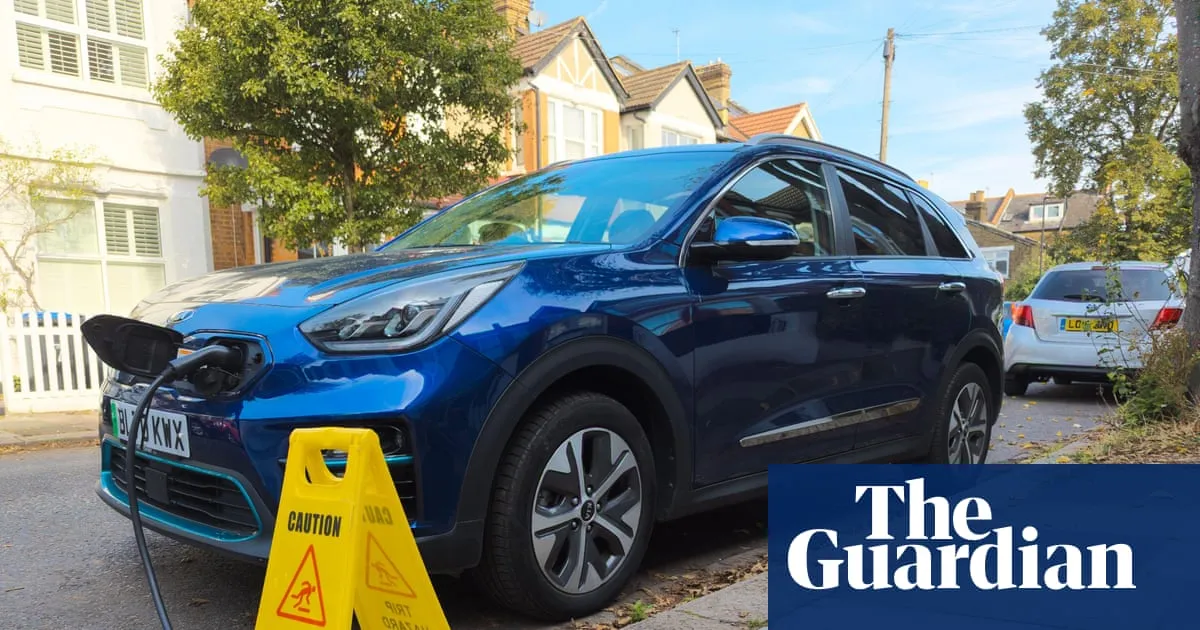
The energy secretary, Ed Miliband, has said charger gullies to connect electric cars parked on streets will help cut costs for drivers, yet millions of UK households may be unable to use the simple technology because their local councils will still not allow charging cables to cross the pavement.Despite government promises to “slash red tape” and make it easier to put in gullies, more than 20 local authorities appear to be holding out against them.They include the councils for Kent, Leicester, and Worcestershire, but the majority of the holdouts are in London including Westminster and Hackney. London has the highest number of electric cars in Britain and the highest number of households without off-street parking.It is much more attractive to charge electric vehicles (EVs) via a domestic energy supply in part because of the VAT rate on the electricity used is 5%, compared with 20% when using a public charger. However, 9.3m households do not have access to off-street parking, according to the consultancy Field Dynamics, making it hard for them to access cheaper energy.Gully makers including Kerbo Charge, Gul-e, Pavecross and ACO argue their products allow households to run a cable to their car parked on the street without creating a trip hazard. However, several councils said they had concerns about safety, parking and the aesthetics of cutting channels into pavements.“It’s still going to require local authority approval before each installation,” said Michael Goulden, the co-founder of Kerbo Charge. The company is working with 48 local authorities that either allow gullies or are trialling them, but the situation is different with every council.“We’re getting more and more streamlined with local authorities to make that more efficient,” Goulden added. Almost a fifth of 83 local authorities or combined authorities in England counted by the government did not apply for funding allocated to cross-pavement solutions, or did not take their full allocation.“Many inner London boroughs have no plans to do cross-pavement right now,” said Goulden. “This change in the legislation [removing the need for planning permission] will make no difference to their residents in the near future.”Reasons given by councils usually boil down to worrying who will maintain them and who will be liable if someone trips over a gully and hurts themselves. Guaranteeing a parking spot directly outside the home presents another problem.Leicester city council said that for owners of its many terrace houses, it was not possible to always park in front of their property, and that the local authority worried about accessibility problems. Kent county council said it was also concerned about electric shock risk if cables were damaged. Worcestershire county council said it did not “permit the breaking or any damage to the highway to install an EV charger connection”, although it would allow cable protector ramps across the pavement.Ealing council in west London said it had “accessibility and safety concerns, particularly for elderly residents, disabled people, wheelchair users and those with visual impairments”, adding that it was focusing on installing public chargers in lamp-posts.In central London, Westminster council said gullies did not work in dense urban areas. Hackney council said it wanted to “minimise street clutter and prioritise vulnerable road users, such as people walking and wheeling over private vehicles” by keeping chargers off pavements and increasing its public charger rollout.The government’s removal of the need for planning permission will help to speed up the process, but it still leaves installers needing street works licences, which are controlled by councils.“They all have their different processes,” said Adam Dolphin, the director of Gul-e. “I wouldn’t say they’re an intentional barrier. They’re just working through the process, how it works.”
SRCThe Guardian - World News
LANGEN
LEANCenter-Left
WORDS602
ENT12
SAT · 2026-05-30 · 07:00 GMTBRIEF NSR-2026-0530-80355
NSR-2026-0530-80355News Report·EN·Technology
On-street EV charging in UK is postcode lottery as drivers face council objections
Despite government efforts to simplify electric vehicle (EV) charging, over 20 UK local authorities are refusing to permit charger gullies, which allow cables to cross pavements. These councils, including those in London, Kent, Leicester, and Worcestershire, cite concerns about safety, legal liability, parking, and accessibility for vulnerable pedestrians.
Jasper JollyThe Guardian - World NewsFiled 2026-05-30 · 07:00 GMTLean · Center-LeftRead · 3 min
The Guardian - World NewsFIG 01
Reading time
3min
Word count
602words
Sources cited
4cited
Entities identified
12entities
Quality score
100%
§ 01
Briefing Summary
AI-generatedNEWSAR · AI
Despite government efforts to simplify electric vehicle (EV) charging, over 20 UK local authorities are refusing to permit charger gullies, which allow cables to cross pavements. These councils, including those in London, Kent, Leicester, and Worcestershire, cite concerns about safety, legal liability, parking, and accessibility for vulnerable pedestrians. While companies argue their gully products prevent trip hazards, councils worry about maintenance and potential accidents. Although the government has removed the need for planning permission, street works licenses controlled by councils remain a hurdle. This creates a postcode lottery for millions of households without off-street parking, hindering access to cheaper domestic EV charging.
Confidence 0.90Sources 4Claims 5Entities 12
§ 02
Article analysis
Model · rule-basedFraming
Technology
Economic Impact
Tone
Mixed Tone
AI-assessed
CalmNeutralAlarmist
Factuality
0.70 / 1.00
Factual
LowHigh
Sources cited
4
Well sourced
FewMany
§ 03
Key claims
5 extracted01
The VAT rate on electricity for public EV chargers is 20%, compared to 5% for domestic supply.
factual
Confidence
1.00
02
9.3 million households in the UK do not have access to off-street parking, making EV charging difficult.
statisticField Dynamics
Confidence
1.00
03
Councils cite concerns about safety, maintenance, liability, and aesthetics as reasons for objecting to gullies.
factual
Confidence
0.90
04
Millions of UK households may be unable to use on-street EV charging gullies due to local council objections.
factual
Confidence
0.90
05
More than 20 local authorities are reportedly holding out against allowing EV charger gullies.
factual
Confidence
0.85
§ 04
Full report
3 min read · 602 words§ 05
Entities
12 identifiedKey playerOppositionContextPositiveNeutralNegative
Organizations4
§ 06
Keywords & salience
9 termsev charging infrastructure
1.00
on-street charging
0.90
council objections
0.90
off-street parking
0.80
charger gullies
0.80
electric vehicles
0.70
local authorities
0.60
pavement charging
0.50
uk households
0.40
§ 07
Topic connections
Interactive graph Network visualization showing 51 related topics
View Full Graph Person Organization Location Event|Click node to navigate|Edge numbers = shared articles