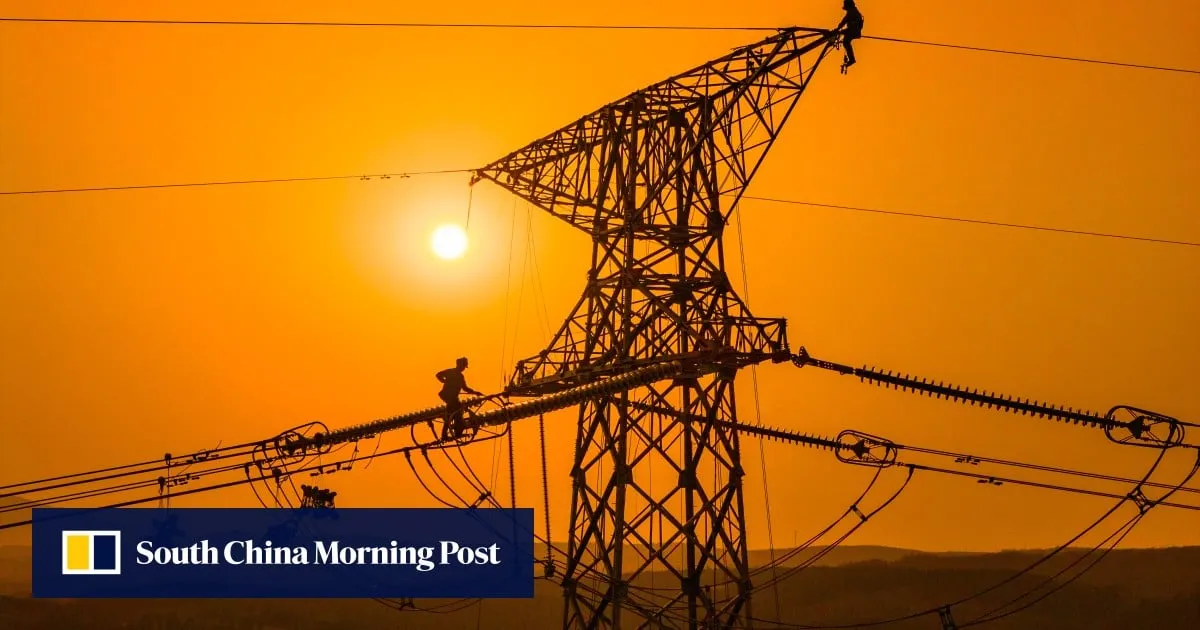
China’s state-owned power grid giant has pledged to increase fixed-asset investment by 40 per cent over the next five years, at a time when some analysts view electricity capacity as a strategic asset in the US-China rivalry amid soaring demand from Artificial Intelligence (AI) and other power-hungry industries.The China" class="entity-link entity-organization" data-entity-id="12626" data-entity-type="organization">State Grid Corporation of China expects the investment amount to reach 4 trillion yuan (US$574 billion) through 2030, a company record, as it accelerates efforts to build a “new-type power system” – a more efficient and flexible grid designed to integrate renewables.The expansion could raise electricity’s share of end-use energy consumption to 35 per cent, with about 200 gigawatts of wind and solar capacity added annually, the company announced on Thursday.The massive investment comes as the world grapples with the enormous energy appetite of AI. The International Energy Agency estimated that from 2024 to 2030, China’s data centres would consume 170 per cent more electricity while the consumption in the US would increase 130 per cent, with both accounting for nearly 80 per cent of global growth.However, China and the US – the world’s two AI powerhouses – face completely different pictures. China tops all countries with a third of global electricity generation volume due to aggressive government planning, while the US is facing an intensifying power shortage, prompting tech giants from Google to Meta to acquire power assets to secure supply for training their AI models.“In the AI race, computing power comes down to chips, electricity and algorithms – and electricity is the one area where China holds an undeniable advantage,” said Peng Peng, executive chairman of the Guangdong Society of Reform, a think tank affiliated with the provincial government.FULL EVENT: China Future Tech Webinar | The US-China chip warFULL EVENT: China Future Tech Webinar | The US-China chip war
SRCSouth China Morning Post
LANGEN
LEANCenter-Right
WORDS299
ENT7
FRI · 2026-01-16 · 14:00 GMTBRIEF NSR-2026-0116-8036
NSR-2026-0116-8036News Report·EN·Technology
AI is reshaping US-China tech race – can electricity tilt the balance?
China's State Grid plans a record $574 billion investment by 2030 to expand and modernize its power grid, aiming to integrate more renewables and increase electricity's share of energy consumption. This investment comes as AI's energy demands surge, with China and the US projected to account for nearly 80% of global growth in data center electricity consumption by 2030.
Luna Sun,Themis Qi,Zhang ShidongSouth China Morning PostFiled 2026-01-16 · 14:00 GMTLean · Center-RightRead · 2 min
South China Morning PostFIG 01
Reading time
2min
Word count
299words
Sources cited
2cited
Entities identified
7entities
Quality score
100%
§ 01
Briefing Summary
AI-generatedNEWSAR · AI
China's State Grid plans a record $574 billion investment by 2030 to expand and modernize its power grid, aiming to integrate more renewables and increase electricity's share of energy consumption. This investment comes as AI's energy demands surge, with China and the US projected to account for nearly 80% of global growth in data center electricity consumption by 2030. While China leads in electricity generation due to government planning, the US faces potential power shortages, prompting tech companies to secure their own energy supplies for AI development. Some analysts believe China's electricity advantage could be a strategic asset in the US-China tech rivalry, particularly in the AI race where computing power relies on chips, algorithms, and electricity.
Confidence 0.90Sources 2Claims 5Entities 7
§ 02
Article analysis
Model · rule-basedFraming
Technology
Economic Impact
Tone
Measured
AI-assessed
CalmNeutralAlarmist
Factuality
0.70 / 1.00
Factual
LowHigh
Sources cited
2
Limited
FewMany
§ 03
Key claims
5 extracted01
The State Grid Corporation of China expects the investment amount to reach 4 trillion yuan (US$574 billion) through 2030.
factualArticle
Confidence
1.00
02
China’s state-owned power grid giant has pledged to increase fixed-asset investment by 40 per cent over the next five years.
factualArticle
Confidence
1.00
03
From 2024 to 2030, China’s data centres would consume 170 per cent more electricity while the consumption in the US would increase 130 per cent.
statisticInternational Energy Agency
Confidence
0.90
04
The expansion could raise electricity’s share of end-use energy consumption to 35 per cent.
predictionArticle
Confidence
0.80
05
In the AI race, electricity is the one area where China holds an undeniable advantage.
quotePeng Peng, Guangdong Society of Reform
Confidence
0.70
§ 04
Full report
2 min read · 299 words§ 05
Entities
7 identifiedKey playerOppositionContextPositiveNeutralNegative
Organizations4
§ 06
Keywords & salience
10 termsai
1.00
us-china tech race
0.90
electricity
0.90
power grid
0.80
data centers
0.70
energy consumption
0.70
power shortage
0.60
renewable energy
0.60
strategic asset
0.50
computing power
0.40
§ 07
Topic connections
Interactive graph Network visualization showing 51 related topics
View Full Graph Person Organization Location Event|Click node to navigate|Edge numbers = shared articles