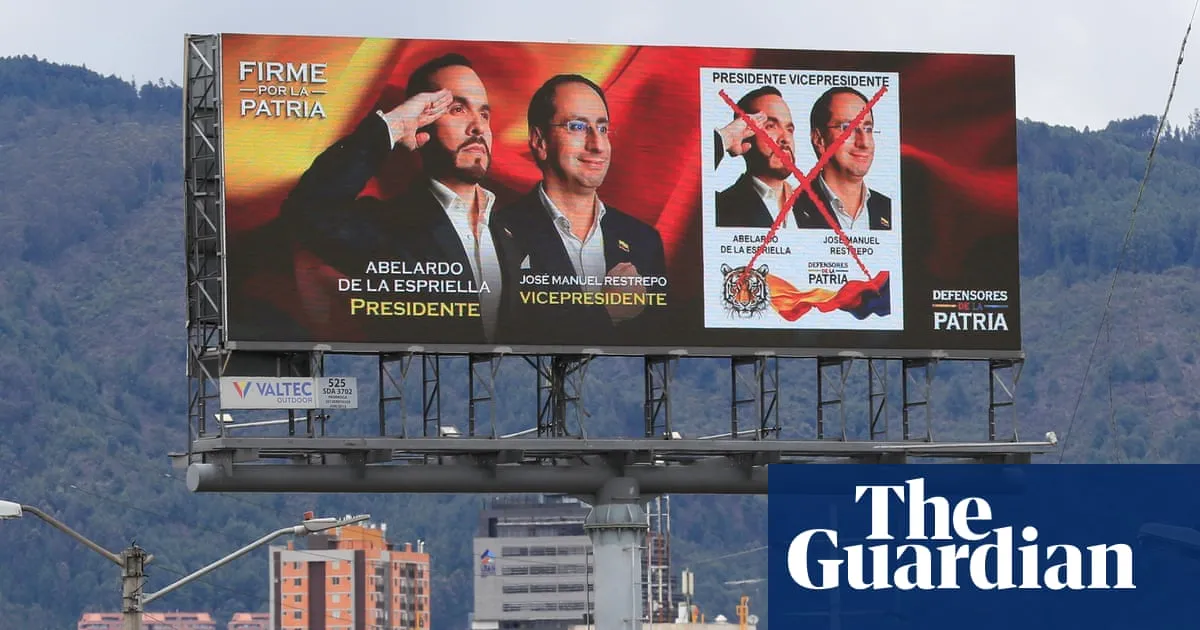
Colombians are casting ballots in the first round of the South American nation’s presidential election, choosing between candidates with radically diverging visions for the future of peace in a country haunted by decades of armed conflict.The vote on Sunday, seen as a referendum on outgoing President Gustavo Petro’s policies, comes 10 years after Colombia signed a historic peace pact with guerrillas of the Colombia" class="entity-link entity-organization" data-entity-id="6250" data-entity-type="organization">Revolutionary Armed Forces of Colombia (FARC).That agreement offered hope to break the nation out of a vicious cycle of fighting between rebel groups and the government but violence has roared back since then, coming to a head in the lead-up to the presidential vote. Criminal groups have increasingly launched drone strikes, armed attacks have plagued the race and last June, presidential hopeful Miguel Uribe Turbay, 39, was fatally shot at a political rally.In a country where the fight for peace has long been a part of the political ethos, the question of how to address the conflict is once again dividing the country.There are 14 candidates on the ballot, but the election has basically turned into a three-horse race.Senator and peace-builder Iván Cepeda – a Petro ally – has led the polls and promises to carry on with Petro’s “total peace” initiative to negotiate with the country’s remaining rebel groups and sign peace agreements with them in an effort to resolve the persistent crisis.Presidential candidate Iván Cepeda holds a press conference in Bogotá. Photograph: Luisa González/ReutersWhile the peace plan has largely failed as criminals have taken advantage of ceasefires with the government, Cepeda and Petro have maintained strong support among many because of progressive policies pushed forward under Petro, such as boosting the minimum wage.Running against Cepeda are Abelardo de la Espriella and Paloma Valencia, who have vowed to come down on armed groups with a heavier hand.De la Espriella – a bombastic lawyer known as “the Tiger” – has particularly gained traction among voters in recent weeks for pitching himself as an outsider keen on emulating the heavy-handed tactics used in El Salvador’s war on gangs, which sharply reduced gang violence but fuellled accusations of human rights abuses.Valencia is considered the political protege of Colombia’s former president and strongman Álvaro Uribe, who governed from 2002 to 2010 with strong support from the US and whose government beat back FARC rebels in an offensive that took a massive civilian toll.Both de la Espriella and Valencia have touted their affinity for Donald Trump even as he has taken a more aggressive stance toward Latin America than any US president in decades and has pressured nations like Colombia, Ecuador and Mexico to more forcefully crack down on criminal groups.If no candidate wins at least 50% of the vote – something extremely rare in Colombia – the two top vote-getters will face a runoff in June.Maria Eugenia, 57, a seamstress in downtown Bogotá, Colombia’s capital, said she welcomed an all-out offensive on an expanding slate of criminal groups, regardless of the human cost.A person walks past a campaign poster for presidential candidate Paloma Valencia in Barranquilla, Colombia. Photograph: Ernesto Guzman/EPAWhile she approved of Petro’s pushes to improve the country’s medical infrastructure, she said she was voting for de la Espriella because violence in rural areas of the country had got out of hand.“Of course, whenever you come down with a heavy hand, there’s always going to be debate,” she said. “But some people are going to have to fall to clean up what needs to be cleaned.”Others, like Cristian Morales, 26, who strolled outside Eugenia’s shop, disagree. While Petro’s peace plan has failed on many fronts, he said, making changes to a plan seeking to break the country out of cycles of violence was far better than swinging to another extreme.He said he planned to vote for Cepeda, prioritising the candidate’s push to protect Colombia’s biodiversity and expand access to education over bold promises to unravel the country’s deeply entrenched conflict. That would be something Morales said he thought was impossible to do in just four years of a president’s term.“The solution to this conflict isn’t aggressive confrontations. It will only end in more bloodshed,” he said. “It’s so difficult because it’s either dialogue or arms, and an internal conflict isn’t good for anyone.”
SRCThe Guardian - World News
LANGEN
LEANCenter-Left
WORDS704
ENT12
SUN · 2026-05-31 · 11:23 GMTBRIEF NSR-2026-0531-80587
NSR-2026-0531-80587News Report·EN·Conflict
Colombia goes to polls in election pitting outgoing leader’s ally against pro-Trump candidates
Colombians are voting in the first round of their presidential election, choosing between candidates with differing approaches to the nation's ongoing conflict. The election is seen as a referendum on outgoing President Gustavo Petro's policies, particularly his "total peace" initiative aimed at negotiating with remaining rebel groups.
Associated Press in BogotáThe Guardian - World NewsFiled 2026-05-31 · 11:23 GMTLean · Center-LeftRead · 3 min
The Guardian - World NewsFIG 01
Reading time
3min
Word count
704words
Sources cited
1cited
Entities identified
12entities
Quality score
100%
§ 01
Briefing Summary
AI-generatedNEWSAR · AI
Colombians are voting in the first round of their presidential election, choosing between candidates with differing approaches to the nation's ongoing conflict. The election is seen as a referendum on outgoing President Gustavo Petro's policies, particularly his "total peace" initiative aimed at negotiating with remaining rebel groups. Senator Iván Cepeda, an ally of Petro, leads polls with a promise to continue this approach, despite its limited success. He is challenged by Abelardo de la Espriella and Paloma Valencia, who advocate for a tougher stance against armed groups, with de la Espriella emulating El Salvador's anti-gang tactics and Valencia aligning with former President Álvaro Uribe's policies. Both de la Espriella and Valencia have expressed affinity for Donald Trump's approach. If no candidate secures over 50% of the vote, a runoff election will be held in June.
Confidence 0.90Sources 1Claims 5Entities 12
§ 02
Article analysis
Model · rule-basedFraming
Conflict
Political Strategy
Tone
Mixed Tone
AI-assessed
CalmNeutralAlarmist
Factuality
0.70 / 1.00
Factual
LowHigh
Sources cited
1
Limited
FewMany
§ 03
Key claims
5 extracted01
Colombians are casting ballots in the first round of the South American nation’s presidential election.
factual
Confidence
1.00
02
Both de la Espriella and Valencia have touted their affinity for Donald Trump.
factual
Confidence
0.90
03
Paloma Valencia is considered the political protege of Colombia’s former president Álvaro Uribe.
factual
Confidence
0.90
04
Senator and peace-builder Iván Cepeda, a Petro ally, has led the polls and promises to carry on with Petro’s “total peace” initiative.
factual
Confidence
0.90
05
Abelardo de la Espriella is pitching himself as an outsider keen on emulating the heavy-handed tactics used in El Salvador’s war on gangs.
factual
Confidence
0.80
§ 04
Full report
3 min read · 704 words§ 05
Entities
12 identifiedKey playerOppositionContextPositiveNeutralNegative
People5
Organizations2
§ 06
Keywords & salience
10 termscolombian presidential election
1.00
peace process
0.90
armed conflict
0.80
total peace initiative
0.70
farc
0.60
criminal groups
0.60
heavy-handed tactics
0.50
progressive policies
0.50
human rights abuses
0.40
álvaro uribe
0.40
§ 07
Topic connections
Interactive graph Network visualization showing 51 related topics
View Full Graph Person Organization Location Event|Click node to navigate|Edge numbers = shared articles