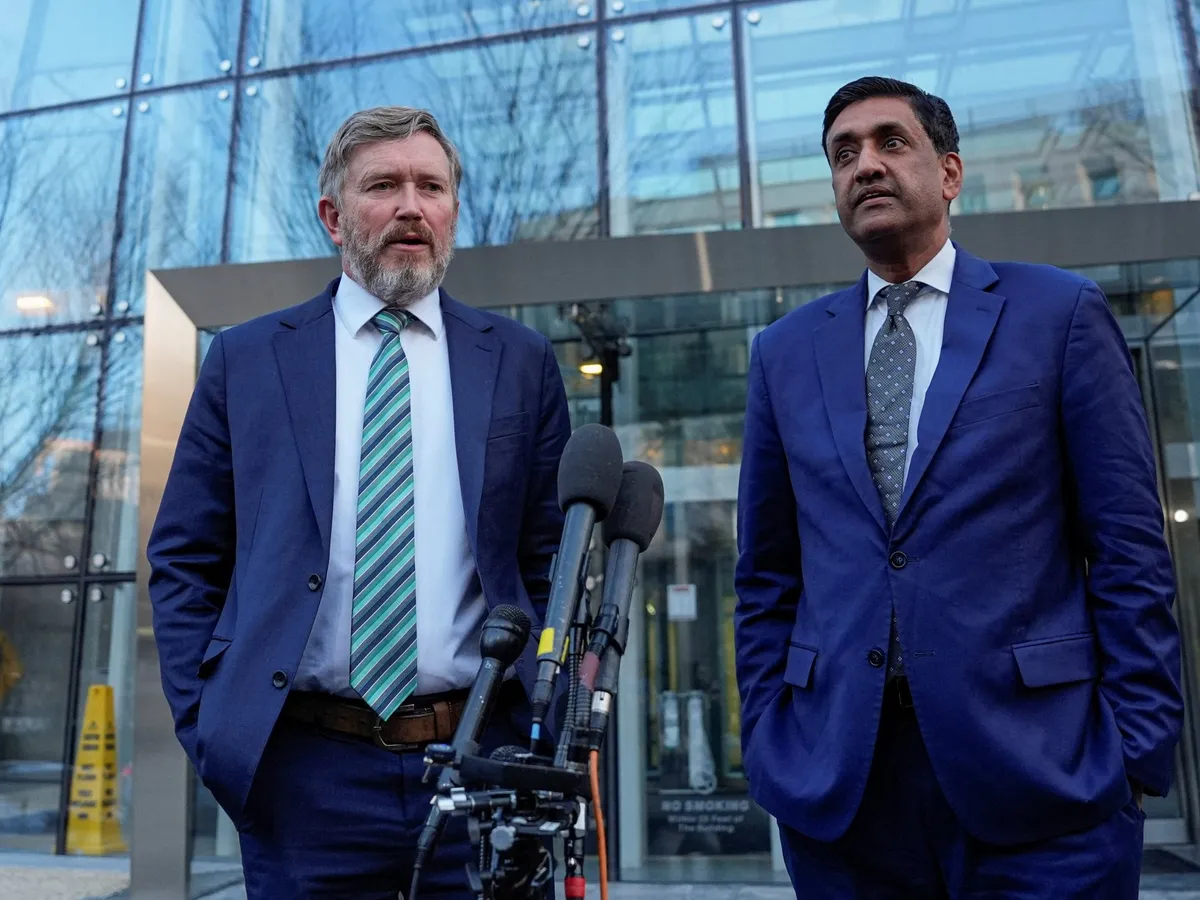
Democrat Ro Khanna and Republican Thomas Massie say they will try to remove the pro-Israel section from US defence bill.Thomas Massie (left) and Ro Khanna after viewing unredacted Jeffrey Epstein files at the Department of Justice in Washington, DC, on February 9 [Kent Nishimura/Reuters]Published On 31 May 2026Two lawmakers in the United States Congress are pushing to repeal a section in an upcoming defence budget that would deepen integration between the US and Israeli militaries.Their effort comes amid outcry against the latest draft of the annual National Defense Authorization Act (NDAA), a bill that sets the budget for the US military.Recommended Stories list of 3 itemslist 1 of 3What are the chances for the Iran-US ‘Declaration of Principles’?list 2 of 3Iran reinstates some internet access but restrictions remain for mostlist 3 of 3Iran restores some gas production at South Pars facilityend of listIt includes a provision, dubbed Section 224, that would boost ties between the two militaries through the appointment of an “executive agent” to oversee joint technological development and coordination.On Sunday, Democratic Congressman Ro Khanna said he would use his seat on the House Armed Services Committee to put forward an amendment to remove Section 224 from the bill.His Republican colleague Thomas Massie also warned that, if the bill is approved by the committee, he would work to oppose it on the floor of the House of Representatives. He framed the issue as a question of US independence from foreign governments.“We are a sovereign country,” Massie wrote on the social media platform X.Khanna responded to Massie’s post, pledging to stand by the Kentucky Republican in opposing Section 224. He also denounced Republican President Donald Trump for attacking Massie, contributing to his primary defeat earlier this month.“Trump can’t kill the Massie/Khanna partnership no matter how much he posts on Truth Social,” Khanna wrote.Massie, a libertarian, and Khanna, a progressive, have formed an unlikely alliance to push forward anti-war measures and scrutinise US-Israeli policy. They also led the campaign to release government files related to the late sex offender Jeffrey Epstein.It is not uncommon for the annual US military budget to be loaded with pro-Israel measures.But the technological integration provision, which comes at a time of increased scepticism towards the US’s unconditional support for Israel, raised questions and protests over the past week.Section 224 “would require the Secretary of Defense to designate an executive agent responsible for synchronising cooperative efforts between the United States and Israel,” the budget bill reads.The executive agent would be in charge of overseeing a range of joint initiatives, “including bilateral defence technology research, development, testing, evaluation, integration, and industrial cooperation”.Critics have expressed concern that the push may make US military aid to Israel less transparent, concealing it as cooperation rather than a separate expense.The measure also risks tethering the US military to its Israeli counterpart technologically at a time when the American public is rapidly turning against Israel, according to recent public opinion polls.For instance, a survey this month from The New York Times and Siena College found that 57 percent of US voters opposed providing Israel with additional economic and military support.Separately, 62 percent said they disapproved of the Israeli-Palestinian conflict. Israel’s genocidal war against Gaza, which started in 2023, has killed more than 75,000 people, prompting widespread condemnation.The US has fielded criticism for its role in backing Israel during that war, as well as its devastating campaign in Lebanon. The role of technology has also come under scrutiny, particularly as Israel becomes more heavily reliant on artificial intelligence (AI) to surveil, identify and strike targets.But some legislators in the US Congress consider questioning US-Israeli ties to be a political third rail. Congressman Derrick Van Orden criticised Massie on Sunday for speaking out against Section 224, accusing his fellow Republican of anti-Semitism.“This security agreement will allow for the US to leverage advanced Israeli technologies,” Van Orden said.Massie responded by pointing to an incident in 2024 when Israel rigged pagers carried by Hezbollah civilian and military members to explode, killing and injuring hundreds of people, including children.“Does this deal qualify us for those advanced Israeli pagers?” Massie asked Van Orden in a social media post.This year’s $1.15 trillion NDAA contains several other proposals to deepen US support for Israel. An entire section is titled, “Matters relating to Israel”.It includes mandating cooperation with the Israeli military on anti-tunnel and anti-drone capabilities.
SRCAl Jazeera
LANGEN
LEANCenter
WORDS724
ENT10
SUN · 2026-05-31 · 18:52 GMTBRIEF NSR-2026-0531-80682
NSR-2026-0531-80682News Report·EN·Political Strategy
US measure to deepen Israel military cooperation faces bipartisan pushback
US Representatives Ro Khanna (Democrat) and Thomas Massie (Republican) are attempting to remove a provision from the upcoming National Defense Authorization Act (NDAA) that would deepen military cooperation between the United States and Israel. Section 224 of the bill proposes appointing an "executive agent" to oversee joint technological development and coordination.
Al Jazeera StaffAl JazeeraFiled 2026-05-31 · 18:52 GMTLean · CenterRead · 3 min
Al JazeeraFIG 01
Reading time
3min
Word count
724words
Sources cited
3cited
Entities identified
10entities
Quality score
100%
§ 01
Briefing Summary
AI-generatedNEWSAR · AI
US Representatives Ro Khanna (Democrat) and Thomas Massie (Republican) are attempting to remove a provision from the upcoming National Defense Authorization Act (NDAA) that would deepen military cooperation between the United States and Israel. Section 224 of the bill proposes appointing an "executive agent" to oversee joint technological development and coordination. Khanna plans to offer an amendment to remove it, while Massie intends to oppose the bill on the House floor, citing concerns about US sovereignty. This pushback comes amid growing public skepticism towards unconditional US support for Israel, with recent polls indicating opposition to further aid. Critics worry the measure could obscure military aid as cooperation and technologically entangle the US military with Israel.
Confidence 0.90Sources 3Claims 5Entities 10
§ 02
Article analysis
Model · rule-basedFraming
Political Strategy
Conflict
Tone
Measured
AI-assessed
CalmNeutralAlarmist
Factuality
0.70 / 1.00
Factual
LowHigh
Sources cited
3
Well sourced
FewMany
§ 03
Key claims
5 extracted01
Ro Khanna pledged to support Thomas Massie in opposing Section 224 and criticized Donald Trump for attacking Massie.
factualRo Khanna
Confidence
1.00
02
Thomas Massie framed the opposition to Section 224 as a matter of US sovereignty, stating, 'We are a sovereign country.'
quoteThomas Massie
Confidence
1.00
03
The section, dubbed Section 224, aims to boost US-Israel military ties through an 'executive agent' for joint technological development and coordination.
factual
Confidence
1.00
04
Two US lawmakers, Ro Khanna (Democrat) and Thomas Massie (Republican), are pushing to remove a section from the US defense bill that deepens military integration with Israel.
factual
Confidence
1.00
05
Critics are concerned that Section 224 could make US military aid to Israel less transparent.
factualCritics
Confidence
0.80
§ 04
Full report
3 min read · 724 words§ 05
Entities
10 identifiedKey playerOppositionContextPositiveNeutralNegative
People4
Organizations2
§ 06
Keywords & salience
10 termsus military cooperation
0.90
defence bill
0.80
israel military
0.80
national defense authorization act
0.70
us-israeli policy
0.70
bipartisan pushback
0.60
technological development
0.50
ro khanna
0.40
thomas massie
0.40
sovereign country
0.40
§ 07
Topic connections
Interactive graph Network visualization showing 8 related topics
View Full Graph Person Organization Location Event|Click node to navigate|Edge numbers = shared articles