Myanmar opposition groups criticise India for hosting Min Aung Hlaing, but India says engagement is the best way forward.India's Prime Minister Narendra Modi (right) shakes hands with Myanmar's President Min Aung Hlaing before their meeting at the Hyderabad House in New Delhi on June 1, 2026 [AFP]Published On 1 Jun 2026India says it will continue engaging with Myanmar after Prime Minister Narendra Modi spoke with Min Aung Hlaing, the leader of the country’s military government, in New Delhi.Indian Foreign Secretary Vikram Misri told reporters on Monday that India’s policy is “not intended to be a commentary on the internal political arrangements” in Myanmar and that New Delhi believes engagement is the best way forward.Recommended Stories list of 3 itemslist 1 of 3Myanmar’s military government rebuffed on peace talks offerlist 2 of 3Myanmar’s former leader Aung San Suu Kyi moved to house arrestlist 3 of 3At least 39 killed in explosives depot blast in northeast Myanmarend of listWestern nations have sought to isolate Myanmar’s military rulers since they overthrew the elected government of Aung San Suu Kyi in a 2021 Coup that triggered a crackdown on opponents and a brutal civil war.The conflict began when the country’s army leader, Min Aung Hlaing, ousted the government and detained civilian leaders, including Nobel Peace Prize laureate Aung San Suu Kyi.Some critics and human rights groups have said Min Aung Hlaing’s visit to India risks lending legitimacy to the military-backed government.“We have always proceeded on the principle that sustained dialogue is what is important,” Misri said, adding that isolating Myanmar would be counterproductive.“History has shown that disengagement doesn’t give us any results that are better than engagement.”The visit is Min Aung Hlaing’s first to India since he was sworn in as president in April following an election that critics say was designed to cement his hold on power. His last visit to India was in 2019, when he served as Myanmar’s military chief.He arrived in India on Saturday, first in the eastern state of Bihar, with a visit to the Buddhist pilgrimage site of Bodh Gaya, where believers say that the Buddha attained enlightenment.India shares a 1,643-kilometre (1,020-mile) border with Myanmar and a maritime boundary in the Bay of Bengal.Narendra Modi (right) with Min Aung Hlaing (left) prior to their meeting at Hyderabad House in New Delhi [Rajat Gupta/EPA]Strategic partnershipMyanmar is also strategically important to India’s security interests. The two countries have cooperated on border security and intelligence sharing to combat armed rebel groups.Modi and Min Aung Hlaing did not address the media after their meeting, as usually occurs after most bilateral talks involving visiting heads of state or government in New Delhi.But Misri said the two leaders discussed trade, defence and security cooperation, border management, and regional issues, with talks also focusing on expanding economic and technology ties. He said both sides agreed to deepen collaboration across sectors, including trade, energy and critical minerals, and to accelerate major connectivity projects.Min Aung Hlaing is expected to hold talks with business representatives during his five-day visit, and will travel to the financial hub, Mumbai.Bilateral trade was $1.95bn in 2025-2026, according to New Delhi.The leaders also discussed cooperation against cybercrime and human trafficking, issues that have affected thousands of Indians lured to scam centres in the region.Misri said India and Myanmar have worked together to rescue more than 2,400 Indian nationals over the past 18 months.Resistance groups formed after the 2021 Coup have captured swaths of Myanmar. Others sought out and fought under the leadership of ethnic armies in exchange for training and weapons with which to fight the military.These resistance groups, known as the People’s Defence Force (PDF), nominally operate under the leadership of the National Unity Government (NUG), a shadow government formed by Myanmar lawmakers removed by the military coup.Zin Mar Aung, the foreign minister of the NUG, wrote a letter to Subrahmanyam Jaishankar, the minister of external affairs for India, on May 28, expressing concern about the visit.“Since the military coup of 2021, which overturned the democratic will of the people, Myanmar has endured prolonged conflict, instability, and immense humanitarian suffering,” she said.“India has long championed democratic governance, the rule of law, and regional stability. We therefore urge the Government of India to weigh carefully the broader implications of formal engagement that may normalise or legitimise military rule in Myanmar.”
SRCAl Jazeera
LANGEN
LEANCenter
WORDS717
ENT12
MON · 2026-06-01 · 14:45 GMTBRIEF NSR-2026-0601-80872
NSR-2026-0601-80872News Report·EN·Diplomatic
Indian PM Modi meets Myanmar military gov’t leader in New Delhi
Indian Prime Minister Narendra Modi met with Myanmar's military government leader, Min Aung Hlaing, in New Delhi on June 1, 2026. India stated its policy of engagement is the best way forward, despite criticism from Myanmar opposition groups who believe the visit risks legitimizing the military regime.
By AFP and APAl JazeeraFiled 2026-06-01 · 14:45 GMTLean · CenterRead · 3 min
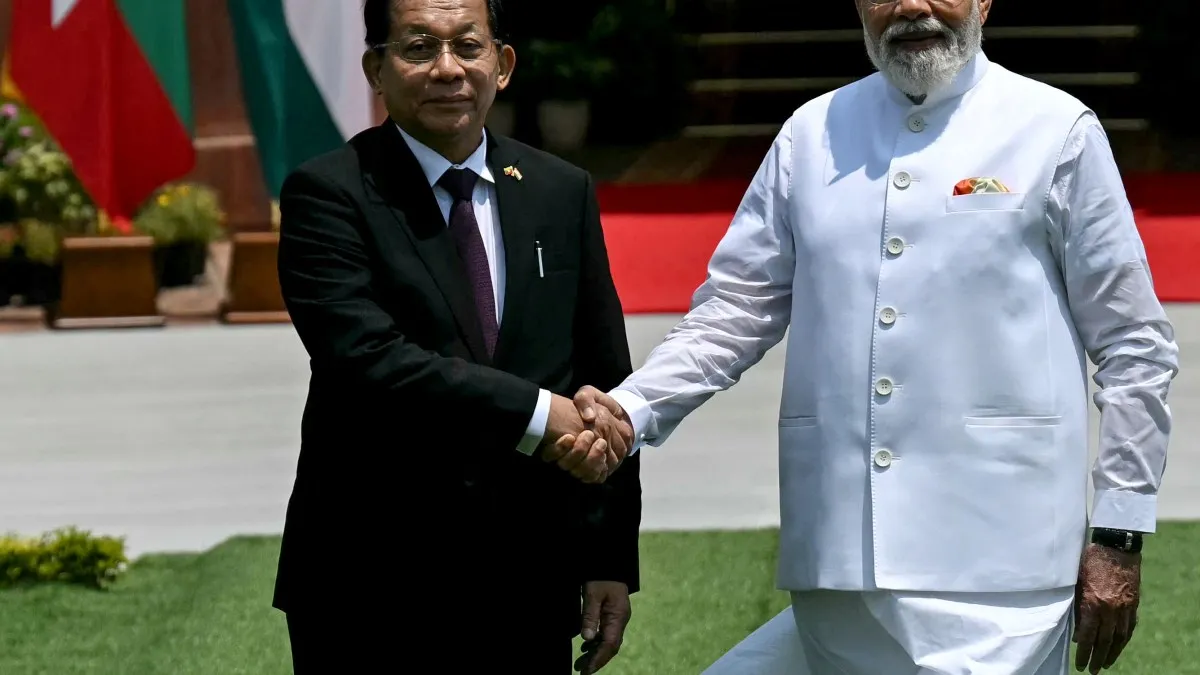
Al JazeeraFIG 01
Reading time
3min
Word count
717words
Sources cited
2cited
Entities identified
12entities
Quality score
100%
§ 01
Briefing Summary
AI-generatedNEWSAR · AI
Indian Prime Minister Narendra Modi met with Myanmar's military government leader, Min Aung Hlaing, in New Delhi on June 1, 2026. India stated its policy of engagement is the best way forward, despite criticism from Myanmar opposition groups who believe the visit risks legitimizing the military regime. The two leaders discussed trade, defense, security cooperation, border management, and regional issues, aiming to deepen collaboration in sectors like energy and critical minerals. This meeting marks Min Aung Hlaing's first visit to India since the 2021 coup. India views Myanmar as strategically important for its security interests and has cooperated on border security and intelligence sharing.
Confidence 0.90Sources 2Claims 5Entities 12
§ 02
Article analysis
Model · rule-basedFraming
Diplomatic
National Security
Tone
Measured
AI-assessed
CalmNeutralAlarmist
Factuality
0.70 / 1.00
Factual
LowHigh
Sources cited
2
Limited
FewMany
§ 03
Key claims
5 extracted01
Western nations have sought to isolate Myanmar's military rulers since the 2021 coup.
factual
Confidence
1.00
02
India believes engagement with Myanmar's military government is the best way forward.
quoteVikram Misri (Indian Foreign Secretary)
Confidence
1.00
03
India's Prime Minister Narendra Modi met with Myanmar's military government leader Min Aung Hlaing in New Delhi.
factual
Confidence
1.00
04
Modi and Min Aung Hlaing discussed trade, defence and security cooperation, border management, and regional issues.
factualVikram Misri (Indian Foreign Secretary)
Confidence
0.90
05
Critics say Min Aung Hlaing's visit risks lending legitimacy to the military-backed government.
quoteCritics and human rights groups
Confidence
0.90
§ 04
Full report
3 min read · 717 words§ 05
Entities
12 identifiedKey playerOppositionContextPositiveNeutralNegative
People4
Organizations1
Locations6
Events1
§ 06
Keywords & salience
10 termsindia-myanmar relations
1.00
myanmar military government
1.00
engagement policy
0.90
min aung hlaing
0.90
narendra modi
0.80
2021 coup
0.70
civil war
0.60
aung san suu kyi
0.50
human rights groups
0.40
strategic partnership
0.40
§ 07
Topic connections
Interactive graph Network visualization showing 17 related topics
View Full Graph Person Organization Location Event|Click node to navigate|Edge numbers = shared articles