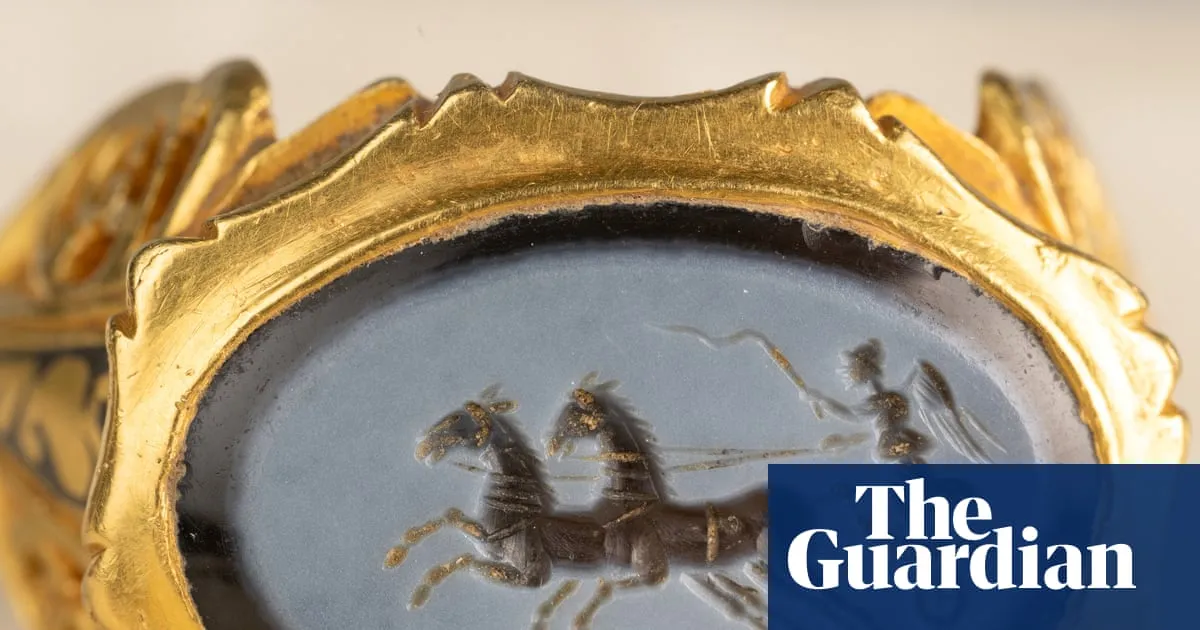
When Kevin Minto, a lorry driver, former soldier and keen metal detectorist, came upon something glinting in a Somerset field, he thought at first it was a coin – potentially quite interesting, probably not amazing.But the object turned out to be extraordinary: a gold Roman ring, unusually large and exquisitely crafted, set with a finely engraved gemstone depicting the goddess Victoria driving a two-horse chariot.“It’s hard to explain what if feels like when you find something like that,” Minto said. “It was like being hit by an express train. At first I thought it was a coin, then a brooch, and then realised it was a ring. You’re a little dumbfounded, really. One of the boys I was with was screaming: ‘We’re rich, we’re rich.’”On Tuesday the South West Heritage Trust announced it had acquired the ring, along with a hoard of 297 Roman coins also found at the site near Ilminster, for £78,000, meaning they will remain in Somerset.Minto took up detecting as a way to keep fit. Photograph: Kevin Minto“I’m chuffed it’s staying,” said Minto, 68, who settled in Wiltshire after leaving the army and took up detecting as a way of keeping fit. “That seems right to me, somehow.”He said the landowner got half of the money. Minto split his half with a metal detecting friend he worked with on the find. He was able to pay his mortgage off and has cut down his lorry driving to four days a week. He may go to three next year.Minto first found Roman coins at the site in 2017. He kept returning and finding more coins scattered over a wide area, probably by ploughs. “The coins were all over the place,” he said.On another occasion he found a lead-lined coffin. Then in 2018, the ring was discovered. “The money was only paid out a couple of months ago, so it’s taken a long time,” he said.There was a complication, too, because the ring was found on the day of a military veterans’ detecting rally – and there was a dispute about who was entitled to the proceeds. “I’m glad it’s all finished now,” he said.Dating to around AD297, the ring weighs 48 grams. South West Heritage Trust, a charity committed to protecting and celebrating Somerset and Devon’s heritage, said it was rare in scale and artistry, and described it as an “unparalleled discovery for Britain”.Amal Khreisheh, senior curator at the trust, said: “The Ilminster ring is both large and heavy, with elaborate gold work and a beautifully executed intaglio [a technique in which a design is engraved into the surface of a gemstone]. While other examples are known, these elements combine to create a spectacular ring that is only paralleled by continental discoveries.”Khreisheh said the ring might have been worn by its owner on important occasions, or could have had a ceremonial function. She said there was a contrast between the simple elegance of the gemstone design and the “extravagant” amount of gold used.‘Things like this don’t come along very often,’ said Amal Khreisheh. Photograph: South West Heritage TrustThe gold has not needed cleaning, and flecks of red soil can still be seen in the gemstone. More analysis of the ring may be carried out to try to find out if it was made in Britain or elsewhere.Khreisheh said the find helped shed light on how south Somerset’s Roman inhabitants navigated a period of unrest from 286-296. “It is likely the ring was buried shortly after, in 297, as part of a hoard including coins, lead and pottery objects.”Khreisheh said there had been a number of wealthy Romans in the Ilminster area at the time, and also important trade routes. “Perhaps the ring belonged to a governor, merchant or big landowner.” More work may be carried out to try to establish if the coffin is linked to the ring.“Usually archaeologists handle broken things – such as pieces of pottery or animal bones. Things like this don’t come along very often,” Khreisheh said.The ring is now off on its travels. It is being taken on a tour of primary schools this month, and an “Ilminster ring discovery day” will take place at the town’s art centre in August. It will be given a permanent home at the Museum of Somerset in Taunton.Meanwhile Minto continues to return to the field, hoping other treasures may lurk there.
SRCThe Guardian - World News
LANGEN
LEANCenter-Left
WORDS726
ENT9
TUE · 2026-06-02 · 06:00 GMTBRIEF NSR-2026-0602-81063
NSR-2026-0602-81063News Report·EN·Human Interest
Somerset detectorist strikes gold with ‘spectacular’ Roman ring find
Metal detectorist Kevin Minto discovered a large, exquisitely crafted gold Roman ring near Ilminster, Somerset, dating to around AD 297. The ring features a gemstone engraved with the goddess Victoria in a chariot.
Steven MorrisThe Guardian - World NewsFiled 2026-06-02 · 06:00 GMTLean · Center-LeftRead · 3 min
The Guardian - World NewsFIG 01
Reading time
3min
Word count
726words
Sources cited
2cited
Entities identified
9entities
Quality score
100%
§ 01
Briefing Summary
AI-generatedNEWSAR · AI
Metal detectorist Kevin Minto discovered a large, exquisitely crafted gold Roman ring near Ilminster, Somerset, dating to around AD 297. The ring features a gemstone engraved with the goddess Victoria in a chariot. The South West Heritage Trust acquired the ring, along with 297 Roman coins found at the same site, for £78,000, ensuring they will remain in Somerset. Minto, who found the ring in 2018 after initially discovering Roman coins in 2017, will share the proceeds with the landowner and a friend. The trust describes the ring as a spectacular and unparalleled discovery for Britain, potentially belonging to a wealthy Roman inhabitant. The ring will be displayed at the Museum of Somerset after touring local schools.
Confidence 0.90Sources 2Claims 5Entities 9
§ 02
Article analysis
Model · rule-basedFraming
Human Interest
Economic Impact
Tone
Mixed Tone
AI-assessed
CalmNeutralAlarmist
Factuality
0.80 / 1.00
Factual
LowHigh
Sources cited
2
Limited
FewMany
§ 03
Key claims
5 extracted01
The ring is paralleled only by continental discoveries in its combination of size, weight, elaborate gold work, and executed intaglio.
factualAmal Khreisheh
Confidence
1.00
02
Kevin Minto used his share of the acquisition money to pay off his mortgage and reduce his working hours.
factualKevin Minto
Confidence
1.00
03
The ring, dating to around AD297, weighs 48 grams and is described as rare in scale and artistry, an 'unparalleled discovery for Britain'.
factualSouth West Heritage Trust
Confidence
1.00
04
The South West Heritage Trust acquired the ring and 297 Roman coins for £78,000, ensuring they remain in Somerset.
factualSouth West Heritage Trust
Confidence
1.00
05
A gold Roman ring, unusually large and exquisitely crafted, set with a finely engraved gemstone depicting the goddess Victoria driving a two-horse chariot was found by Kevin Minto.
factualKevin Minto
Confidence
1.00
§ 04
Full report
3 min read · 726 words§ 05
Entities
9 identifiedKey playerOppositionContextPositiveNeutralNegative
Organizations1
§ 06
Keywords & salience
9 termsroman ring
1.00
metal detectorist
0.90
somerset
0.80
south west heritage trust
0.70
archaeological find
0.60
roman coins
0.60
gemstone
0.50
ilminster
0.40
gold work
0.40
§ 07
Topic connections
Interactive graph No topic relationship data available yet. This graph will appear once topic relationships have been computed.