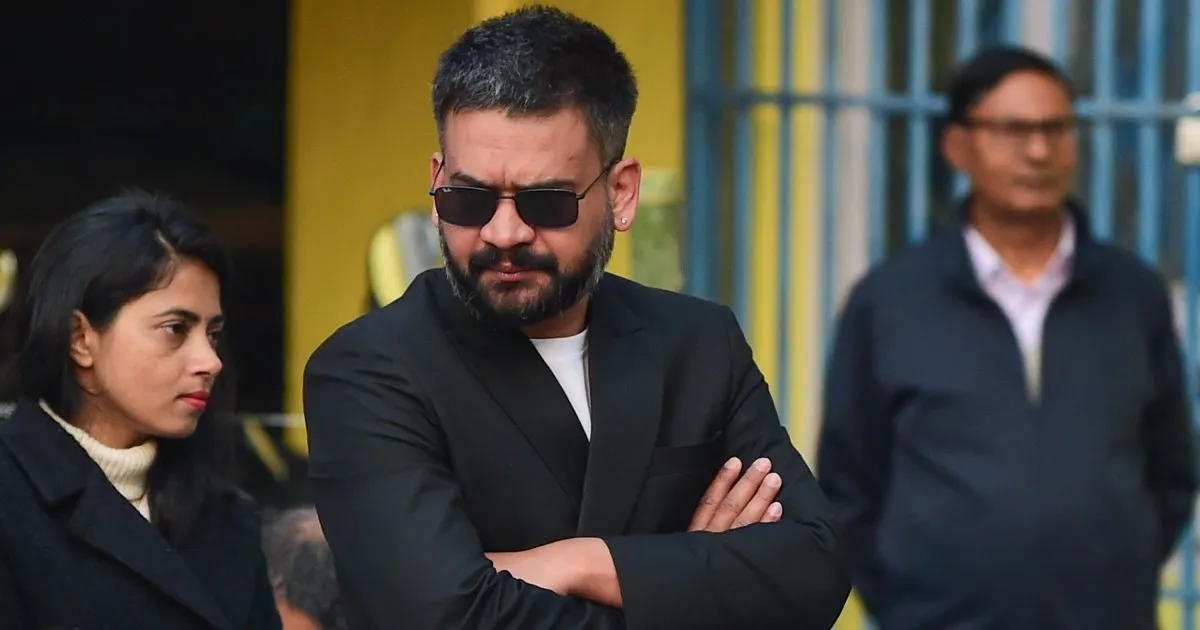
EXPLAINERBalendra Shah’s recent comments about Nepal encroaching on Indian territory have revived a 200-year-old border dispute.Balendra Shah, leader of Nepal's Rastriya Swatantra Party (RSP), is a rapper-turned-Kathmandu mayor-turned-prime minister [File: Ritesh Shukla/Getty Images]Published On 2 Jun 2026Nepal’s Prime Minister Balendra Shah has reignited a border dispute with India after claiming in parliament that Nepal has also encroached on Indian territory – a departure from Nepal’s usual stance, which has largely focused on accusing its bigger neighbour of occupying its land.Speaking on Sunday in his first formal address to the Nepal" class="entity-link entity-organization" data-entity-id="139041" data-entity-type="organization">Federal Parliament of Nepal since becoming the country’s youngest prime minister earlier this year, Shah, 35, sparked anger among Nepali lawmakers with his comments.The long-running dispute between Nepal and India over border territories including Limpiyadhura, Lipulekh and Kalapani has periodically bubbled up over the years. The conflict is a mix of contested history, geography, politics and mapping.Here is what Shah said, what the border dispute is about, and what this means.What did Shah say about Kalapani-Lipulekh?“You will be surprised to know a fact that I have learned recently, only after becoming prime minister: not only has India encroached Nepali territory, but Nepal has also encroached Indian territory in many places,” Shah said during his address to parliament.He did not elaborate on which parts of India he believed Nepal had encroached on.“Now both countries should study the facts and sit together as friends and resolve the issue,” the Nepali leader added.Shah was sworn in as the PM of Nepal on March 27 this year. He was previously the mayor of Kathmandu, winning the seat in 2022 as an independent candidate. He was a controversial figure, launching a crackdown on street vendors that drew criticism from civil society leaders. Before this, he was a musician who used his work to highlight corruption and inequality.Shah joined the Rastriya Swatantra Party (RSP) in December 2025, shortly after youth protests deposed the previous government, leading to the resignation of Prime Minister Khadga Prasad Sharma Oli in September 2025.The party, barely four years old, was founded by former journalist Rabi Lamichhane, who is currently a lawmaker in the Nepali parliament. Lamichhane arrived in the Indian capital of New Delhi on Monday for a five-day visit that will include high-level political and diplomatic talks with Indian PM Narendra Modi’s Bharatiya Janata Party (BJP).Shah added that Nepali lawmakers have reached out to China and the United Kingdom regarding the territorial dispute, the latter due to its colonial legacy in the Indian subcontinent.In using British help, Shah “is not seeking the UK’s mediation on this issue – rather assistance with regards to various original survey maps as early as 1827 and 1834, which would strengthen our position when negotiating with India”, Nishchal Pandey, the director of the Kathmandu-based Centre for South Asian Studies, told Al Jazeera.Lok Raj Baral, a former Nepali diplomat, told Al Jazeera back in 2020 that the country had historically lacked maps of its own, and so “depended on maps published by British India”.What is the Kalapani-Lipulekh conflict about?India and Nepal share a 1,800km (1,118-mile) open border – Indians and Nepalis do not need visas to cross over. One stretch of that border, in the far west, is disputed: the area spanning Limpiyadhura, Lipulekh and Kalapani.The conflict dates back to the 1816 Sugauli Treaty, which Nepal entered with British colonial rulers to define its western border with India.“Nepal is the oldest sovereign nation state of South Asia and never had any war with India, rather with the British,” Pandey said.“The Treaty of Sugauli of 1816, which was signed after the Anglo-Nepalese War, depicts that Nepal cedes territory ‘west of the Kali river’ but does not define where the river Kali originates from. The treaty also did not have any map attached,” Pandey said.He explained that this cartographic omission has led to various arguments in favour and against the territory of Limpiyadhura, Lipulekh and Kalapani belonging to Nepal.India pushes back against Nepali claims over the territory, citing revenue records dating back to the 1830s from India’s Uttarakhand state that suggest that the region was historically administered by what is today India.Indian troops have been deployed in Kalapani since New Delhi fought a war with Beijing in 1962. Sandwiched between India and China, Nepal chose to stay silent back then and remain neutral during the conflict between its giant neighbours.But it has since claimed that the Kali river – the demarcation line for the boundary between India and Nepal – originates in Limpiyadhura, while New Delhi asserts that the river, which acts as the boundary, emerged from Lipulekh. Nepal says the river that India considers to be the border is a tributary of the main river mentioned in the 1816 treaty.The disputed land falls between the two rivers.(Al Jazeera)When else has the conflict come to the forefront recently?Last month, New Delhi announced the resumption of a religious pilgrimage through the contested Lipulekh Pass. It was suspended in 2020 due to the COVID-19 pandemic.Nepal’s Ministry of Foreign Affairs stressed that the territories of Limpiyadhura, Lipulekh and Kalapani are part of Nepal, “a position on which the government remains clear and firm”.India’s Ministry of External Affairs responded by asserting that Lipulekh has been used by Hindus, Buddhists, Jains and Bon followers for the pilgrimage to Mount Kailash and Lake Manasarovar in Tibet since 1954.“This is not a new development,” a spokesman said. “India has consistently maintained that such claims are neither justified nor based on historical facts and evidence. Such unilateral artificial enlargement of territorial claims is untenable.”In May 2020, India inaugurated an 80km (50-mile) Lipulekh road to serve as the shortest route between the capital New Delhi and Kailash-Mansarovar, a revered pilgrimage site in the Tibetan Plateau. Nepal protested against India’s inauguration of the Himalayan link road.“The Government of Nepal has learnt with regret about the ‘inauguration’ yesterday by India of ‘Link Road’ connecting to Lipulekh (Nepal), which passes through Nepali territory,” Nepal’s Ministry of Foreign Affairs said in a statement back then.Is this the same Shah who unveiled a ‘Greater Nepal’ map?Nepal’s PM Balendra Shah has, in the past, backed the idea of a “Greater Nepal” – with parts of present-day India included.In 2023, after India installed a mural of “Akhand Bharat” (a Greater India) in the Parliament of India – encompassing many of its neighbours – Shah hung a “Greater Nepal” map in his office, including territories that once belonged to Nepal but now lie within India’s borders.Neither map is a political map with clearly demarcated present‑day borders and labels like Lipulekh or Kalapani. Instead, both the Akhand Bharat mural and the Greater Nepal map appeal to maximalist historical visions of territory. It is unclear where Lipulekh and Kalpani were on these two maps.In June 2023, as mayor of Kathmandu, Shah ordered cinemas in the capital to stop screening Hindi films. Screenings resumed later that month after a high court, acting on a petition from the Nepal Motion Picture Association, issued an interim order telling authorities not to halt Hindi movie screenings.Basana Thapa, a parliamentarian representing the opposition Nepali Congress party, demanded clarification on Shah’s comments, the Nepali leading daily, Kantipur, reported on Sunday.According to the report, Thapa said: “If the prime minister’s statement about the border of the two countries without facts is not correct, I would like to demand that it be removed from the record.”Ramesh Kumar Malla, a parliamentarian representing the Nepali Communist Party (NCP) – also in opposition – described Shah’s comments as “a derogatory statement about the country’s national integrity”, Kantipur reported.Nepal’s former ambassador to India, Nilambar Acharya, told Kantipur that Nepal has not encroached on Indian land, contrary to what Shah had claimed.“No land of India has been encroached on by the Nepali state. It is not as the prime minister said,” Acharya was quoted as saying.On Sunday, Nepal’s Ministry of Foreign Affairs released a response to Shah’s comments.The ministry statement said that both Nepal and India “have expressed their commitment to resolving border‑related disputes through diplomatic channels and mutual dialogue” pertaining to the Lipulekh Pass.“The government’s willingness to engage with India on the boundary dispute is neither new nor surprising,” Anurag Acharya, a former journalist and Kathmandu-based political analyst, told Al Jazeera.Acharya explained that previous governments in Nepal have also attempted it, with the Oli government and India agreeing to establish a joint Eminent Persons Group (EPG) in 2016 to comprehensively review Nepal-India relations and suggest ways to resolve all outstanding bilateral issues.“However, the exercise was haunted by the same trust deficit that it set out to address,” Acharya said.Nepal’s Foreign Ministry said that Shah had meant that there might be technical, local mismatches between legal borders and actual land usage or “cross‑border occupation”. For example, Nepali citizens could be farming or living on land that, legally, is on the Indian side of the old boundary line, and vice versa.“To manage the long border between Nepal and India in an orderly and scientific manner, the boundary‑related mechanisms and technical teams of the two countries are active in areas where mapping has been completed,” the ministry’s statement said.“The prime minister’s ‘off-the-cuff’ remarks on a diplomatically sensitive issue, inside the parliament, will have serious consequences for Nepal in its bilateral negotiations with India as we negotiate on contentious border disputes,” Acharya, the Kathmandu-based political analyst, said.“I think it will be a baggage that Nepali negotiators will have to carry, if and when they sit to discuss this tricky issue.”
SRCAl Jazeera
LANGEN
LEANCenter
WORDS1 566
ENT12
TUE · 2026-06-02 · 14:36 GMTBRIEF NSR-2026-0602-81178
NSR-2026-0602-81178News Report·EN·Conflict
‘Encroached territory’: Why India-Nepal border dispute is heating up again
Nepal's Prime Minister Balendra Shah has reignited a 200-year-old border dispute with India by stating that Nepal has also encroached on Indian territory, a departure from Nepal's usual stance. This claim, made in a recent parliamentary address, has sparked anger among Nepali lawmakers.
Sarah ShamimAl JazeeraFiled 2026-06-02 · 14:36 GMTLean · CenterRead · 7 min
Al JazeeraFIG 01
Reading time
7min
Word count
1 566words
Sources cited
2cited
Entities identified
12entities
Quality score
100%
§ 01
Briefing Summary
AI-generatedNEWSAR · AI
Nepal's Prime Minister Balendra Shah has reignited a 200-year-old border dispute with India by stating that Nepal has also encroached on Indian territory, a departure from Nepal's usual stance. This claim, made in a recent parliamentary address, has sparked anger among Nepali lawmakers. The long-standing conflict centers on territories including Limpiyadhura, Lipulekh, and Kalapani, stemming from the 1816 Sugauli Treaty which defined Nepal's western border with British India but lacked a clear map of the Kali river's origin. India claims historical administrative records and revenue data support its claims, while Nepal argues the Kali river, the demarcation line, originates in Limpiyadhura. Shah has indicated Nepal is seeking assistance from the United Kingdom for historical survey maps to aid negotiations with India.
Confidence 0.90Sources 2Claims 5Entities 12
§ 02
Article analysis
Model · rule-basedFraming
Conflict
Diplomatic
Tone
Mixed Tone
AI-assessed
CalmNeutralAlarmist
Factuality
0.70 / 1.00
Factual
LowHigh
Sources cited
2
Limited
FewMany
§ 03
Key claims
5 extracted01
Nepali lawmakers have reached out to China and the United Kingdom regarding the territorial dispute.
quoteBalendra Shah
Confidence
1.00
02
Balendra Shah joined the Rastriya Swatantra Party (RSP) in December 2025.
factual
Confidence
1.00
03
The border dispute between Nepal and India involves territories including Limpiyadhura, Lipulekh, and Kalapani.
factual
Confidence
1.00
04
Nepal's Prime Minister Balendra Shah claimed in parliament that Nepal has also encroached on Indian territory.
quoteBalendra Shah
Confidence
1.00
05
Nepal is seeking assistance from the UK regarding original survey maps from 1827 and 1834 to strengthen its negotiating position with India.
factualNishchal Pandey
Confidence
0.90
§ 04
Full report
7 min read · 1 566 words§ 05
Entities
12 identifiedKey playerOppositionContextPositiveNeutralNegative
People3
Organizations2
Locations6
§ 06
Keywords & salience
7 termsindia-nepal border dispute
1.00
territorial claims
0.90
balendra shah
0.80
kalapani-lipulekh
0.70
nepal politics
0.60
diplomatic talks
0.50
historical dispute
0.40
§ 07
Topic connections
Interactive graph Network visualization showing 8 related topics
View Full Graph Person Organization Location Event|Click node to navigate|Edge numbers = shared articles