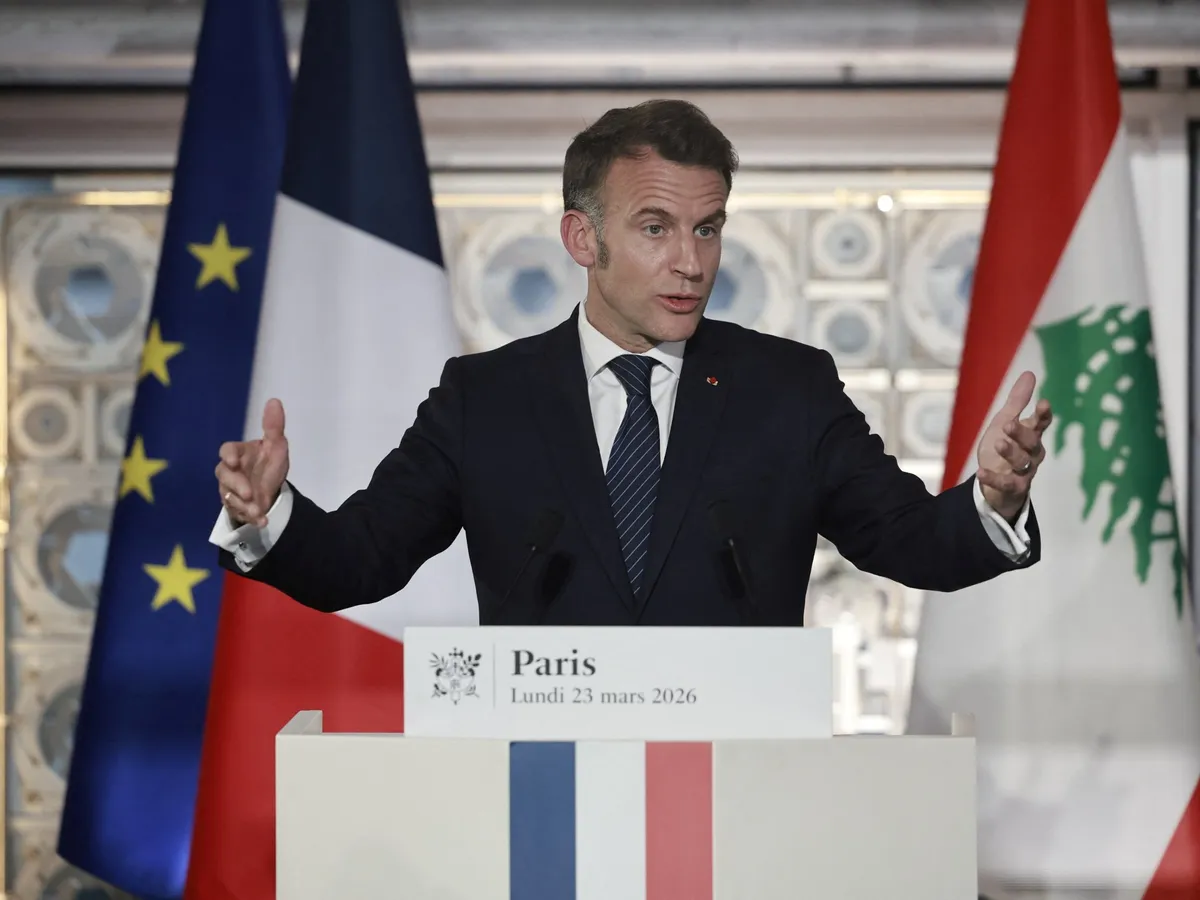
EXPLAINERAnalysts say France is hoping to reassert its diminishing influence in the region.French President Emmanuel Macron speaks at the Arab World Institute in Paris, France, on March 23, 2026 [Christophe Petit Tesson/Reuters]Published On 3 Jun 2026Jean-Yves Le Drian, France’s special envoy for Lebanon, is to arrive in Beirut on Wednesday as Paris seeks to restore its flagging diplomatic role in the country, experts say.When the former French foreign minister meets President Joseph Aoun, Parliament Speaker Nabih Berri and Prime Minister Nawaf Salam, talks are expected to focus on continued aid for communities badly affected by Lebanon’s economic collapse, Israel’s invasion and occupation of one-fifth of the country, and the future of the Lebanon" class="entity-link entity-organization" data-entity-id="139659" data-entity-type="organization">United Nations peacekeeping force in southern Lebanon, which France is deeply involved in and whose mandate is due to end this year.Recommended Stories list of 4 itemslist 1 of 4Turkish Riviera: The land of lightlist 2 of 4Can a US president promote stock they’ve invested inlist 3 of 4Iranian drone attack kills one in Kuwait after US strikes Qeshm Islandlist 4 of 4Photos: Foreign nationals among 21 dead in New Delhi building fireend of listIsrael renewed heavy strikes and its occupation of southern Lebanon in early March after Iran-backed Hezbollah began firing rockets into northern Israel in retaliation for the killing of Iranian Supreme Leader Ali Khamenei in US-Israeli strikes on Tehran. Despite Israel and Lebanon agreeing to a United States-brokered cessation of hostilities on April 16, daily attacks have continued in Lebanon. More than 3,000 people have been killed, and more than one million have been forced from their homes.On Monday when US President Donald Trump reportedly intervened to prevent imminent Israeli attacks on Beirut’s southern suburbs, French President Emmanuel Macron spoke by phone with Trump – a sign that Paris is still seeking a role in shaping diplomatic efforts.But analysts said France is also wary of US overreach in Lebanon and is looking to reassert itself in a country in which its colonial legacy and political interests have long given it a strategic foothold in the Middle East. With its influence diminishing, particularly as the future of the UN Interim Force in Lebanon (UNIFIL) becomes uncertain, Paris is searching for ways to preserve its influence in Lebanon.Here is what we know:What are France’s ties to Lebanon?France’s ties to Lebanon date back centuries. Their colonial relationship was rooted in cultural and political alliances with Lebanon’s Christian communities.The French Mandate from 1920 to 1943 defined Lebanon’s borders, introduced constitutional governance and entrenched French cultural influence in the Mediterranean country. Even after independence, Beirut remained a Francophone hub, earning the nickname “Paris of the Middle East”. French is still spoken by many Lebanese, particularly in Christian communities.After the catastrophic Beirut port explosion in 2020, France showed its influence. Macron immediately visited the devastated capital and provided a major aid package, showing France’s desire to position itself as Lebanon’s most engaged European partner.But like many former colonial powers, France’s interest in Lebanon is also strategic. “From Paris’s perspective, Lebanon constitutes a strategic foothold” that allows France to maintain influence across the Arab Mashreq and eastern Mediterranean while playing a role in issues ranging from Syria and migration to energy and Euro-Arab relations, Lebanese journalist and analyst Souhayb Jawhar told Al Jazeera.That interest is also tied to preserving French influence. According to Jawhar, France seeks to prevent the collapse of Lebanese state institutions, including the army, public administration and central bank, fearing a vacuum that could be filled by rival regional or international powers.French interests are also economic with TotalEnergies involved in gas exploration in Lebanese waters while shipping giant CMA CGM sees the Port of Beirut as part of a broader French logistical network stretching across the Mediterranean.But France’s role remains contentious. Some factions aligned with Hezbollah and Iran view Paris’s involvement with suspicion, seeing it as an extension of Western influence in Lebanon rather than a neutral diplomatic actor.Is France being edged out of Lebanon by the US?Karim Safieddine, a nonresident fellow at the Tahrir Institute for Middle East Policy, said Paris is watching closely for any “US overreach”, which remains a “concern for France”. France, he added, is “always cautious” about confrontation in Lebanon that could damage its ties to the region, particularly during the era of Trump, who has shown a distaste for the traditional norms of diplomacy and international law.“So generally speaking, they [France] don’t like taking radical approaches to policy in Lebanon and prefer more conventional, status quo-maintaining approaches,” Safieddine said.But the expanding US role in Lebanon has become increasingly visible with Washington no longer merely mediating negotiations between Lebanon and Israel. In a rare move, US Secretary of State Marco Rubio personally intervened to counter calls by Hezbollah leader Naim Qassem to bring down Salam’s government.Trump also claimed to have talked with Hezbollah representatives this week. Although it is unclear whether this was via intermediaries, it is still an unprecedented step for a US president given Washington’s designation of Hezbollah as a “terrorist organisation”.Amid this flurry of US activity in Lebanon, France has found itself increasingly sidelined, particularly since a previous US-brokered ceasefire between Lebanon and Israel in November 2024 and as Israel has actively sought to limit Paris’s role, favouring US mediation instead.That 2024 ceasefire, which was meant to end more than a year of fighting between Israel and Hezbollah, clearly stipulates that the US will sponsor negotiations between Lebanon and Israel, further formalising Washington’s lead role. Despite the agreement, Israel continued carrying out strikes inside Lebanon, with the UN documenting more than 10,000 ceasefire violations during this so-called ceasefire.Khalil Helou, a geopolitical analyst and lecturer, explained that while France still has normal diplomatic relations with Israel, those relations have deteriorated over the Israeli wars on Gaza and southern Lebanon. While France remains involved diplomatically, it no longer plays the central role it once did during Lebanese crises.“Pragmatically, France has no leverage over Israel to push for a ceasefire,” he said.Another example of expanding US influence came on Monday when Trump reportedly managed to prevent imminent Israeli attacks on Beirut’s southern suburbs following open Israeli threats.Jawhar said there is “genuine French concern regarding the decline of its influence in Lebanon over recent years”.“French decision-makers recognise that most major initiatives related to Lebanon’s future now pass through Washington or influential Gulf capitals while the French role has become closer to that of a partner than that of a leader,” he told Al Jazeera.“For this reason, Paris continuously seeks to reaffirm its position in any future settlement, not by confronting the United States, but by presenting itself as an indispensable channel of communication with the Lebanese, Europeans and international institutions.“It can be said that France is not seeking to compete with Washington as much as it is seeking to prevent its complete marginalisation within the Lebanese file.”How will France seek to maintain influence in Lebanon?One way is through humanitarian assistance. On May 11, the French Ministry for Europe and Foreign Affairs said it had provided 17 million euros ($19.8m) “to meet the needs of the displaced civilian population”.But analysts said one of France’s most important remaining sources of leverage in Lebanon is the UNIFIL peacekeeping mission.
SRCAl Jazeera
LANGEN
LEANCenter
WORDS1 191
ENT12
WED · 2026-06-03 · 13:09 GMTBRIEF NSR-2026-0603-81444
NSR-2026-0603-81444Analysis·EN·Political Strategy
Why is France so invested in the future of Lebanon?
France is actively seeking to reassert its diplomatic influence in Lebanon, a country with deep historical and cultural ties to France dating back to its colonial mandate. Special envoy Jean-Yves Le Drian's visit to Beirut focuses on aid for Lebanon's economic collapse, the ongoing conflict with Israel, and the future of UNIFIL, a peacekeeping force France is heavily involved in.
Caolán MageeAl JazeeraFiled 2026-06-03 · 13:09 GMTLean · CenterRead · 5 min
Al JazeeraFIG 01
Reading time
5min
Word count
1 191words
Sources cited
3cited
Entities identified
12entities
Quality score
100%
§ 01
Briefing Summary
AI-generatedNEWSAR · AI
France is actively seeking to reassert its diplomatic influence in Lebanon, a country with deep historical and cultural ties to France dating back to its colonial mandate. Special envoy Jean-Yves Le Drian's visit to Beirut focuses on aid for Lebanon's economic collapse, the ongoing conflict with Israel, and the future of UNIFIL, a peacekeeping force France is heavily involved in. Analysts suggest France is wary of US overreach and aims to prevent a power vacuum that could be filled by rival nations. France's strategic interests in Lebanon include maintaining influence in the Arab Mashreq and Eastern Mediterranean, supporting Lebanese institutions, and economic ties through energy exploration and logistics. However, some factions view French involvement with suspicion.
Confidence 0.90Sources 3Claims 5Entities 12
§ 02
Article analysis
Model · rule-basedFraming
Political Strategy
Diplomatic
Tone
Measured
AI-assessed
CalmNeutralAlarmist
Factuality
0.60 / 1.00
Mixed
LowHigh
Sources cited
3
Well sourced
FewMany
§ 03
Key claims
5 extracted01
France's ties to Lebanon date back centuries, rooted in colonial relationships and cultural/political alliances.
factual
Confidence
0.95
02
Israel renewed heavy strikes and its occupation of southern Lebanon in early March after Iran-backed Hezbollah began firing rockets into northern Israel.
factual
Confidence
0.95
03
More than 3,000 people have been killed, and more than one million have been forced from their homes in Lebanon.
statistic
Confidence
0.90
04
France is hoping to reassert its diminishing influence in the Middle East.
factualanalysts
Confidence
0.90
05
France is seeking to restore its flagging diplomatic role in Lebanon.
factualexperts
Confidence
0.90
§ 04
Full report
5 min read · 1 191 words§ 05
Entities
12 identifiedKey playerOppositionContextPositiveNeutralNegative
People6
Organizations2
§ 06
Keywords & salience
9 termsfrance lebanon relations
1.00
lebanon economic collapse
0.90
un peacekeeping force
0.80
french influence middle east
0.70
israel lebanon conflict
0.60
french diplomatic role
0.50
colonial legacy
0.40
emmanuel macron
0.40
unifil mandate
0.40
§ 07
Topic connections
Interactive graph Network visualization showing 51 related topics
View Full Graph Person Organization Location Event|Click node to navigate|Edge numbers = shared articles