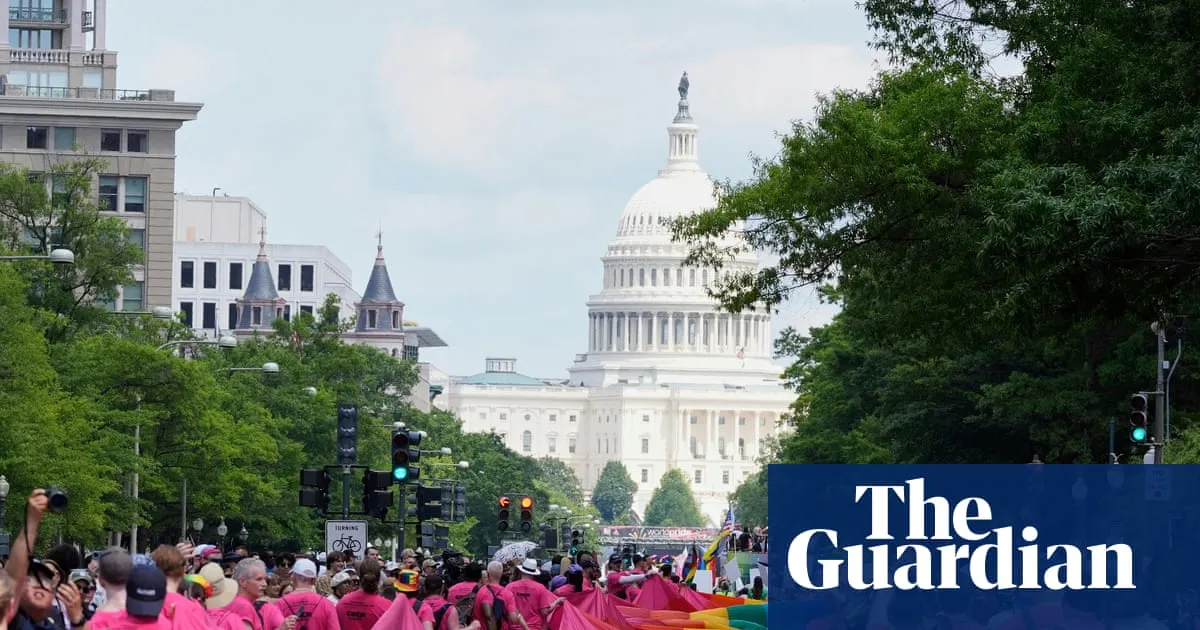
Acceptance of same-sex marriage and relationships in the US has flattened after more than two decades of steadily increasing support, with an ongoing decline among Republicans, according to a new Gallup poll.About 65% of US adults believe same-sex marriage should be legal, down slightly from 71% in 2022 and 2023.Most of the change is due to dropping acceptance among Republicans. In the new survey, which was conducted in May, only 37% of Republicans say same-sex marriage should be legally valid, while 35% say gay and lesbian relations are “morally acceptable”.The views of Democrats and independents are largely stable in the findings released Wednesday, with most in both groups saying same-sex marriage should be legal and that gay or lesbian relations are moral.The widening partisan divide is also reflected in policy around LGBTQ+ issues across the US, particularly regarding transgender people, and a rising push in some states to ban same-sex marriage.The downtick in support for same-sex marriage, while slight, is still striking because of how dramatically US views on the issue have shifted over the past few decades.According to Gallup’s trend data, only 27% of US adults supported legal same-sex marriage in 1996. Since then, support for same-sex marriage rose steadily until a few years ago, when it peaked with about seven in 10 US adults saying same-sex marriage should be legal.Opinion about the morality of same-sex relationships followed the same pattern. About four in 10 US adults said same-sex relations were morally acceptable in 2001. That increased nearly 30 percentage points over the next two decades.Over the past few years, Gallup’s data has shown signs of a shift in the other direction. In addition to the slight decline on same-sex marriage, the new poll also found that 62% of US adults view gay and lesbian relations as morally acceptable, down from 71% in 2022.same-sex marriage has been recognized nationally since a 2015 Supreme Court ruling. That case capped a 12-year run in which court rulings and state laws recognized it in most states.By last year, there were more than 800,000 married same-sex couples, according to data compiled by the Williams Institute at the University of California Los Angeles School of Law.The pushback has never stopped, though. A call to overturn the 2015 ruling reached the Supreme Court last year, invoking the words of Justice Clarence Thomas, who has called for undoing it. The court turned away the appeal without comment.Last year, the Southern Baptist Convention overwhelmingly called for reversing the ruling that led to nationwide marriage recognition and imposing a ban.Lawmakers in at least 11 states introduced legislation for their current or most recent sessions calling on a ban on same-sex marriage, according to an Associated Press analysis of bills compiled by the legislation tracking service Plural. Most didn’t pick up momentum. But the Tennessee house passed a measure to allow private citizens and organizations not to recognize the unions; Idaho’s house passed a resolution calling on the Supreme Court to undo the 2015 decision.A similar number of states have had measures aimed at protecting same-sex marriage introduced recently.In a sign that views of LGBTQ+ issues may be shifting more broadly, the new Gallup poll found that about four in 10 Americans view changing one’s gender as morally acceptable, down from nearly half in 2021.The rights of transgender people have been a hot-button political issue this decade.Most Republican-controlled states have adopted laws in the last five years to bar gender-affirming medical treatments for transgender minors, restrict which school bathrooms transgender people may use and bar transgender girls and women from some sports competitions.Trump has signed executive orders seeking some of the same policies on a federal level.This week, one of those policies suffered a blow when a court ruled that the military illegally banned transgender troops.The Gallup poll, conducted on 1-17 May, was based on telephone interviews with a random sample of 1,001 US adults. The margin of sampling error for adults overall is plus or minus 4 percentage points.
SRCThe Guardian - World News
LANGEN
LEANCenter-Left
WORDS661
ENT11
WED · 2026-06-03 · 12:54 GMTBRIEF NSR-2026-0603-81456
NSR-2026-0603-81456News Report·EN·Social Justice
New US poll shows downtick in support for same-sex marriage and trans people
A new Gallup poll indicates a plateau in US support for same-sex marriage and relationships, with a slight decrease from 71% in 2022-2023 to 65% currently. This shift is primarily driven by a decline in acceptance among Republicans, where only 37% now support legal same-sex marriage.
Associated PressThe Guardian - World NewsFiled 2026-06-03 · 12:54 GMTLean · Center-LeftRead · 3 min
The Guardian - World NewsFIG 01
Reading time
3min
Word count
661words
Sources cited
3cited
Entities identified
11entities
Quality score
100%
§ 01
Briefing Summary
AI-generatedNEWSAR · AI
A new Gallup poll indicates a plateau in US support for same-sex marriage and relationships, with a slight decrease from 71% in 2022-2023 to 65% currently. This shift is primarily driven by a decline in acceptance among Republicans, where only 37% now support legal same-sex marriage. Support among Democrats and independents remains largely stable. The poll also found a downtick in the moral acceptability of gay and lesbian relations, falling to 62% from 71% in 2022. Furthermore, acceptance of changing one's gender has decreased to about 40% from nearly half in 2021, reflecting a broader trend in views on LGBTQ+ issues. This comes amidst ongoing political debates and legislative actions concerning LGBTQ+ rights in various states.
Confidence 0.90Sources 3Claims 5Entities 11
§ 02
Article analysis
Model · rule-basedFraming
Social Justice
Legal & Judicial
Tone
Measured
AI-assessed
CalmNeutralAlarmist
Factuality
0.80 / 1.00
Factual
LowHigh
Sources cited
3
Well sourced
FewMany
§ 03
Key claims
5 extracted01
Same-sex marriage has been recognized nationally since a 2015 Supreme Court ruling.
factual
Confidence
1.00
02
Only 37% of Republicans in the new survey say same-sex marriage should be legally valid.
statisticGallup poll
Confidence
1.00
03
About 65% of US adults believe same-sex marriage should be legal, down from 71% in 2022-2023.
statisticGallup poll
Confidence
1.00
04
Acceptance of same-sex marriage in the US has flattened after two decades of increase, with a decline among Republicans.
statisticGallup poll
Confidence
1.00
05
Lawmakers in at least 11 states introduced legislation calling for a ban on same-sex marriage.
statisticAssociated Press analysis
Confidence
0.90
§ 04
Full report
3 min read · 661 words§ 05
Entities
11 identifiedKey playerOppositionContextPositiveNeutralNegative
Organizations6
Locations1
§ 06
Keywords & salience
9 termssame-sex marriage
1.00
public opinion
0.90
transgender people
0.80
partisan divide
0.80
republican support
0.70
gallup poll
0.70
lgbtq+ issues
0.70
moral acceptability
0.60
supreme court ruling
0.50
§ 07
Topic connections
Interactive graph Network visualization showing 51 related topics
View Full Graph Person Organization Location Event|Click node to navigate|Edge numbers = shared articles