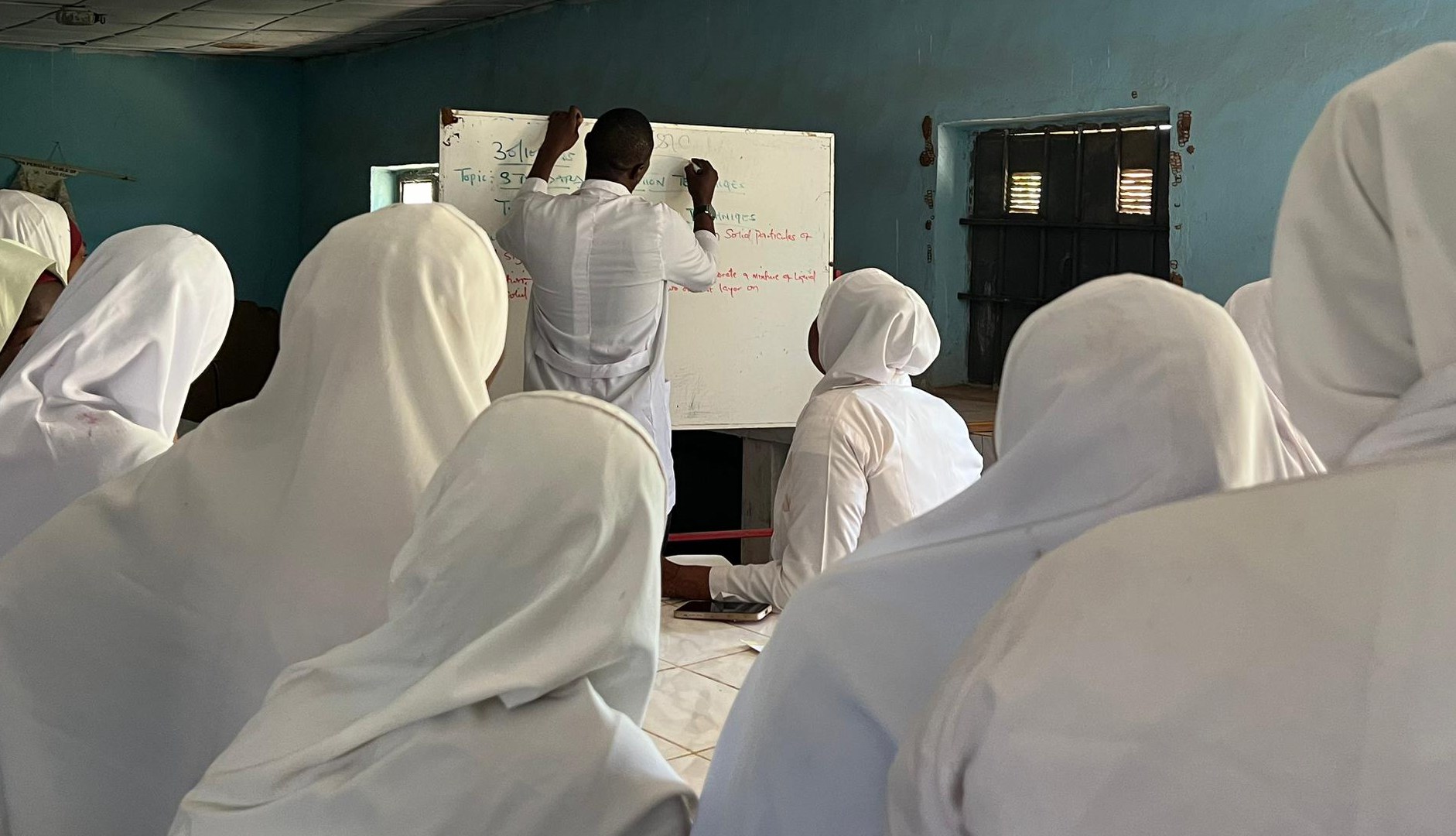
Women in northern Nigeria return to school after years out but must balance childcare, duties, and costs.Women in northern Nigeria are returning to school years after dropping out, but many must balance childcare, household duties and costs [Abdulaziz Bagwai/Al Jazeera]Published On 4 Jun 2026Sokoto, Nigeria – Each time her curious seven-year-old child returned home from school with homework, 28-year-old Habiba Abubakar knew it was time to take him to her neighbour, whom the child called “aunt”, even though they were not related by blood, who had been his saviour every time he wanted to stand in front of his class and receive a standing ovation.But that changed in 2021, when Abubakar enrolled herself in the Women Centre for Continuing Education (WCCE) in Sokoto State, northwest Nigeria.“I’ve always felt ashamed when Muhammad told me that they’ve been given another assignment,” she told Al Jazeera.This frustration, coupled with her enthusiasm for learning English, pushed her to return to the classroom 13 years after she left.Now, the mother of four said she helps all the children with their assignments.The interruption in Abibaker’s studies is not uncommon across northern Nigeria, especially in rural communities, where girls are more likely to drop out of school due to cultural practices, such as early marriage, or poverty, which forces parents to make gender-biased decisions by enrolling male children over females.UNICEF reported that more than half of the girls in the region are not attending school.Jennifer Agbaji, a social accountability professional and the executive director at Basileia Vulnerable Persons Rights Initiative (BVPRI), a Nigerian nonprofit dedicated to advancing the rights of women, girls, and other vulnerable populations through education and leadership development, viewed the initiative as a positive and necessary intervention.Nonetheless, she said second-chance education should not be limited to classroom-based learning alone.“If access to education depends solely on physical attendance, many women who face mobility, childcare, economic, health, or security challenges may still be excluded.”How the system worksWCCE, commissioned by the then-military governor of Sokoto State, Navy Captain Abdul Rasheed Adisa Raji, was founded in 1997 to provide adult education and vocational skills to women in the state.Since then, Nuraddeen Ladan Dogon Daji, a physics teacher, told Al Jazeera that the centre has trained many students, some of whom now practise professions, such as teaching and nursing, helping to address the country’s shortage of skilled professionals.Unlike other public schools, where pupils spend six years, the centre designed a three-year curriculum for its primary section, from adult one to three.In the secondary sections, students spend three years each in the junior and senior levels.In their final years, they also sit for the mandatory Junior Leaving School Certificate of Education (JLSCE) and Senior School Certificate of Education (SSCE) examinations.To help these students realise their dreams, the centre also offers free education, benefitting from the state government’s effort to reduce the number of out-of-school children.This has helped students like Abubakar, who, following her divorce, relied heavily on her father’s support to stay in school.“We used to pay 5,000 naira ($3.5) per term, but were later told to stop because the state government has given us a chance to study for free,” Abubakar told Al Jazeera from her home in the Kofar Atiku neighbourhood.But free tuition does not eliminate all costs. Students still have to pay for transport, books, and other daily expenses.The challengesAccording to Agbaji, beyond poverty and early marriage, there are several structural barriers, including restrictive gender norms that prioritise domestic responsibilities over education.She said many women lose confidence after years away from formal education, and in some communities, education is still viewed as an investment for boys rather than a lifelong right for women.In her opinion, these norms often combine to make re-entry into education difficult, even when opportunities exist. In her journey to becoming a nurse, Fatima Attahir, who left school after primary school 12 years ago, found it necessary to go back to the classroom and start afresh.To support herself while studying, she helps with her family’s trading activities when she is not in class.She said that although some of her friends already saw the decision as time-consuming, she is not satisfied with the system’s duration.“I wish the primary section was also up to six years,” she said.“Because to become a nurse, I need to have a solid background in the core subjects.” Some of the students Al Jazeera spoke to said their greatest challenge is juggling academic activities with household responsibilities.Before her divorce, Abubakar said she would wake up earlier than usual to prepare breakfast, clean the house, and get herself and her children ready for school.“When I finally set my foot in class, I was already tired, and as the lectures went on, I would start slumbering because I hadn’t had enough sleep.” She said the pressure became worse when her youngest child frequently fell ill, sometimes forcing her to leave class before lectures ended.After her divorce, transport costs became another obstacle. “Since I was no longer married, my parents were the ones paying for the transport fares, but when they couldn’t, I would not go to school because I couldn’t afford it myself,” she said.Later, her father gave her 10,000 naira to start making and selling local snacks and small chops.The small business now helps her cover transport costs and other school-related expenses. Abubakar still credits the neighbour who used to help her son with homework before she returned to school.When transport costs became difficult to afford after her divorce, her parents stepped in when they could, while her father later provided the capital that helped her start a small business and continue her studies.Her experience is not unique.A classroom session at the Women’s Centre for Continuing Education in northern Nigeria [Abdulaziz Bagwai /Al Jazeera]Another student, Hafsat Aliyu, said she leaves her two-year-old child with her in-laws whenever she attends classes to avoid disrupting lessons.Her husband pays for books and other occasional school needs, while she sells local pastries during break time at the centre to earn money for daily transport and personal expenses.During examination periods, she studies late into the night after completing household chores and putting her children to bed.“My husband does his best, but I thought it was time for me to get a source of income, too,” she said.“Now, I pay for my transport and a few other daily needs.”However, the physics teacher, Dogon Daji, said that in his seven years of teaching at the centre, a recurring challenge among students is the pace of learning.“I’ve taught young people, and the level of their understanding is quite different,” he said.But he added that there are still outstanding students among them; one recently won this year’s Usmanu Danfodio Week, an annual quiz competition organised for secondary school students in the state.On the other hand, the vocational section of the centre, which was designed to equip students with practical skills such as tailoring and soap-making, now offers only tailoring.Students are required to provide tools, such as scissors, including those whose interests may lie in other trades.Agbaji acknowledged that for Nigeria to bridge the gender disparity in education, the country must adopt a lifelong learning framework that recognises education as a continuous right and opportunity.This requires increased investment in adult education, digital and remote learning platforms, community-based education, and flexible pathways for women who missed formal schooling, because the long-term consequences are significant.She added that many women pursuing second-chance education continue to balance childcare, household responsibilities, and income-generating activities, often relying on family and community support networks to remain in school.“Educational exclusion perpetuates poverty, limits economic opportunities, increases vulnerability to abuse and exploitation, and restricts women’s participation in governance and public service. It also affects future generations because children of educated mothers are generally more likely to enrol in and complete school,” Agbaji clarified.
SRCAl Jazeera
LANGEN
LEANCenter
WORDS1 292
ENT10
THU · 2026-06-04 · 01:16 GMTBRIEF NSR-2026-0604-81579
NSR-2026-0604-81579News Report·EN·Human Interest
Nigeria’s second-chance schools: women balancing study and survival
Women in northern Nigeria are returning to school through initiatives like the Women Centre for Continuing Education (WCCE) in Sokoto State, which offers adult education and vocational skills. Many women, like Habiba Abubakar, had to leave school years ago due to cultural practices, early marriage, or poverty, but are now pursuing education to improve their lives and assist their children.
By Abdulaziz BagwaiAl JazeeraFiled 2026-06-04 · 01:16 GMTLean · CenterRead · 6 min
Al JazeeraFIG 01
Reading time
6min
Word count
1 292words
Sources cited
2cited
Entities identified
10entities
Quality score
100%
§ 01
Briefing Summary
AI-generatedNEWSAR · AI
Women in northern Nigeria are returning to school through initiatives like the Women Centre for Continuing Education (WCCE) in Sokoto State, which offers adult education and vocational skills. Many women, like Habiba Abubakar, had to leave school years ago due to cultural practices, early marriage, or poverty, but are now pursuing education to improve their lives and assist their children. The WCCE provides a three-year primary curriculum and three-year junior and senior secondary levels, with free tuition funded by the state government. Despite this, students still face challenges balancing childcare, household duties, and the costs of transport and books. Experts highlight that restrictive gender norms and a lack of confidence can also hinder women's re-entry into education.
Confidence 0.90Sources 2Claims 5Entities 10
§ 02
Article analysis
Model · rule-basedFraming
Human Interest
Social Justice
Tone
Measured
AI-assessed
CalmNeutralAlarmist
Factuality
0.70 / 1.00
Factual
LowHigh
Sources cited
2
Limited
FewMany
§ 03
Key claims
5 extracted01
The WCCE has a three-year curriculum for its primary section and three years each for junior and senior secondary levels.
factual
Confidence
1.00
02
Jennifer Agbaji states that if access to education depends solely on physical attendance, many women facing challenges may still be excluded.
quoteJennifer Agbaji
Confidence
1.00
03
The Women Centre for Continuing Education (WCCE) in Sokoto State was founded in 1997 to provide adult education and vocational skills to women.
factual
Confidence
1.00
04
More than half of the girls in the region are not attending school, according to UNICEF.
statisticUNICEF
Confidence
1.00
05
Women in northern Nigeria are returning to school years after dropping out, balancing childcare, household duties, and costs.
factual
Confidence
1.00
§ 04
Full report
6 min read · 1 292 words§ 05
Entities
10 identifiedKey playerOppositionContextPositiveNeutralNegative
People4
Organizations4
§ 06
Keywords & salience
10 termssecond-chance education
1.00
women's education
0.90
northern nigeria
0.80
balancing study and survival
0.80
childcare
0.70
poverty
0.60
gender-biased decisions
0.50
early marriage
0.50
women centre for continuing education
0.40
unicef
0.40
§ 07
Topic connections
Interactive graph Network visualization showing 51 related topics
View Full Graph Person Organization Location Event|Click node to navigate|Edge numbers = shared articles