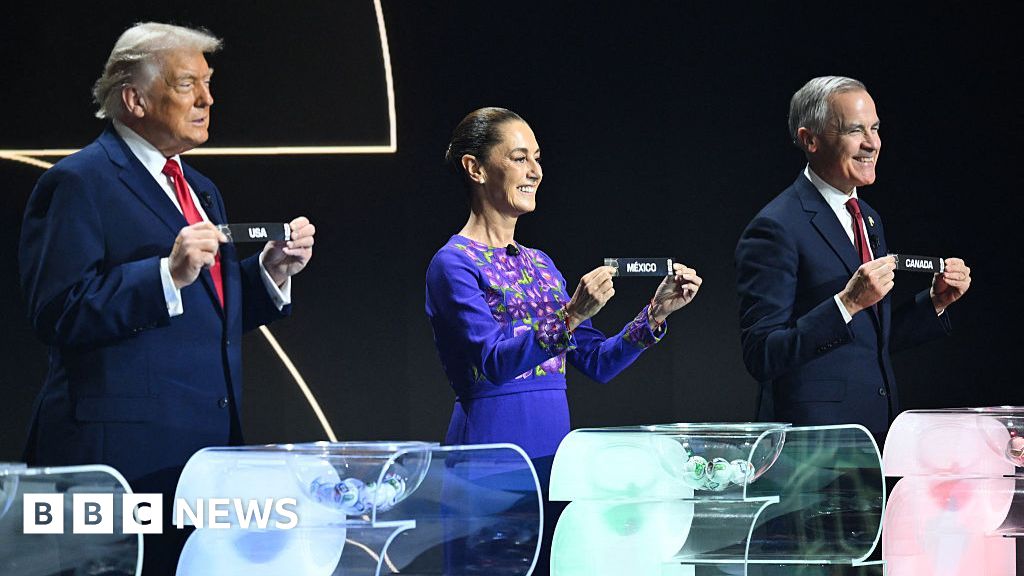
Site search1 hour agoAnthony Zurcher, Jessica Murphy and Will GrantWashington DC, Toronto and Mexico CityThink of it as being like a dinner party where the hosts are in the midst of a tense argument when you arrive.Football fans travelling to North America for the continent's first co-hosted World Cup will find three host countries who have endured a tense time.The tournament, which will take place across a sprawling 16 host cities and three countries, comes after a period of fractious relations between its hosts: the US, Canada and Mexico.The underlying issues seemed distant when the countries' leaders met for the draw in Washington DC in December and posed for a selfie with FIFA boss Gianni Infantino. But teaming up for a full 39-day tournament is likely to be a different ball game.US President Donald Trump has been unashamedly open about the fact that the US is the dominant power on the continent. That means the very real tensions between the three nations on issues such as trade, Immigration and drug-trafficking - which have all simmered since Trump returned to office - could spill back into view.On the other hand, get it right and the World Cup could forge closer ties between the trio.Tensions over trade, tourism - and TrumpMexico and Canada, the top trading partners for the US, will not have forgotten that they were among the first countries to be targeted by Trump with tariffs.Canada - which was also angered by Trump's repeated comments about making the country a "51st state" of the US - hit back with its own counter-measures. Provinces pulled US alcohol from shelves and Canadians significantly curbed travel south, which irritated the US in return.The issues Canada and Mexico both have with the US have also impacted relationship between them, suggests Carlo Dade, director of international policy at the University of Calgary.Canada had been accused of throwing Mexico under the bus ahead of Trump's second term, as Canadian and US officials argued that Mexico was serving as a back door in North America for Chinese investment."It was downright disrespectful," Dade comments.That means Canadian Prime Minister Mark Carney has also found himself trying to patch things up with Mexico as he tries to diversify trade away from the US.Three's a crowdA World Cup has never before been hosted across three countries. And given that the 2026 tournament is spanning an entire continent, there is a wide array of different authorities involved.With fans travelling between the three nations to watch matches, stepped-up US Immigration enforcement efforts could create logistical headaches and inflame already frayed nerves.And American security concerns – heightened because of the ongoing Iran war – could add new layers of frustration and the potential for seemingly innocuous incidents to escalate unexpectedly."Co-hosting these global sporting events is not necessarily a recipe for a lovey-dovey relationship between the co-hosts," says Lindsay Sarah Krasnoff, an author and clinical assistant professor of global sport at New York University.Krasnoff says that while the women's 2023 World Cup hosted by New Zealand and Australia was a net positive, the joint Japan-South Korea men's tournament in 2002 was a "mixed bag" for two nations with a long and uneven history. "It didn't negatively impact the bilateral relationship, but it's kind of viewed historically as kind of a draw," she adds.FIFA itself has voiced great hopes for the model, saying: "It's a moment when three countries and an entire continent collectively say: 'We are united as one to welcome the world and deliver the biggest, best and most inclusive FIFA World Cup ever.'"Papering over the cracks?The leader of each nation may want to use the tournament not only to show they can get along with their neighbours, but to prove a point to those who criticise them on domestic issues.That is certainly true of Mexico, where there has been a degree of doom and gloom around co-hosting. There have been persistent questions over the readiness of the capital's main airport, its saturated public transport system and the revamped Azteca stadium. Not to mention the appearance of cartel members on the streets a few months ago in a short-lived but widespread display of violence.And now, the main teachers' union is holding a nationwide strike over pensions and conditions - and massive protests which threaten to close the main thoroughfares to the matches. Their slogan is "without a solution (to their demands), there will be no kick off".But throughout all the challenges, Mexican President Claudia Sheinbaum has remained resolutely upbeat."It's time to witness the best football in the world and to share with everyone who we are - not only a country of immense cultural heritage, but of an empowered people," she said last year.It would be wrong to paper over the cracks or whitewash the issues Mexico has faced in the run-up to kick, argues Mexican football journalist, Rafael Puente."I really hope the fans show patience and good behaviour in the face of some of these problems which we can't hide," Puente adds. "The only thing we can hope for is the excitement, illusion and expectation which the Mexican people have shown in the past, particularly around the participation of the national team."Trio eye goals beyond the tournamentAnalysts have suggested that the three neighbours could manage some other breakthroughs if they can get the sport right over the next month or so.The trio are in the middle of a challenging review of a landmark North American free trade agreement, known as the USMCA. The review has left uncertainty hanging over a trading partnership that has been in place in some form since 1994.Mexico has launched formal talks with the US, something Canada has yet to do.Canada, which is seeking closer trade ties with China, and Mexico, which has increased tariffs on the Asian country, are also moving in different direction with respect to the Trump administration's "elevation of the importance of China as a primary consideration", says Dade, of the University of Calgary.Getty ImagesThe three posed for a selfie with FIFA boss Gianni Infantino during the tournament draw in DecemberBut the the World Cup offers an opportunity for diplomacy - as we saw when the Trump, Carney and Mexico's Claudia Sheinbaum were all smiles together at the tournament draw in December."Anytime you get leaders together, it's generally a good thing," Dade comments.For his part, Trump, who regularly boasts of his nation being the "hottest" in the world, clearly views the World Cup as a chance for the US to bask in the global limelight.His desire to dominate the proceedings, whether by attending events or firing off Truth Social posts, might foster resentment among America's two neighbours and, ultimately, cause damage to North American relations in the longer term.On the other hand, he is heavily invested in the tournament's success – and may take special efforts to avoid the kind of diplomatic incidents that could mar proceedings.Football is a funny old game, as the cliche goes. Just as the sport itself is unpredictable, there is no telling which way this new experiment in three-way hosting will go."It was always going to be very complicated and very complex from the get go," Krasnoff observes, "even when the bid was first awarded."
SRCBBC News - World
LANGEN
LEANCenter
WORDS1 195
ENT12
THU · 2026-06-04 · 08:46 GMTBRIEF NSR-2026-0604-81666
NSR-2026-0604-81666Analysis·EN·Diplomatic
Uneasy neighbours: Can three World Cup hosts put differences aside for a month?
The 2026 FIFA World Cup, co-hosted by the US, Canada, and Mexico, arrives amid a period of strained relations between the three North American neighbors. Tensions have arisen from trade disputes, immigration policies, and differing political stances, particularly under former US President Donald Trump's administration.
BBC News - WorldFiled 2026-06-04 · 08:46 GMTLean · CenterRead · 5 min
BBC News - WorldFIG 01
Reading time
5min
Word count
1 195words
Sources cited
2cited
Entities identified
12entities
Quality score
100%
§ 01
Briefing Summary
AI-generatedNEWSAR · AI
The 2026 FIFA World Cup, co-hosted by the US, Canada, and Mexico, arrives amid a period of strained relations between the three North American neighbors. Tensions have arisen from trade disputes, immigration policies, and differing political stances, particularly under former US President Donald Trump's administration. Despite these underlying issues, the tournament presents an opportunity for the countries to foster closer ties. However, the logistical complexities of a three-nation hosting, coupled with potential security concerns and domestic challenges in Mexico, could also exacerbate existing frictions. While FIFA expresses hope for unity, past co-hosted tournaments have yielded mixed results, suggesting the World Cup's impact on bilateral relationships remains uncertain.
Confidence 0.90Sources 2Claims 5Entities 12
§ 02
Article analysis
Model · rule-basedFraming
Diplomatic
Human Interest
Tone
Mixed Tone
AI-assessed
CalmNeutralAlarmist
Factuality
0.60 / 1.00
Mixed
LowHigh
Sources cited
2
Limited
FewMany
§ 03
Key claims
5 extracted01
Co-hosting global sporting events is not necessarily a recipe for a 'lovey-dovey relationship' between co-hosts.
quoteLindsay Sarah Krasnoff
Confidence
1.00
02
Carlo Dade suggests that US-Canada-Mexico tensions have impacted relations between Canada and Mexico.
quoteCarlo Dade
Confidence
1.00
03
Mexico and Canada were among the first countries targeted by US tariffs under Donald Trump.
factual
Confidence
1.00
04
The 2026 World Cup will be the first co-hosted tournament across three countries: the US, Canada, and Mexico.
factual
Confidence
1.00
05
Relations between the US, Canada, and Mexico have been tense due to issues like trade, immigration, and drug-trafficking.
factual
Confidence
0.90
§ 04
Full report
5 min read · 1 195 words§ 05
Entities
12 identifiedKey playerOppositionContextPositiveNeutralNegative
People3
Organizations1
Locations4
§ 06
Keywords & salience
9 termsworld cup hosts
1.00
us, canada, mexico relations
0.90
north american tensions
0.80
trade disputes
0.70
immigration issues
0.60
donald trump
0.50
drug trafficking
0.50
co-hosted tournament
0.40
geopolitical relations
0.40
§ 07
Topic connections
Interactive graph Network visualization showing 51 related topics
View Full Graph Person Organization Location Event|Click node to navigate|Edge numbers = shared articles