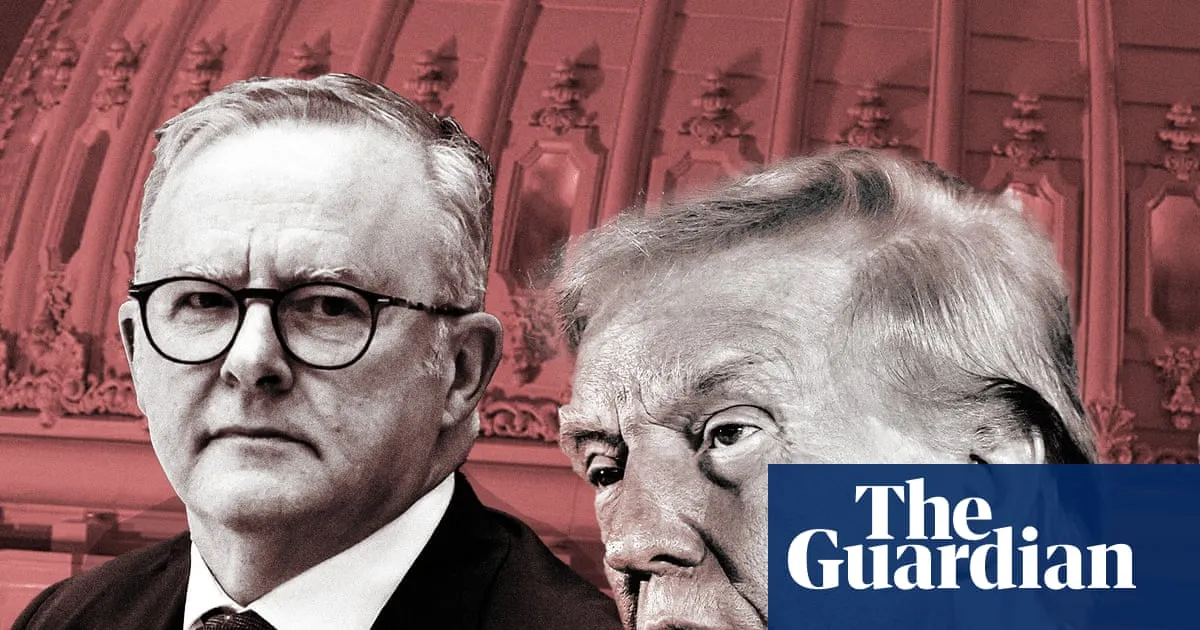
The Albanese government’s news media bargaining incentive is the type of measure the Trump administration might retaliate against, one tech industry group says. Composite: Guardian design View image in fullscreen The Albanese government’s news media bargaining incentive is the type of measure the Trump administration might retaliate against, one tech industry group says. Composite: Guardian design Tech companies invoke possibility of Trump’s wrath in fight against Labor’s media laws Tech giants claim Australia’s free trade agreement with US will be violated as they try to kill a proposal to force them to pay news companies Follow our Australia news live blog for latest updates Get our breaking news email, free app or daily news podcast Tech companies are invoking Australia’s free trade agreement with the US and threats of Trump administration retaliation in an attempt to kill off the federal government’s proposal to force them to pay news companies. The news media bargaining incentive is designed to force Meta, Google and TikTok to make commercial deals with Australian media outlets or pay a dedicated 2.25% levy on local revenues. The Albanese government has been consulting on the draft legislation since April, with submissions closing late last month. Meta, the parent company of Facebook, Instagram and WhatsApp, has argued that the news media bargaining incentive is a “discriminatory tax” that is “poorly designed” and “grossly unfair”. It released its formal submission to the draft legislation on Thursday morning, and said it would insulate publishers from competitive pressures by guaranteeing revenue. The company again argued that news organisations share their content on Meta platforms for free because they get commercial benefits. Meta said the NBI was a “discriminatory, retroactive tax targeting a handful of foreign companies while competitors offering comparable services face no equivalent obligation”. It “plainly violates” the US and Australia free trade agreement, Meta claimed Meta’s position has been echoed by US tech lobby groups, who in letters to the government last month also cited the agreement. The National Foreign Trade Council, which represents US multinational tech companies, said the bill created a disincentive for growth for digital platforms and was potentially in violation of the agreement. “Legal analysis suggests the draft bill will result in potential inconsistencies with prohibitions against discrimination against US services and service suppliers under its national treatment and most-favored-nation rules; discrimination against digital products; and performance requirements, including a requirement to “achieve a given level or percentage of domestic content,” the trade council said. The Software & Information Industry Association said the incentive would “likely run afoul” of Australia’s obligations in the trade agreement concerning cross-border trade in services, electronic commerce and investment and would be the “type of measure that the Trump administration has said it might retaliate against”. The organisation said the bill was built on a flawed premise, and most major media companies appeared to be economically viable. News Corp Australasia’s executive chair, Michael Miller, said the bill cleared a pathway for tech companies to make commercial agreements with news media. “Meta’s strident opposition to the incentive once again reveals its readiness to go to extreme lengths to not pay for the content it profits from combined with deep contempt for Australian law and standards of behaviour,” he said. Nine Entertainment’s chief executive, Matt Stanton, said the bill would be “completely unnecessary if these companies simply adhered to existing Australian law” and bargained under the news media bargaining code. “To suggest it’s a disincentive to investment to require companies to follow Australian law is disingenuous,” he said. “It’s time these companies stopped riding roughshod over the Australian public, respect our laws and pay their fair share.” The Southern Cross chief executive, Rohan Lund, said the government asking for platforms to pay for news content was not unfair. “Quality news is vital for a diversity of voices in a healthy democracy,” he said. “If digital platforms don’t pay for the use of the news content they profit from, then journalism becomes unsustainable.” Scott Purcell, a co-founder of Man of Many, called for amendments to the proposed bill to ensure that the funding was distributed among all newsrooms, not just the major players, and that it was used directly to fund journalists. Meta said the bill wasn’t a plan to save journalism but “a tax on innovation dressed up as media policy” to which it was “vehemently opposed”. The company argued that most people now come to its platforms for “creator-driven video content” and was not the role of digital platforms to pay to rescue public interest journalism. TikTok, Google and Microsoft were approached for comment. Explore more on these topics Australian media Australian politics Donald Trump Meta News Corporation Trump administration Social media news Share Reuse this content
SRCThe Guardian - World News
LANGEN
LEANCenter-Left
WORDS785
ENT12
FRI · 2026-06-05 · 05:37 GMTBRIEF NSR-2026-0605-81896
NSR-2026-0605-81896News Report·EN·Political Strategy
Tech companies invoke possibility of Trump’s wrath in fight against Labor’s media laws
Australian tech companies, including Meta, Google, and TikTok, are opposing a proposed government law that would require them to pay news organizations for content or face a 2.25% levy on local revenue. These companies argue the "news media bargaining incentive" violates the US-Australia free trade agreement and could provoke retaliation from a Trump administration.
Josh Taylor and Amanda MeadeThe Guardian - World NewsFiled 2026-06-05 · 05:37 GMTLean · Center-LeftRead · 4 min
The Guardian - World NewsFIG 01
Reading time
4min
Word count
785words
Sources cited
3cited
Entities identified
12entities
Quality score
100%
§ 01
Briefing Summary
AI-generatedNEWSAR · AI
Australian tech companies, including Meta, Google, and TikTok, are opposing a proposed government law that would require them to pay news organizations for content or face a 2.25% levy on local revenue. These companies argue the "news media bargaining incentive" violates the US-Australia free trade agreement and could provoke retaliation from a Trump administration. They claim the proposal is a "discriminatory tax" and that news outlets already benefit commercially from sharing content on their platforms. US tech lobby groups echo these concerns, citing potential inconsistencies with trade agreement rules. Australian media executives, however, argue the law is necessary for journalism's sustainability and that tech companies should pay for the content they profit from.
Confidence 0.90Sources 3Claims 4Entities 12
§ 02
Article analysis
Model · rule-basedFraming
Political Strategy
Legal & Judicial
Tone
Measured
AI-assessed
CalmNeutralAlarmist
Factuality
0.60 / 1.00
Mixed
LowHigh
Sources cited
3
Well sourced
FewMany
§ 03
Key claims
4 extracted01
Meta argues the incentive is a 'discriminatory tax' that violates the US-Australia free trade agreement.
quoteMeta
Confidence
1.00
02
Australia's news media bargaining incentive would force Meta, Google, and TikTok to make commercial deals with local news outlets or pay a 2.25% levy on local revenues.
factualAlbanese government
Confidence
1.00
03
US tech lobby groups claim the bill may violate national treatment and most-favored-nation rules in the trade agreement.
factualNational Foreign Trade Council
Confidence
0.90
04
Tech companies are using the threat of US retaliation under a Trump administration to fight Australia's proposed media laws.
factualGuardian analysis
Confidence
0.90
§ 04
Full report
4 min read · 785 words§ 05
Entities
12 identifiedKey playerOppositionContextPositiveNeutralNegative
Organizations7
§ 06
Keywords & salience
9 termsnews media bargaining incentive
1.00
tech companies
0.90
trump administration
0.80
free trade agreement
0.70
media laws
0.60
meta
0.50
google
0.40
tiktok
0.40
australian government
0.40
§ 07
Topic connections
Interactive graph No topic relationship data available yet. This graph will appear once topic relationships have been computed.