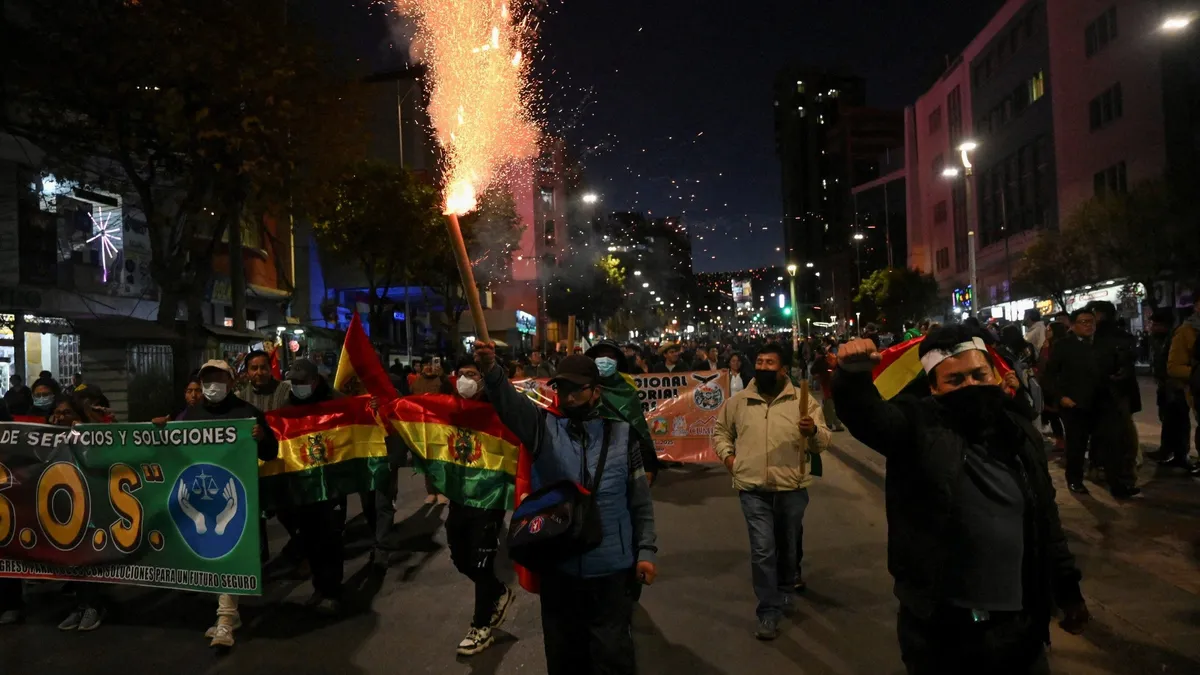
close Video Former Colombian ambassador says Venezuelan people have endured decades of oppression under a dictatorship Former Colombian Ambassador to the U.S. Juan Carlos Pinzon discusses President Trump's statement about the US running Venezuela and highlights the potential for a peaceful transition on ‘Fox Report.’ NEWYou can now listen to Fox News articles! Hören Sie sich diesen Artikel an 3 Min The United States, along with the other countries that make up the Shield of the Americas, condemned the "ongoing efforts" in Bolivia to "overthrow the legitimately and overwhelmingly elected" government of President Rodrigo Paz on Friday. "The member countries of Shield of the Americas denounce ongoing efforts to overthrow the legitimately and overwhelmingly elected government of President Rodrigo Paz in Bolivia," the statement read. "We stand with Paz’s democratic government as it fights back against attempts to drag Bolivia backwards through cynical efforts to prevent the delivery of food, medicine and other vital supplies to the Bolivian people through fake road blockades." The statement added that "Mob rule cannot replace the decision that a majority of Bolivians made at the ballot box to turn the page on two decades of corrupt governments." It also said that anyone who is funding protests with "dirty money" from drug trafficking and transnational crime "should be held accountable. Those who have legitimate grievances should take advantage of the government’s willingness to dialogue, and denounce those who would abuse their causes to regain power." PETE HEGSETH WARNS NARCO-TERRORISTS AS U.S. BACKS Bolivia'S GOVERNMENT AMID COUP WARNINGS Demonstrators march in La Paz, Bolivia, on May 20, 2026, rallying against road blockades and pressure tactics used by protesters demanding the resignation of President Rodrigo Paz amid the country's economic and fuel crisis. (Claudia Morales/Reuters) The State Department made the joint statement along with Argentina, Bolivia, Chile, Costa Rica, Dominican Republic, Ecuador, El Salvador, Guyana, Honduras, Panama, Paraguay, and Trinidad and Tobago. The statement comes as Bolivia's capital, La Paz, has been rocked by weeks of social unrest as mass protests have blocked streets in major cities amid economic inflation and rising fuel prices. Bolivian Defense Minister Marcelo Salinas resigned Tuesday. Upon taking office, Paz supported a land reform bill to boost agribusiness that Indigenous farmers said put them at risk of eviction. He further scrapped fuel subsidies, sending prices surging by nearly 90%. Motorists complained that the gasoline was contaminated and ruined their cars. PETE HEGSETH MAKES HOMELAND SECURITY TOP MISSION IN FIRST INTERVIEW AS SECRETARY OF WAR The Trump administration has said drug traffickers are responsible for inciting the mass unrest. Meanwhile, former President Evo Morales of the Movement for Socialism (MAS) party, the country's first Indigenous president who ruled for an unprecedented 14 years, is calling for early elections. "Paz only has two paths left: a suicidal decision like militarization or ... an election in the next 90 days," he wrote on X. Police officers fired tear gas at community members who seized the Humberto Suarez oil facility during protests calling for President Rodrigo Paz's resignation in Santa Rosa del Sara, Bolivia, on June 3, 2026. The protests have caused fuel and food shortages. (Ipa Ibanez/Reuters) For almost two years now, Morales has been hiding out in Bolivia's central coca-growing Chapare region, evading an arrest warrant on human trafficking charges relating to allegedly having sex with a 15-year-old girl. He rejects the allegations as politically motivated. Bolivia's President Rodrigo Paz delivers a speech in La Paz on June 3, 2026, after naming Ernesto Justiniano as defense minister following the resignation of Marcelo Salinas amid protests. (Claudia Morales/Reuters) On Thursday, War Secretary Pete Hegseth said in a post on X, that the War Department and the Americas Counter Cartel Coalition (A3C), a recently established multinational military and political alliance, reject all attempts to overthrow the government of Rodrigo Paz Pereira six months into his term. Bolivia's former President Evo Morales greets a member of the country's anti-drugs forces in Santa Cruz province near the Paraguay border on March 28, 2009. T (Stringer/Reuters) "The United States is watching. Bolivia must not allow itself to fall prey to the old status quo of narco-terrorist dominance in the region," Hegseth wrote. "We will continue to support our A3C partners like Bolivia to ensure that narco-terrorists are deterred from profiting on death and destruction in our hemisphere." Fox News' Louis Casiano contributed to this report.
SRCFox News - World
LANGEN
LEANCenter-Right
WORDS726
ENT12
FRI · 2026-06-05 · 22:43 GMTBRIEF NSR-2026-0606-82133
NSR-2026-0606-82133News Report·EN·Political Strategy
US, Shield of the Americas condemn 'ongoing efforts' to overthrow Bolivia's elected president amid unrest
The United States and other Shield of the Americas nations have condemned "ongoing efforts" to overthrow Bolivia's democratically elected President Rodrigo Paz amid weeks of social unrest. The joint statement, issued by the State Department and several Latin American countries, denounces attempts to block vital supplies and asserts that "mob rule cannot replace the decision that a majority of Bolivians made at the ballot box." The US administration attributes the unrest to drug traffickers and transnational crime, calling for accountability for those funding protests with "dirty money." This comes as Bolivia faces economic inflation, rising fuel prices, and calls for early elections from former President Evo Morales, who is currently evading arrest.
Fox News - WorldFiled 2026-06-05 · 22:43 GMTLean · Center-RightRead · 3 min
Fox News - WorldFIG 01
Reading time
3min
Word count
726words
Sources cited
3cited
Entities identified
12entities
Quality score
100%
§ 01
Briefing Summary
AI-generatedNEWSAR · AI
The United States and other Shield of the Americas nations have condemned "ongoing efforts" to overthrow Bolivia's democratically elected President Rodrigo Paz amid weeks of social unrest. The joint statement, issued by the State Department and several Latin American countries, denounces attempts to block vital supplies and asserts that "mob rule cannot replace the decision that a majority of Bolivians made at the ballot box." The US administration attributes the unrest to drug traffickers and transnational crime, calling for accountability for those funding protests with "dirty money." This comes as Bolivia faces economic inflation, rising fuel prices, and calls for early elections from former President Evo Morales, who is currently evading arrest.
Confidence 0.90Sources 3Claims 5Entities 12
§ 02
Article analysis
Model · rule-basedFraming
Political Strategy
Conflict
Tone
Mixed Tone
AI-assessed
CalmNeutralAlarmist
Factuality
0.60 / 1.00
Mixed
LowHigh
Sources cited
3
Well sourced
FewMany
§ 03
Key claims
5 extracted01
Mob rule cannot replace the decision that a majority of Bolivians made at the ballot box.
quoteUnited States and Shield of the Americas countries
Confidence
1.00
02
Protests in Bolivia are blocking streets amid economic inflation and rising fuel prices.
factual
Confidence
1.00
03
The United States and Shield of the Americas countries condemned 'ongoing efforts' to overthrow Bolivia's elected president.
quoteUnited States and Shield of the Americas countries
Confidence
1.00
04
The Trump administration claims drug traffickers are responsible for inciting the mass unrest in Bolivia.
factualTrump administration
Confidence
0.90
05
Bolivian President Rodrigo Paz scrapped fuel subsidies, sending prices surging by nearly 90%.
factual
Confidence
0.90
§ 04
Full report
3 min read · 726 words§ 05
Entities
12 identifiedKey playerOppositionContextPositiveNeutralNegative
Locations10
§ 06
Keywords & salience
10 termsoverthrow government
1.00
bolivia unrest
0.90
shield of the americas
0.80
democratic government
0.70
elected president
0.70
transnational crime
0.60
drug trafficking
0.60
fuel prices
0.50
economic inflation
0.50
land reform
0.40
§ 07
Topic connections
Interactive graph Network visualization showing 42 related topics
View Full Graph Person Organization Location Event|Click node to navigate|Edge numbers = shared articles