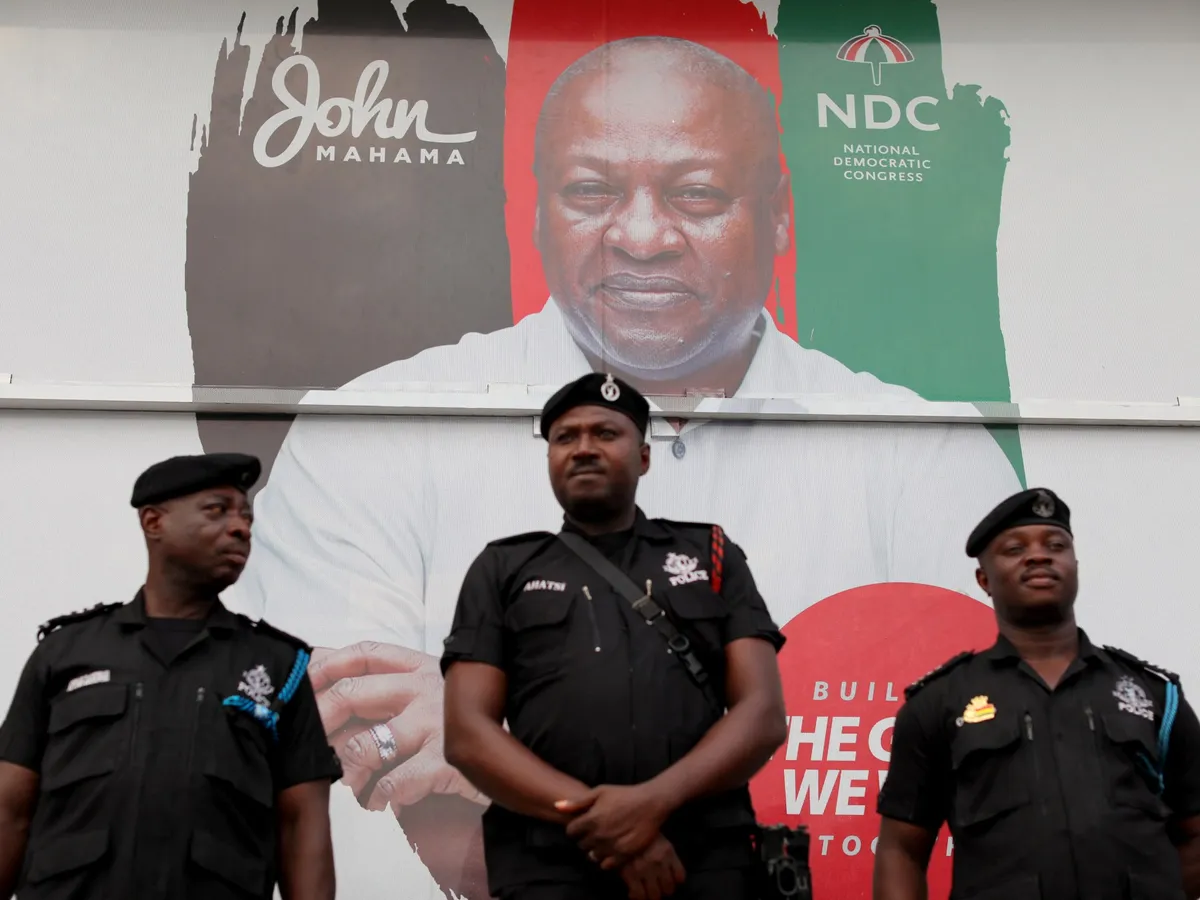
Ghana’s 14 arrests in 16 months linked to false news have raised concerns about free speech.A campaign image of then-presidential candidate Mahama" class="entity-link entity-person" data-entity-id="2804" data-entity-type="person">John Mahama the election that brought him to power [Francis Kokoroko/Reuters]Published On 6 Jun 2026Accra, Ghana – Ghana has recorded 14 arrests linked to false news and offensive speech in less than 16 months, nearly double the number documented during the previous administration’s entire eight-year tenure, according to the Media Foundation for West Africa (MFWA).The rise has triggered a sharp debate in one of West Africa’s most stable democracies over whether authorities are simply enforcing long-standing laws in a new digital environment, or edging into a more restrictive approach to public speech.The controversy carries added political weight because President Mahama" class="entity-link entity-person" data-entity-id="2804" data-entity-type="person">John Mahama, while in opposition in 2022, warned that using state power to intimidate dissent was a “dangerous blueprint” for democracy.Government: enforcement not repressionA senior ruling party official dismissed allegations that the arrests amount to a crackdown.“The opposition intentionally sponsors people to insult the President,” he told Al Jazeera. “When the law catches up with them, they cry persecution to score cheap political points.”He pointed to the case of TikToker Prince Ofori, known as “Fante Comedy”, who was arrested last August over alleged threats to President Mahama.Days after his arrest, Ofori appeared at a political rally alongside opposition figures, a development the official said showed how quickly such cases become politicised.“They paraded him at an opposition rally,” he said.Opposition: a warning sign for democracyOpposition leaders see something more troubling taking shape.Minority leader Alexander Afenyo-Markin has been among the most outspoken critics.“The state-sponsored persecution must stop,” he told Al Jazeera. “Arresting citizens for words that do not constitute genuine threats is not justice. It is intimidation.”Police officers on security patrol in front of the Ghana black star symbol [Frank Kporfor/Epa]He said free speech has limits, but argued that the state is increasingly crossing a line.“Excessive use of state power risks undoing Ghana’s hard-won democratic gains,” he said.Where is the line?At the centre of the debate are long-standing provisions in Ghana’s Criminal Code and Electronic Communications Act, which authorities say are now being applied to a fast-moving digital landscape.Government supporters argue the increase in arrests reflects the explosion of anonymous and unregulated online content.Critics say the problem is not the laws themselves, but how they are being used.A legal consultant who reviewed recent cases said he counted at least 16 alleged misapplications of Section 208 in the past 18 months, compared with roughly a dozen in the previous eight years.“The law has been abused beyond repair,” he said. “Repeal is the only remedy.”Veteran journalist Ben Ephson said Ghana needs clearer guidance on where free expression ends and harm begins.“The government must properly explain the arrests so people can draw the line between press freedom and responsible journalism,” he said.He added that both journalists and state institutions risk overstepping if the rules remain unclear.“When you compare the freedom of the media and the rights of the individual, we need to be careful that the media, in trying to do their work, don’t trample on people’s rights,” he said.A wider global debateOthers say Ghana’s debate mirrors tensions playing out in other democracies.Tegha King of the Universal Peace Federation Ghana said concerns about shrinking civic space are not unique to Ghana.“The global civic space must cultivate more free speech, not less,” he told Al Jazeera.He said stronger institutions, not more arrests, are needed to manage the pressures of the digital age.“There must be independent courts, transparent enforcement, media self-regulation and digital literacy,” he said.Civic awareness and external concernSome analysts point to gaps in public understanding of constitutional rights.“There is a lack of constitutional education among many Ghanaians,” said David Adofo of the African Chamber of Content Producers. “People must know the consequences of their actions before they act, not after.”Concerns are also being voiced outside the country.“We have had many concerns from diasporans about perceived erosion of press and political freedoms, especially news of blogger arrests,” said Nana Kofi Opoku-Agyemang of the NuGhana Expat Center. “Negative news sells fast. The government must be cautious so it does not project a negative image of Ghana in the diasporan community.”Government stanceOfficials insist there is no coordinated effort to silence dissent.An NDC communicator said the legal framework in question predates the current administration and defended the approach.“Ghana’s laws, Section 208 of the Criminal Code and Section 76 of the Electronic Communications Act, have been on the books for decades,” he said. “What has changed is the sheer volume of reckless, anonymous and sometimes dangerous content on social media. There is no systematic crackdown. There is simply enforcement of existing law.”Police stand guard during a Show of Force Exercise in Accra last December [Francis Kokoroko/Reuters]A political irony at the centre of it allGhana remains one of West Africa’s more open democracies, with a competitive political system and active media landscape.But the rise in speech-related arrests has sharpened scrutiny of how far the state can go in policing online expression without undermining the democratic culture that helped define its reputation.The debate is also politically charged because of Mahama’s own past warnings.As opposition leader, he described the use of state power against dissent as a “dangerous blueprint.” Today, critics say his government faces accusations it once condemned.For Alexander Afenyo-Markin, the moment calls for restraint — and reflection.“We should not continue to say that because it happened yesterday, it should happen today and tomorrow. That cycle must end,” he said. “President Mahama has an opportunity to leave a legacy of tolerance and free speech. I hope he takes it.”
SRCAl Jazeera
LANGEN
LEANCenter
WORDS927
ENT12
SAT · 2026-06-06 · 02:01 GMTBRIEF NSR-2026-0606-82152
NSR-2026-0606-82152News Report·EN·Human Rights
Arrests of critics in Ghana provokes alarm over free speech under Mahama
Ghana has seen a significant increase in arrests linked to false news and offensive speech, with 14 such arrests in under 16 months. This surge has sparked debate in Ghana over whether authorities are simply enforcing existing laws in the digital age or moving towards a more restrictive approach to public speech.
By Dwomoh-Doyen BenjaminAl JazeeraFiled 2026-06-06 · 02:01 GMTLean · CenterRead · 4 min
Al JazeeraFIG 01
Reading time
4min
Word count
927words
Sources cited
4cited
Entities identified
12entities
Quality score
100%
§ 01
Briefing Summary
AI-generatedNEWSAR · AI
Ghana has seen a significant increase in arrests linked to false news and offensive speech, with 14 such arrests in under 16 months. This surge has sparked debate in Ghana over whether authorities are simply enforcing existing laws in the digital age or moving towards a more restrictive approach to public speech. The government maintains these arrests are necessary to counter intentional insults and threats, citing cases like that of TikToker Prince Ofori. However, opposition leaders and legal experts argue that these laws are being abused to intimidate dissent and that the application of these laws needs clearer definition. Concerns about shrinking civic space are also being voiced internationally, with analysts suggesting stronger institutions and public education are needed to navigate the digital landscape.
Confidence 0.90Sources 4Claims 5Entities 12
§ 02
Article analysis
Model · rule-basedFraming
Human Rights
Political Strategy
Tone
Mixed Tone
AI-assessed
CalmNeutralAlarmist
Factuality
0.60 / 1.00
Mixed
LowHigh
Sources cited
4
Well sourced
FewMany
§ 03
Key claims
5 extracted01
The opposition intentionally sponsors people to insult the President; when the law catches up, they cry persecution.
quoteSenior ruling party official
Confidence
1.00
02
Arresting citizens for words that do not constitute genuine threats is intimidation, not justice.
quoteAlexander Afenyo-Markin
Confidence
1.00
03
The law has been abused beyond repair and repeal is the only remedy.
quoteLegal consultant
Confidence
0.90
04
Ghana has recorded 14 arrests linked to false news and offensive speech in less than 16 months.
statisticMedia Foundation for West Africa (MFWA)
Confidence
0.90
05
The number of arrests for false news in Ghana has nearly doubled compared to the previous administration's eight-year tenure.
statisticMedia Foundation for West Africa (MFWA)
Confidence
0.85
§ 04
Full report
4 min read · 927 words§ 05
Entities
12 identifiedKey playerOppositionContextPositiveNeutralNegative
People4
§ 06
Keywords & salience
9 termsfree speech
1.00
false news
0.90
arrests
0.80
ghana
0.70
democracy
0.70
john mahama
0.60
offensive speech
0.50
state power
0.40
digital environment
0.40
§ 07
Topic connections
Interactive graph Network visualization showing 38 related topics
View Full Graph Person Organization Location Event|Click node to navigate|Edge numbers = shared articles