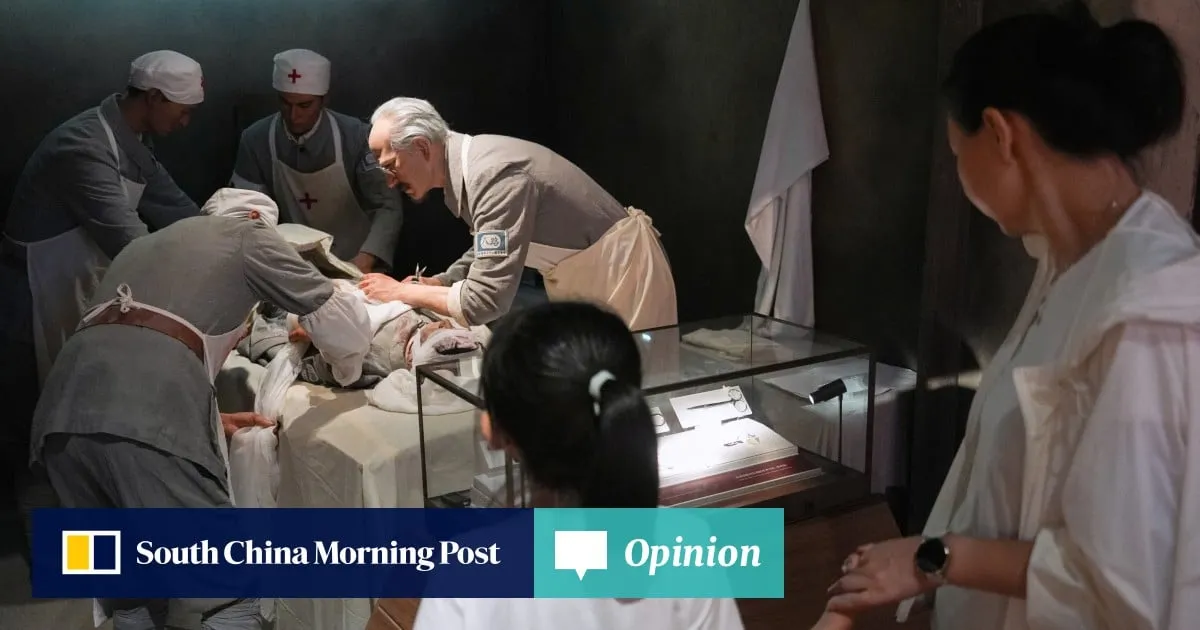
I grew up in a classroom where the name Norman Bethune was invoked with reverence. Like every schoolchild in China, I could recite from memory Chairman Mao’s 1939 essay “In Memory of Norman Bethune”, which characterised Bethune as a man who had come from afar, who gave his life to the Chinese revolution, who embodied selflessness and internationalism.For years, I kept a poster in my office – the famous oil painting of Mao meeting Bethune in Yan’an – as a quiet tribute. As the years passed and Canada-China relations cooled, mention of Bethune began to feel like a cliché, a relic of propaganda. It was only during a recent visit to the Norman Bethune memorial in Hebei’s Shijiazhuang city that I found myself confronting the man behind the myth, realising how little I truly knew of his life, his artistry and the full measure of his devotion to justice.The memorial does not merely rehearse the familiar narrative of the Canadian doctor who served in the war against Japanese aggression. It gathers artefacts that trace Bethune’s journey from Detroit to Montreal, as a thoracic surgeon and an artist, from a passionate advocate for socialised medicine to a volunteer in the Spanish Civil War, and finally to the dusty battlefields of northern China. One sees his sketches, his medical instruments, letters written in a hand that betrays both urgency and tenderness.The exhibition reveals a man who was not only a healer but also a creator, a thinker who believed medicine and art were both acts of solidarity.Standing before these objects, I felt a sudden, almost physical jolt: Bethune had been reduced to a symbol of Sino-Canadian friendship but was, in truth, a complex human being whose life pulsed with contradictions and convictions. His commitment was not a diplomatic gesture; it was a moral imperative born of witnessing inequality.This realisation came at a moment when official interactions between Ottawa and Beijing are often framed by trade disputes, strategic rivalry and mutual suspicion. The election of Mark Carney as prime minister, his visit to China in January and Foreign Minister Wang Yi’s recent visit to Ottawa – these are important developments, yet they occupy a plane far removed from the lived experience of ordinary people.
SRCSouth China Morning Post
LANGEN
LEANCenter-Right
WORDS371
ENT12
SAT · 2026-06-06 · 21:30 GMTBRIEF NSR-2026-0606-82308
NSR-2026-0606-82308Opinion·EN·Human Interest
Norman Bethune’s story still holds lessons for China-Canada relations
The author reflects on Norman Bethune, a Canadian doctor revered in China for his service during the war against Japanese aggression. Initially viewed as a propaganda symbol, a visit to Bethune's memorial revealed a complex individual, a surgeon and artist dedicated to justice and socialized medicine, who volunteered in the Spanish Civil War before going to China.
Wenran JiangSouth China Morning PostFiled 2026-06-06 · 21:30 GMTLean · Center-RightRead · 2 min
South China Morning PostFIG 01
Reading time
2min
Word count
371words
Sources cited
0cited
Entities identified
12entities
Quality score
100%
§ 01
Briefing Summary
AI-generatedNEWSAR · AI
The author reflects on Norman Bethune, a Canadian doctor revered in China for his service during the war against Japanese aggression. Initially viewed as a propaganda symbol, a visit to Bethune's memorial revealed a complex individual, a surgeon and artist dedicated to justice and socialized medicine, who volunteered in the Spanish Civil War before going to China. This personal realization contrasts with current strained Canada-China relations, which are dominated by trade disputes and rivalry, suggesting Bethune's story offers a deeper, human connection beyond official interactions.
Confidence 0.90Claims 4Entities 12
§ 02
Article analysis
Model · rule-basedFraming
Human Interest
Diplomatic
Tone
Measured
AI-assessed
CalmNeutralAlarmist
Factuality
0.30 / 1.00
Opinion-Heavy
LowHigh
Sources cited
0
No named sources
FewMany
§ 03
Key claims
4 extracted01
Official interactions between Ottawa and Beijing are often framed by trade disputes, strategic rivalry, and mutual suspicion.
factual
Confidence
1.00
02
Bethune is presented as a complex human being with contradictions and convictions, not just a symbol of Sino-Canadian friendship.
factual
Confidence
1.00
03
The Norman Bethune memorial in Shijiazhuang displays artifacts tracing his journey from Detroit to China, including his art and medical work.
factual
Confidence
1.00
04
Norman Bethune was characterized by Chairman Mao as a selfless internationalist who gave his life to the Chinese revolution.
quoteChairman Mao
Confidence
1.00
§ 04
Full report
2 min read · 371 words§ 05
Entities
12 identifiedKey playerOppositionContextPositiveNeutralNegative
People3
Locations8
§ 06
Keywords & salience
10 termsnorman bethune
1.00
china-canada relations
0.90
socialised medicine
0.70
internationalism
0.60
justice
0.50
propaganda
0.50
trade disputes
0.40
strategic rivalry
0.40
moral imperative
0.40
mutual suspicion
0.40
§ 07
Topic connections
Interactive graph Network visualization showing 51 related topics
View Full Graph Person Organization Location Event|Click node to navigate|Edge numbers = shared articles