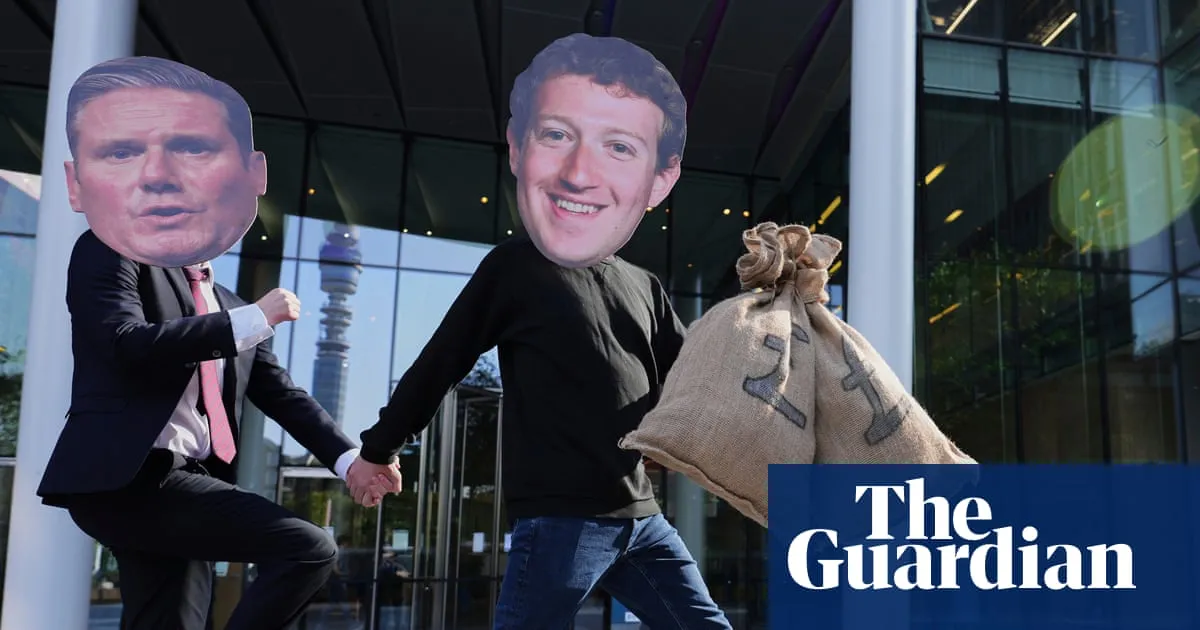
Tech companies have been meeting government ministers at a rate of more than once per working day, enjoying high-level political access that dwarfs that of child safety and copyright campaigners, who called the pattern “shocking” and “disturbing”.Amazon, Meta, Microsoft and Elon Musk’s X, whose Grok AI image generator has sparked outrage with its sexualised images of women and children, were among the US tech companies holding hundreds of meetings with people at the heart of government, a Guardian investigation has found.Google, the $4tn California company, had the greatest access, with more than 100 ministerial meetings, according to an analysis of meeting records for the two years to October 2025, which campaigners said showed the tech industry’s “capture” of government. The industry lobbying group Tech UK met ministers at the rate of more than once every eight working days.X attended 13 meetings, a small proportion of the overall number, but still more than the child safety campaign group the NSPCC or the Molly Rose Foundation, founded by the family of 14-year-old Molly Russell who killed herself after viewing harmful online content.“The frequency of meetings between government and big tech and their advocates is astounding and points to the incredible power imbalance at stake when it comes to protecting children online,” said Andy Burrows, the chief executive of the Molly Rose Foundation.Molly Russell, two years before she died. Photograph: Family handout/PAThe government defended its position, saying “regular engagement with technology companies is vital to delivering economic growth and transforming public services”. Campaigners said the government should stop “bending the knee to US big tech companies” and that the figures revealed an “incredible power imbalance” when it came to protecting children online.There has been growing controversy over X’s Grok AI tool, and a resurgence in the campaign for the government to follow Australia and ban social media for under-16s, which is opposed by tech companies. In the UK, 84% of people are concerned ministers will prioritise tech company partnerships over the public interest when it comes to AI regulation.Dame Chi Onwurah, the Labour chair of the science and technology select committee, said the findings underscored “the reality that these firms have turnovers larger than the GDP of many countries, and their ability to influence stands in stark contrast to that of their users, our constituents, or those campaigning to make the internet safer”.She said it was “crucial for big tech to be accountable to parliament – something that the disturbing recent news about ‘nudification’ tools has only underlined further”.Chi Onwurah MP said it was crucial that big tech was accountable to parliament. Photograph: Richard Gardner/Rex/ShutterstockThe technology companies and their lobbyists attended at least 639 meetings with ministers compared with just 75 meetings attended by the organisations and campaigners fighting for greater protections for children online, such as the NSPCC.The tech firms’ access was also more than three times greater than that of organisations and campaigners seeking to protect creatives’ copyrighted works from being mined to build AI models, a development that figures including Elton John and Kazuo Ishiguro have said risks giving away artists’ “lifeblood”.Ed Newton-Rex, a campaigner for creators’ rights, called the figures “shocking” and said they explained why ministers had launched their consultation on AI and copyright “with a ‘preferred option’ that read like a wishlist from big tech”.“It is imperative that the government stop bending the knee to US big tech companies – which, as the recent Grok debacle has shown, don’t have the interests of the British people at heart,” he said.A van drives through Westminster bearing a billboard organised by the corporate accountability group Eko urging the prime minister to shut down X and Grok. Photograph: Maja Smiejkowska/ReutersRecords of more than 11,000 meetings under both Labour and the Conservatives show there were almost 160 meetings with technology companies, more than 100 with organisations lobbying for protections over AI and copyright, and 25 with those involved in child safety.The US and Canadian AI start ups Anthropic, OpenAI and Cohere together had 27 meetings with ministers. Last summer they each signed memorandums of understanding with the UK government which included exploring using AI more in public services.A Department for Science, Innovation and Technology (DSIT) spokesperson said regular engagement with tech companies was essential to ensure safe deployment of their technology in the UK.“These meetings cover a wide range of issues – from investment and innovation to implementing our recent laws for a safer online world,” they said. “DSIT ministers also routinely meet with campaign and civil society groups. As her actions on online safety this week have shown, the science and tech secretary [Liz Kendall] is always prepared to stand up and uphold the law and British values.”Julian David, the chief executive of Tech UK, said that given its central role in so many aspects of the economy and society, “it is normal that the technology sector engages regularly and broadly with government”.Google said it worked closely with the government to ensure it had “a positive and safe impact in the UK through our investments in communities, digital skills training, new AI products and enhanced product design – including age assurance and compliance with the Online Safety Act”.Lady Beeban Kidron, who campaigns on child safety and copyright as a cross-bench peer, said: “Successive governments’ naivety in relation to tech lobbying is disturbing. This privileged access is mirrored in their policy, and tech industry talking points are parotted by officials. This capture creates harm.“In opposition, Labour promised safety for women and children, and to protect the creative industries, but in government they have refused to take necessary actions on both. It is not wrong to meet with tech companies, but these numbers tell us all we need to know. A government of a sovereign state has a duty to its own citizens, not to the tech bros.”
SRCThe Guardian - World News
LANGEN
LEANCenter-Left
WORDS966
ENT11
SAT · 2026-01-17 · 17:00 GMTBRIEF NSR-2026-0117-8251
NSR-2026-0117-8251News Report·EN·Political Strategy
Tech companies’ access to UK ministers dwarfs that of child safety groups
A Guardian investigation revealed that tech companies like Google, Amazon, Meta, Microsoft, and X have significantly more access to UK government ministers than child safety organizations. Between October 2023 and October 2025, tech companies and their lobbying groups met with ministers at a rate exceeding once per working day.
Robert Booth and Michael GoodierThe Guardian - World NewsFiled 2026-01-17 · 17:00 GMTLean · Center-LeftRead · 4 min
The Guardian - World NewsFIG 01
Reading time
4min
Word count
966words
Sources cited
6cited
Entities identified
11entities
Quality score
100%
§ 01
Briefing Summary
AI-generatedNEWSAR · AI
A Guardian investigation revealed that tech companies like Google, Amazon, Meta, Microsoft, and X have significantly more access to UK government ministers than child safety organizations. Between October 2023 and October 2025, tech companies and their lobbying groups met with ministers at a rate exceeding once per working day. Google alone had over 100 ministerial meetings. This disparity in access has drawn criticism from child safety campaigners, including the Molly Rose Foundation and the NSPCC, who argue it demonstrates a power imbalance that hinders online child protection. The government defends its engagement with tech companies as vital for economic growth and public service transformation, while critics urge a shift in focus towards public interest and stricter regulation, especially concerning AI and social media safety for minors.
Confidence 0.90Sources 6Claims 5Entities 11
§ 02
Article analysis
Model · rule-basedFraming
Political Strategy
Social Justice
Tone
Mixed Tone
AI-assessed
CalmNeutralAlarmist
Factuality
0.70 / 1.00
Factual
LowHigh
Sources cited
6
Well sourced
FewMany
§ 03
Key claims
5 extracted01
84% of people are concerned ministers will prioritise tech company partnerships over the public interest when it comes to AI regulation.
statisticnull
Confidence
1.00
02
The industry lobbying group Tech UK met ministers at the rate of more than once every eight working days.
factualThe Guardian analysis of meeting records
Confidence
1.00
03
Google had more than 100 ministerial meetings in the two years to October 2025.
factualThe Guardian analysis of meeting records
Confidence
1.00
04
Tech companies have been meeting government ministers at a rate of more than once per working day.
factualThe Guardian investigation
Confidence
1.00
05
The frequency of meetings points to the incredible power imbalance at stake when it comes to protecting children online.
quoteAndy Burrows, the chief executive of the Molly Rose Foundation
Confidence
0.90
§ 04
Full report
4 min read · 966 words§ 05
Entities
11 identifiedKey playerOppositionContextPositiveNeutralNegative
People4
§ 06
Keywords & salience
8 termstech companies
1.00
government access
0.90
child safety
0.80
political influence
0.70
online safety
0.60
power imbalance
0.50
ai regulation
0.50
lobbying
0.40
§ 07
Topic connections
Interactive graph Network visualization showing 51 related topics
View Full Graph Person Organization Location Event|Click node to navigate|Edge numbers = shared articles