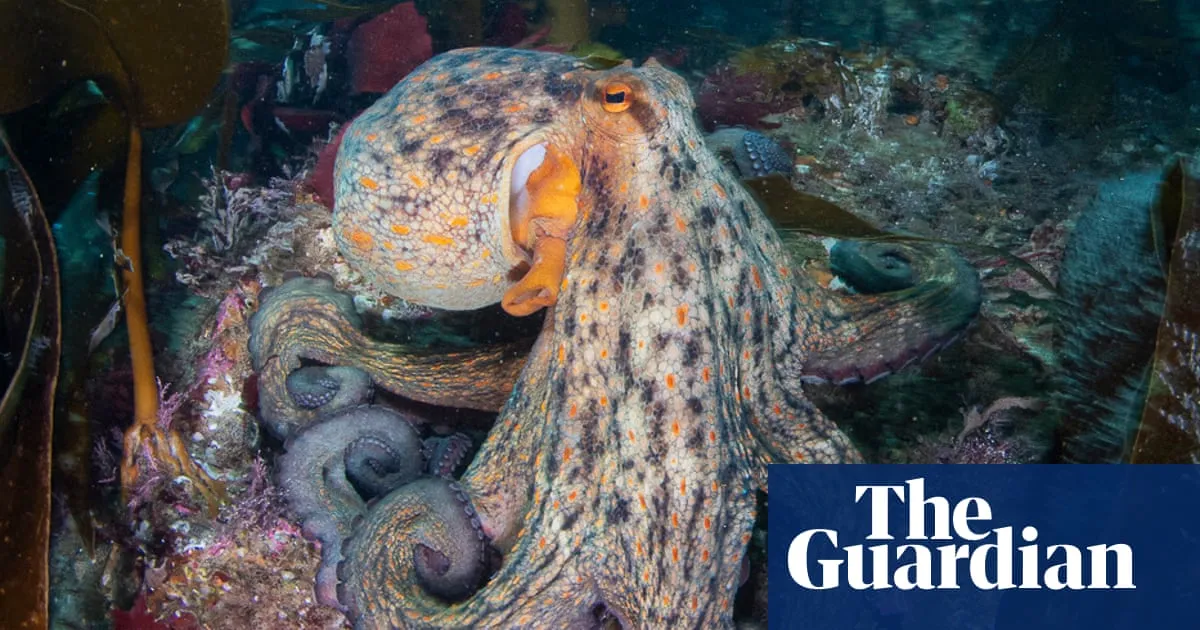
Record numbers of octopuses found off the south-west coast of England last year have now spread as far as Scotland and Wales and are transforming the fishing industry and the marine ecosystem, according to a study.The surge in sightings of one of the world’s most intelligent invertebrates was first recorded in 2025 off the south coast of Devon and Cornwall.A new study, based on scientific surveys, underwater monitoring and observations from recreational divers and snorkellers, has found octopuses have spread along the north coasts of Devon and Cornwall, with sightings as far afield as Wales, Dorset, East Sussex and Scotland.“It is pretty extraordinary,” said Bryce Stewart, a senior researcher at the Marine Biological Association and lead author of the study. “We have had blooms before but everything I am seeing is telling me this is the biggest bloom we have seen, it is quite different.”The common or Mediterranean Octopus, Octopus-vulgaris" class="entity-link entity-topic" data-entity-id="142324" data-entity-type="topic">Octopus vulgaris, is native to UK waters but ordinarily in such small numbers that it is rarely seen. A sudden increase in the population – a bloom – is caused by a combination of a mild winter followed by a warm breeding season in the spring, and researchers say the surging numbers in UK waters are likely to be linked to warming seas and wider changes in the marine environment.“Now we have warmer waters much more suited to these animals, we are seeing a huge increase in numbers,” Stewart said.‘It is a shake-up of the whole ecosystem.’ Photograph: Kirsty AndrewsThe current bloom has sparked growing interest from the public, with hundreds of divers and snorkellers helping scientists to survey the burgeoning Octopus population.The bloom has been mixed news for fishers. Those relying on traditional shellfish have been badly hit as octopuses, which are highly effective predators, target crabs and lobsters often from fishers’ pots. However, others have cashed in with record hauls of octopuses.Stewart said the Octopus catch increased by 7,700% in 2025 and just last week at Brixham market in Devon, where most of the catch is sold, a record 100 tonnes of Octopus was sold in one day.“Some fishermen have had to sell their boats because of the impact on crab and lobster populations, while others are doing extremely well,” he said.Stewart said the influx of octopuses was also upending the marine ecosystem. As well as preying on shellfish and some other fish, the Octopus were providing food for seals, conga eels and the rare risso’s dolphins. “It is a shake-up of the whole ecosystem,” he said.
SRCThe Guardian - World News
LANGEN
LEANCenter-Left
WORDS418
ENT11
MON · 2026-06-08 · 07:00 GMTBRIEF NSR-2026-0608-82622
NSR-2026-0608-82622News Report·EN·Environmental
Octopus surge spreads up UK coast as far as Scotland, study finds
A recent study reveals a significant surge in octopus populations across UK waters, extending from the south-west coast of England to Scotland and Wales. This "bloom," first observed in 2025, is attributed to warming seas and favorable breeding conditions, leading to unprecedented numbers of the common octopus, Octopus vulgaris.
Matthew TaylorThe Guardian - World NewsFiled 2026-06-08 · 07:00 GMTLean · Center-LeftRead · 2 min
The Guardian - World NewsFIG 01
Reading time
2min
Word count
418words
Sources cited
1cited
Entities identified
11entities
Quality score
100%
§ 01
Briefing Summary
AI-generatedNEWSAR · AI
A recent study reveals a significant surge in octopus populations across UK waters, extending from the south-west coast of England to Scotland and Wales. This "bloom," first observed in 2025, is attributed to warming seas and favorable breeding conditions, leading to unprecedented numbers of the common octopus, Octopus vulgaris. The increase is transforming the marine ecosystem, with octopuses preying on shellfish and impacting traditional fisheries. While some fishers have experienced reduced catches of crabs and lobsters, others have seen booming octopus harvests, with one market selling a record 100 tonnes in a single day. The study, based on scientific surveys and public observations, highlights the octopus bloom as a major shake-up for the marine environment and fishing industry.
Confidence 0.90Sources 1Claims 4Entities 11
§ 02
Article analysis
Model · rule-basedFraming
Environmental
Economic Impact
Tone
Mixed Tone
AI-assessed
CalmNeutralAlarmist
Factuality
0.80 / 1.00
Factual
LowHigh
Sources cited
1
Limited
FewMany
§ 03
Key claims
4 extracted01
The influx of octopuses is upending the marine ecosystem by preying on shellfish and providing food for other marine life.
factualBryce Stewart
Confidence
0.90
02
The octopus bloom has caused a 7,700% increase in octopus catch in 2025.
statisticBryce Stewart
Confidence
0.90
03
The surge in octopus numbers is linked to warming seas and changes in the marine environment.
factualBryce Stewart
Confidence
0.90
04
Record numbers of octopuses have spread from the south-west coast of England as far as Scotland and Wales.
factualstudy
Confidence
0.90
§ 04
Full report
2 min read · 418 words§ 05
Entities
11 identifiedKey playerOppositionContextPositiveNeutralNegative
People1
Locations7
§ 06
Keywords & salience
9 termsoctopus surge
1.00
marine ecosystem
0.90
warming seas
0.80
octopus population bloom
0.80
fishing industry
0.70
octopus vulgaris
0.60
predator-prey dynamics
0.50
uk coast
0.50
scientific study
0.40
§ 07
Topic connections
Interactive graph No topic relationship data available yet. This graph will appear once topic relationships have been computed.