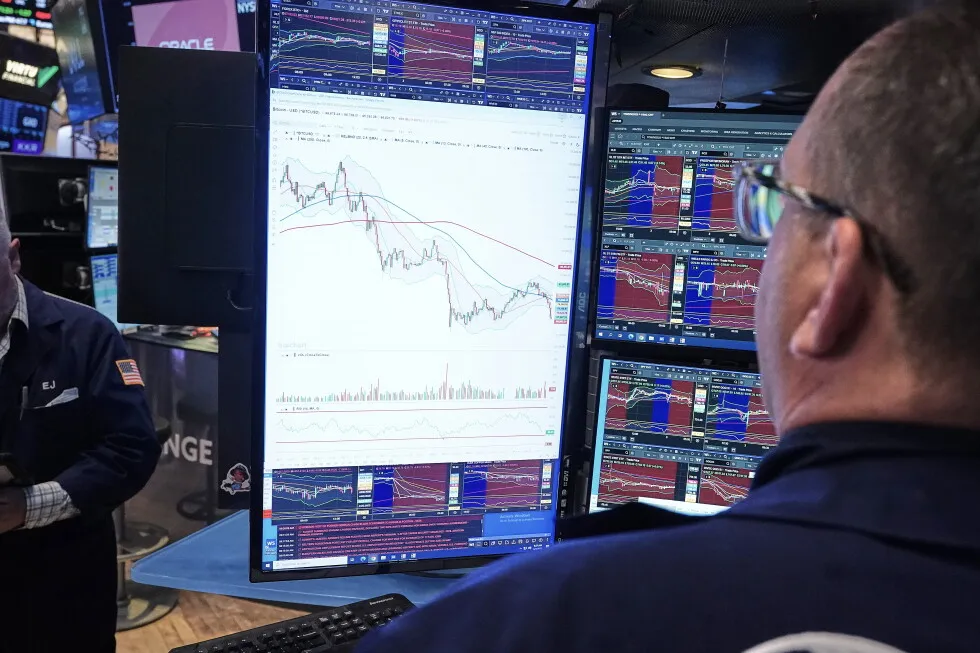
Asian shares drop after plunge in Big Tech stocks gives Wall St its worst day in months 1 of 5 | Specialist Anthony Matesic works at his post on the floor of the New York Stock Exchange, Wednesday, June 3, 2026. (AP Photo/Richard Drew) 2 of 5 | A screen shows the stock prices of South Korean chipmakers at the foreign exchange dealing room of the Hana Bank headquarters in Seoul, South Korea, Monday, June 8, 2026. (AP Photo/Ahn Young-joon) 3 of 5 | Currency traders pass by a screen showing the Korea Composite Stock Price Index (KOSPI) and the foreign exchange rate between U.S. dollar and South Korean won at the foreign exchange dealing room of the Hana Bank headquarters in Seoul, South Korea, Monday, June 8, 2026. (AP Photo/Ahn Young-joon) 4 of 5 | A trio of traders work on the floor of the New York Stock Exchange, Wednesday, June 3, 2026. (AP Photo/Richard Drew) 5 of 5 | A board above the trading floor of the New York Stock Exchange displays the closing number for the Dow Jones industrial average, Wednesday, June 3, 2026. (AP Photo/Richard Drew) By YURI KAGEYAMA Updated 8:45 AM MESZ, June 8, 2026 Leer en español Add AP News on Google Add AP News as your preferred source to see more of our stories on Google. Share Share Facebook Copy Link copied Print Email X LinkedIn Bluesky Flipboard Pinterest Reddit TOKYO (AP) — Asian shares skidded Monday after worries about Big Tech investments and rising odds for an Interest Rate Hike gave U.S. stocks their worst day since October. Japan’s benchmark Nikkei 225 dropped 4.5% to 63,604.15. The Japanese government revised the annualized economic growth rate to 1.8% for the first quarter this year, down from an earlier estimate of 2.1%. Despite Monday’s dip, the Nikkei is still trading at double the levels the benchmark was at five years ago. Oil prices surged as Israel launched airstrikes early Monday targeting central and western Iran in response to missile fire. Iranian state television reported the sound of explosions being heard in Isfahan, Tabriz and Tehran, without immediately elaborating. American and Iranian negotiators reached a tentative deal last week to extend their ceasefire, but the agreement has not been finalized and the latest attacks further strain efforts to end the conflict. Brent crude, the international standard, jumped $4.55 to $97.64 a barrel. Benchmark U.S. crude surged $4.17 to $94.71 a barrel. In other share trading, South Korea’s Kospi slipped 8.2% to 7,493.34 as Samsung Electronics, the country’s biggest company, dropped 9.7%. SK Hynix declined 7%. Japan records trade surplus as export growth balances out weak China demand Japan’s economy expands at a 2.1% annual pace, boosted by consumer spending US stocks lose ground as war with Iran keeps pressure on oil prices Hong Kong’s Hang Seng lost 1.7% to 24,527.22. The Shanghai Composite shed 1.8% to 3,955.72. Trading was closed in Australia for the King’s Birthday, a holiday. “Obviously, given the strength and the size of the rally over the past months, a deeper correction would be needed to bring valuations back to healthier and more fundamentally meaningful levels,” said Ipek Ozkardeskaya, senior analyst at Swissquote of what he called a “reality check” for the AI enthusiasm. Wall Street finished last week with the S&P 500 sinking 2.6%, to 7,383.74, after a strong jobs report boosted expectations that the Federal Reserve will raise rates at some point this year. It was the biggest one-day drop since Oct. 10, when the Trump administration threatened to impose a 100% tariff on imported goods from China. The Dow Jones Industrial Average fell 1.4% to 50,866.78. The Nasdaq composite slumped 4.2% to 25,709.43. Bond yields jumped after a report showed the U.S. added a surprising 172,000 jobs in May, according to the Labor Department. It is the latest report showing that employment remains solid, despite the squeeze inflation is putting on businesses and consumers. The yield on the 10-year Treasury rose to 4.54% from 4.50% just before the report was released. The yield on the 2-year Treasury, which more closely tracks the Fed’s actions, jumped to 4.16% from 4.04% just prior to the report. The Fed has been holding interest rates steady as it tries to gauge the ongoing impact from rising inflation. Prices were already ticking higher from the impact of tariffs. The U.S. war with Iran has essentially blocked crude oil shipments from moving through the Strait of Hormuz. In currency trading early Monday, the U.S. dollar inched up to 160.27 Japanese yen from 160.25 yen. The euro cost $1.1522, up from $1.1515. Yuri Kageyama is on Threads: https://www.threads.com/@yurikageyama YURI KAGEYAMA Kageyama covers Japan news for The Associated Press. Her topics include social issues, the environment, businesses, entertainment and technology. twitter instagram facebook mailto
SRCAssociated Press (AP)
LANGEN
LEANCenter
WORDS797
ENT12
MON · 2026-06-08 · 07:53 GMTBRIEF NSR-2026-0608-82625
NSR-2026-0608-82625News Report·EN·Economic Impact
Asian shares drop after plunge in Big Tech stocks gives Wall St its worst day in months
Asian shares declined on Monday, mirroring a significant drop on Wall Street, which experienced its worst day since October. This market downturn was attributed to concerns over Big Tech investments and increased likelihood of an interest rate hike.
Associated Press (AP)Filed 2026-06-08 · 07:53 GMTLean · CenterRead · 4 min
Associated Press (AP)FIG 01
Reading time
4min
Word count
797words
Sources cited
0cited
Entities identified
12entities
Quality score
100%
§ 01
Briefing Summary
AI-generatedNEWSAR · AI
Asian shares declined on Monday, mirroring a significant drop on Wall Street, which experienced its worst day since October. This market downturn was attributed to concerns over Big Tech investments and increased likelihood of an interest rate hike. Japan's Nikkei 225 fell 4.5%, with the government revising its first-quarter economic growth rate downward. South Korea's Kospi saw an 8.2% decrease, with major companies like Samsung Electronics experiencing substantial losses. Meanwhile, oil prices surged following Israeli airstrikes on Iran, further straining efforts to end the conflict. U.S. bond yields also rose after a stronger-than-expected jobs report fueled expectations of a Federal Reserve rate increase.
Confidence 0.90Claims 5Entities 12
§ 02
Article analysis
Model · rule-basedFraming
Economic Impact
Conflict
Tone
Measured
AI-assessed
CalmNeutralAlarmist
Factuality
0.90 / 1.00
Factual
LowHigh
Sources cited
0
No named sources
FewMany
§ 03
Key claims
5 extracted01
South Korea's Kospi index slipped 8.2% to 7,493.34, with Samsung Electronics dropping 9.7%.
statistic
Confidence
1.00
02
Brent crude oil prices surged $4.55 to $97.64 a barrel following Israeli airstrikes in Iran.
statistic
Confidence
1.00
03
The Japanese government revised its Q1 annualized economic growth rate to 1.8% from 2.1%.
statistic
Confidence
1.00
04
Japan’s Nikkei 225 index fell 4.5% to 63,604.15.
statistic
Confidence
1.00
05
Asian shares dropped after U.S. stocks experienced their worst day in months due to Big Tech investment worries and potential interest rate hikes.
factual
Confidence
1.00
§ 04
Full report
4 min read · 797 words§ 05
Entities
12 identifiedKey playerOppositionContextPositiveNeutralNegative
Organizations3
Locations8
§ 06
Keywords & salience
10 termsbig tech stocks
1.00
asian shares
1.00
wall street
0.90
interest rate hike
0.80
oil prices
0.70
israel airstrikes
0.60
kospi
0.50
nikkei 225
0.50
economic growth rate
0.40
ceasefire
0.40
§ 07
Topic connections
Interactive graph Network visualization showing 51 related topics
View Full Graph Person Organization Location Event|Click node to navigate|Edge numbers = shared articles