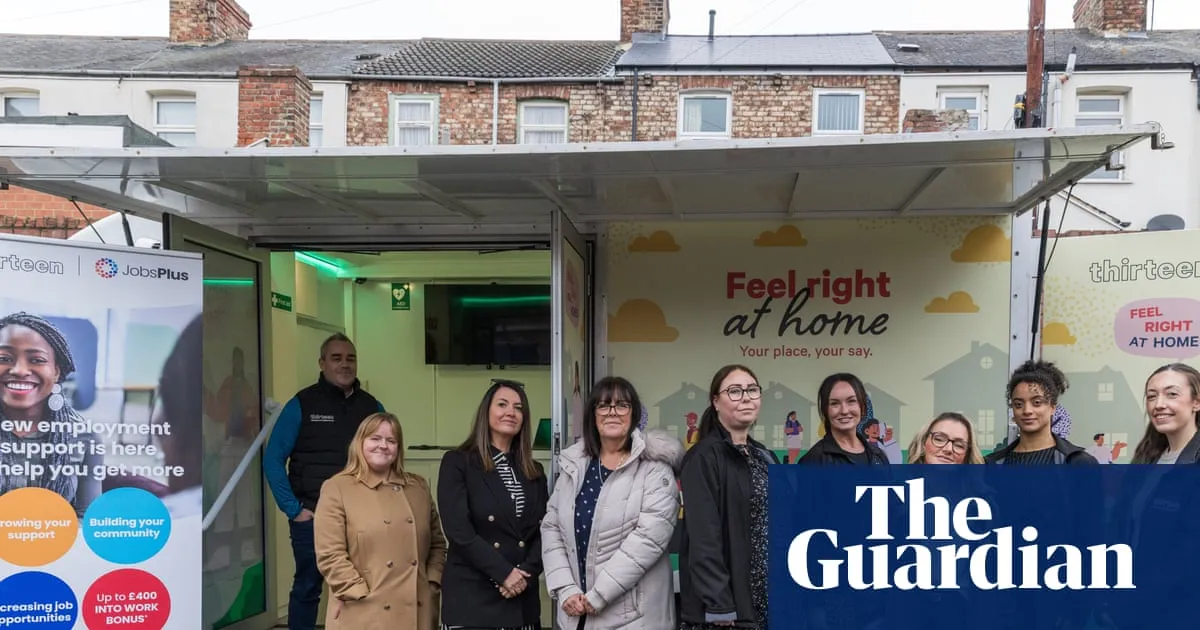
A government-funded pilot of “hyperlocal” job support in 10 neighbourhoods across England has shown “promising early signs of effectiveness”, including for young people, and could be scalable nationwide, a new evaluation has shown.The JobsPlus scheme, backed by the Department for Work and Pensions (DWP) and the Youth Futures Foundation, an independent non-profit organisation, focuses intensive support in a small area of predominantly social housing. Echoing a similar, long-established scheme in the US, “community champions” at each site help to engage hard-to-reach people in the local area.Residents of social housing are almost twice as likely to be unemployed as the population as a whole, and many of the participants have barriers to work such as caring responsibilities or a health condition.JobsPlus caseworkers offer one-to-one support, financial help with needs such as interview clothing or transport to facilitate finding work, and can connect clients with local employers, Jobcentre Plus offices or NHS services.The evaluation found the pilots were “engaging residents who are typically further from the labour market and who may require longer and more intensive support before employment outcomes can be achieved”.‘Everything is done within the community so that [clients] don’t have to venture out as much – sometimes it’s about building their confidence,’ says Lyndsey Henry, left, seen here with her fellow caseworkers at the pilot scheme in Stockton on Tees. Photograph: Gary Calton/The GuardianBetween July 2024 and December last year, 27% of the 1,000-plus participants in the scheme had achieved a positive employment outcome – in the vast majority of cases, moving from unemployment into a job, or for a few, finding a better job.Participants as a whole reported “improvements in mental health including reduced anxiety, low mood and social isolation alongside improved resilience”, the evaluation found, many feeling these improvements were “essential precursors to applying for roles or sustaining work once secured”.About a third of those enrolled so far (31%) are aged 16-24, compared with 12% of local people in the eligible locations.Labour is keen to experiment with ways of supporting young people into jobs or training, with the number of 16-to 24-year-olds not in employment, education or training (Neet) exceeding 1 million for the first time in a decade. The former minister Alan Milburn is reviewing this issue for the government, and underlined the scale of the problem in his interim report last month.Stephen Evans, the chief executive of the Learning and Work Institute, the independent policy and research organisation which is running the pilot schemes, said: “With over a million young people now estimated to not be in education, employment or training, it’s time to move from analysis to action.“We welcome findings that the hyperlocal approach of JobsPlus offers that chance of action: proactively finding and supporting young people in their local communities, and offering wrap-around support that understands them as people.”The 10 pilot schemes, in locations including Stockton-on-Tees, Toxteth and Wirral on Merseyside, and Penge in south London, have been funded by DWP until next March.Diana Johnson, the minister for employment, said too many young people were ‘not accessing the support that exists to help them, and that must change’. Photograph: Jonathan Brady/PAThe minister for employment, Diana Johnson, said: “Too many young people are currently not accessing the support that exists to help them, and that must change. That’s why we are backing innovative approaches like JobsPlus, which works directly with local communities to find and support young people.”She added: “JobsPlus complements our youth guarantee – our commitment to giving every young person the chance to earn or learn – by reaching those who have fallen furthest from the system.”The evaluation was carried out by the independent Institute for Employment Studies, which said the scheme could be scaled up nationally.One aspect of the pilots has been a £400 “into work bonus” for people who manage to find a job and remain employed for two months. The evaluation found this was “useful but not central” to achieving successful outcomes.
SRCThe Guardian - World News
LANGEN
LEANCenter-Left
WORDS653
ENT12
MON · 2026-06-08 · 23:01 GMTBRIEF NSR-2026-0609-82825
NSR-2026-0609-82825News Report·EN·Social Justice
Pilot ‘hyperlocal’ job support scheme in England shows promising signs of effectiveness
A government-funded pilot program called JobsPlus, operating in 10 English neighborhoods, has shown promising early results in supporting people into employment, particularly young individuals. Backed by the Department for Work and Pensions and the Youth Futures Foundation, the scheme provides intensive, localized support to individuals in social housing, many of whom face barriers like caring responsibilities or health conditions.
Heather Stewart Economics editorThe Guardian - World NewsFiled 2026-06-08 · 23:01 GMTLean · Center-LeftRead · 3 min
The Guardian - World NewsFIG 01
Reading time
3min
Word count
653words
Sources cited
3cited
Entities identified
12entities
Quality score
100%
§ 01
Briefing Summary
AI-generatedNEWSAR · AI
A government-funded pilot program called JobsPlus, operating in 10 English neighborhoods, has shown promising early results in supporting people into employment, particularly young individuals. Backed by the Department for Work and Pensions and the Youth Futures Foundation, the scheme provides intensive, localized support to individuals in social housing, many of whom face barriers like caring responsibilities or health conditions. "Community champions" engage hard-to-reach residents, offering one-to-one casework, financial assistance for work-related needs, and connections to employers and services. The evaluation found that 27% of over 1,000 participants achieved a positive employment outcome, and many reported improvements in mental health and resilience. The scheme's success suggests it could be scaled nationwide to address the issue of young people not in employment, education, or training.
Confidence 0.90Sources 3Claims 5Entities 12
§ 02
Article analysis
Model · rule-basedFraming
Social Justice
Economic Impact
Tone
Measured
AI-assessed
CalmNeutralAlarmist
Factuality
0.80 / 1.00
Factual
LowHigh
Sources cited
3
Well sourced
FewMany
§ 03
Key claims
5 extracted01
The number of 16-to 24-year-olds not in employment, education, or training (Neet) has exceeded 1 million for the first time in a decade.
statisticarticle
Confidence
0.95
02
Between July 2024 and December last year, 27% of the 1,000-plus participants in the scheme had achieved a positive employment outcome.
statisticevaluation
Confidence
0.95
03
Participants reported improvements in mental health, including reduced anxiety, low mood, and social isolation.
factualevaluation
Confidence
0.90
04
Residents of social housing are almost twice as likely to be unemployed as the population as a whole.
statisticarticle
Confidence
0.90
05
A pilot of “hyperlocal” job support in 10 English neighbourhoods shows promising early signs of effectiveness, including for young people.
factualevaluation
Confidence
0.90
§ 04
Full report
3 min read · 653 words§ 05
Entities
12 identifiedKey playerOppositionContextPositiveNeutralNegative
Organizations4
§ 06
Keywords & salience
10 termsjob support scheme
1.00
hyperlocal
0.90
jobsplus
0.80
youth employment
0.80
social housing
0.70
hard-to-reach people
0.60
community champions
0.60
mental health
0.50
barriers to work
0.50
neet
0.40
§ 07
Topic connections
Interactive graph Network visualization showing 51 related topics
View Full Graph Person Organization Location Event|Click node to navigate|Edge numbers = shared articles