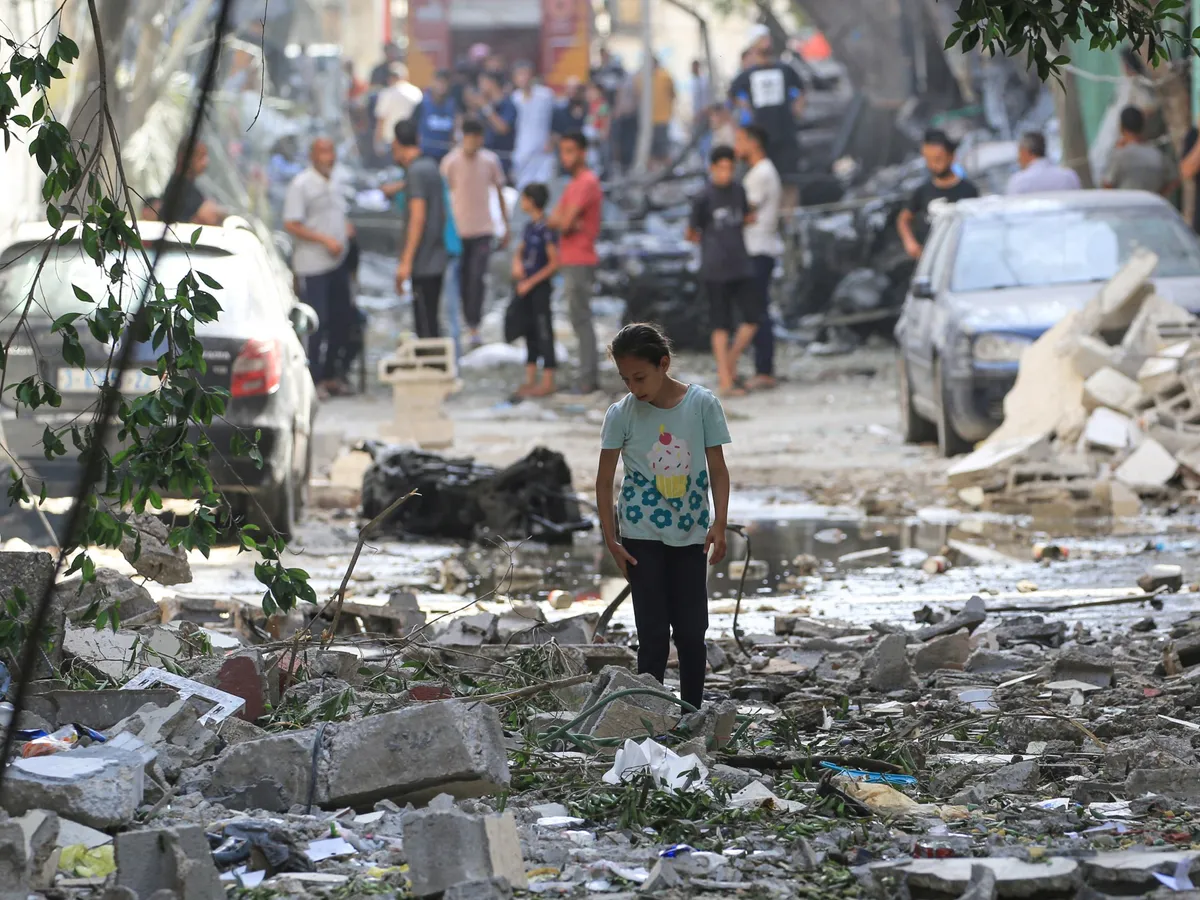
ESSAYMy family survived the massacre that freed four captives and killed hundreds of innocents. Its wounds and nightmares have not left us.A Palestinian girl walks amid the debris a day after the deadly 'rescue' operation by the Israeli military in the Nuseirat camp, in the central Gaza Strip on June 9, 2024 [Eyad Baba/AFP]Published On 9 Jun 2026In May 2024, after seven months of displacement and moving between tents and other people’s houses, we returned to Nuseirat-refugee-camp" class="entity-link entity-location" data-entity-id="5996" data-entity-type="location">Nuseirat refugee camp in central Gaza. Our home had been made uninhabitable in an attack in January, so we rented an apartment overlooking what is now called the “yellow line”.There were seven of us: my parents, my two sisters, 23-year-old Eman and 20-year-old Yasmin, my nine-year-old brother Abdullah, my bedridden grandmother, and me.We thought we might finally have some semblance of stability.Instead, we faced horror.On the morning of June 8, 2024, my father looked out of the window and saw a thick cloud of dust on the horizon. He alerted us. When we looked more closely, we saw military vehicles moving in the area.Some neighbours left, but we stayed. We were convinced the movement was still far from us.Then, in a single moment, everything changed.A shell struck our apartment, destroying parts of it. I was in the corridor when the explosion happened. Outside, a drone hovered above the building, as if checking that no life remained.The pressure of the explosion was suffocating. Sound almost disappeared, as if we were underwater.I could hear my father calling us, as if from far away, but whenever I tried to answer, my voice disappeared.Then I saw my sister Eman crawling towards me. She was covered in blood. Her injuries were so severe that, at first, I could not recognise her.My younger sister Yasmin was in no better condition. Three pieces of shrapnel had struck her chest, leaving her struggling for air.My mother had suffered a devastating facial injury. The force of the explosion had torn away part of her cheek, leaving a gaping wound.We managed to crawl out of the apartment and reach my father outside the door. I was relieved to see my little brother Abdullah there with him. He did not appear to have any serious injuries. My father had shielded him, taking the shrapnel himself. He had been struck in both legs and was in immense pain.My bedridden grandmother was still inside. We initially thought she had not survived, but my father went back in to check on her despite the danger.Thankfully, she was alive, though also injured by shrapnel. My father carried her out. With great difficulty, we dragged ourselves down to the ground floor and stepped outside.The shelling was still ongoing. We tried calling an ambulance again and again, but no one picked up. Eventually, someone answered. The voice on the other end was clear and harsh: “I cannot reach you. The tank is at the end of the street, and if we move, the ambulance will be targeted.”His words fell on us heavier than the shelling itself.There was no help on the way. There was no way out.We waited by the entrance of the half-destroyed building, bleeding and struggling to breathe, for over three hours. My sisters and mother were slipping in and out of consciousness.My sister Eman was lying on the ground in a pool of blood, while my brother Abdullah sat beside her, saying in a trembling voice: “Say there is no god but God… say God is great… say the shahada.”On the other side, my other sister Yasmin was calling out to me in a broken voice, injured in her chest, barely breathing: “Lina… I can’t… help me… I can’t breathe…”The ambulance finally arrived. It carried us through streets covered in rubble.At Al-Aqsa Martyrs Hospital, we found an even greater horror.When the doors opened, we saw hundreds of people waiting: tense faces, frightened eyes, some searching for family members, others already grieving.Inside, the floor was covered in blood. People kept trying, futilely, to wipe it away.The horror was difficult to comprehend as real: hundreds of injured people, bodies without limbs, screams and moans merging into one another. I tried to distract my brother, but there was nowhere to look that was not covered in blood.A nurse approached and examined me. She noticed an injury I had not even realised I had. “Don’t be afraid,” she said calmly. “Stay here.”I stood there barefoot, staring at everything around me in silence. I was not crying. I was in a state of complete shock, as if my mind had detached from reality but was still observing it.It was in that state, surrounded by blood and screams, that I first heard someone describe what had just happened as a “military operation to free captives”.We stayed in the hospital for five days. Five days in which I did not sleep. Every time I closed my eyes, the scenes of death returned to me: tanks, dust and the explosion.After we were discharged, we went back to the apartment because we had no other shelter. But staying there, in the place where it had happened, was psychologically unbearable. Eventually, we moved back into a tent.The impact of that day is still visible in my family. My sister Eman still has a shrapnel fragment lodged in her hand near a sensitive nerve. It cannot be removed because of the risk of permanent damage to her hand’s movement, despite the constant pain it causes her.Yasmin still carries shrapnel in her chest, which left her struggling to breathe for a long time. My mother’s facial wound remains clearly visible. My grandmother continues to live with shrapnel injuries across her back and ongoing pain, made worse by her age and weak immunity.Two rooms of our apartment were completely destroyed, and most of our belongings, including clothes and furniture, were damaged by shrapnel. We became afraid of windows, and of any place exposed to the outside. Every view out took us back to the moment of the shelling, and to the terror that came with it, a memory that has not left us since.It was only after I recovered that I saw how the attack that shattered our family was being described: a “successful rescue operation”. Reports described how armed individuals in civilian clothing had entered the area in aid trucks, while others had spent time in the streets posing as vendors as a form of camouflage. At the same time, dozens of tanks had advanced towards Salah al-Din Street, where we were living, and the main roads had been surrounded under heavy fire, including shooting from helicopters and quadcopters.The so-called “rescue operation” killed at least 274 people and injured nearly 700 others, according to health authorities. Nevertheless, some media outlets described it as “bold” and considered it an outright “Israeli success” because it freed a few captives. No attention was paid to the destruction left behind, or to the lives shattered in the process.That Nuseirat had been turned into hell was no more than a line in news bulletins.Two years later, I still wake up to recurring nightmares: shelling, tanks, loud sounds, and seas of blood. Any sound of shelling still brings me back to that moment, to the same feeling of suffocation and danger, and to the question that has never left me: Will I survive this time?No one has been held accountable.No real investigation has been opened.Two years after that massacre, the tragedy is still ongoing in different forms. Violations continue day after day without any real accountability, and there is no actual ceasefire that can be felt on the ground.There is no safe place in Gaza. The skies are constantly filled with surveillance drones watching us around the clock, along with repeated artillery shelling and the continuous expansion of what is known as the “yellow line”, which keeps increasing the zones of danger and further restricting people’s movement.
SRCAl Jazeera
LANGEN
LEANCenter
WORDS1 311
ENT10
TUE · 2026-06-09 · 06:12 GMTBRIEF NSR-2026-0609-82907
NSR-2026-0609-82907Opinion·EN·Human Interest
Two years after Israel’s Nuseirat ‘rescue’ success, we are still bleeding
On June 8, 2024, the author's family was injured when their apartment in the Nuseirat refugee camp was struck by a shell during what the article describes as an Israeli military operation. The author, her parents, two sisters, brother, and grandmother were all affected, with severe injuries sustained by the sisters and mother, and the father shielding their youngest brother.
Lina Ghassan Abu ZayedAl JazeeraFiled 2026-06-09 · 06:12 GMTLean · CenterRead · 6 min
Al JazeeraFIG 01
Reading time
6min
Word count
1 311words
Sources cited
0cited
Entities identified
10entities
Quality score
100%
§ 01
Briefing Summary
AI-generatedNEWSAR · AI
On June 8, 2024, the author's family was injured when their apartment in the Nuseirat refugee camp was struck by a shell during what the article describes as an Israeli military operation. The author, her parents, two sisters, brother, and grandmother were all affected, with severe injuries sustained by the sisters and mother, and the father shielding their youngest brother. The family faced significant delays in receiving medical assistance due to the ongoing military activity. At Al-Aqsa Martyrs Hospital, they witnessed widespread casualties and a chaotic environment. The author recounts hearing the event described as a "military operation to free captives" while in shock. The family returned to their damaged apartment due to lack of shelter, continuing to experience trauma from the event.
Confidence 0.90Claims 5Entities 10
§ 02
Article analysis
Model · rule-basedFraming
Human Interest
Conflict
Tone
Sensational
AI-assessed
CalmNeutralAlarmist
Factuality
0.20 / 1.00
Opinion-Heavy
LowHigh
Sources cited
0
No named sources
FewMany
§ 03
Key claims
5 extracted01
The author's mother suffered a devastating facial injury, with part of her cheek torn away.
factual
Confidence
1.00
02
The author's sister Yasmin sustained chest injuries from shrapnel.
factual
Confidence
1.00
03
The author's sister Eman was covered in blood and unrecognizable due to severe injuries.
factual
Confidence
1.00
04
On the morning of June 8, 2024, the author's apartment was struck by a shell, causing severe injuries to family members.
factual
Confidence
1.00
05
The author's family returned to their home in Nuseirat refugee camp in May 2024 after seven months of displacement.
factual
Confidence
1.00
§ 04
Full report
6 min read · 1 311 words§ 05
Entities
10 identifiedKey playerOppositionContextPositiveNeutralNegative
People4
§ 06
Keywords & salience
9 termsnuseirat camp
1.00
gaza
0.90
rescue operation
0.80
civilian casualties
0.70
refugee camp
0.60
military attack
0.50
displacement
0.50
family trauma
0.40
shrapnel injuries
0.40
§ 07
Topic connections
Interactive graph Network visualization showing 51 related topics
View Full Graph Person Organization Location Event|Click node to navigate|Edge numbers = shared articles