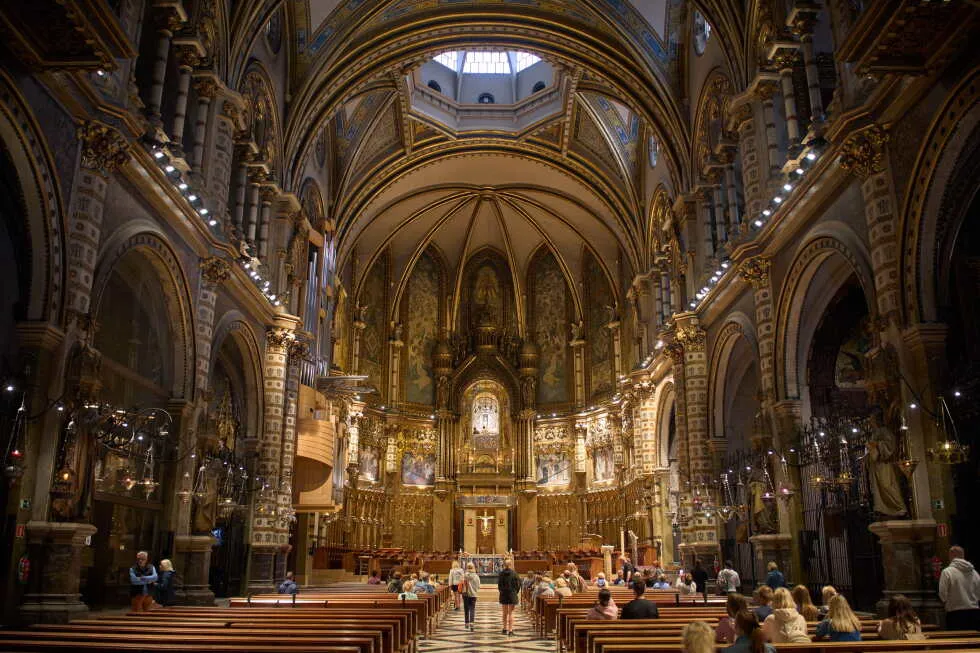
Pope Leo will tap into the Sagrada Familia’s allure while honoring Catalonia’s holy mountain 1 of 6 | A view of the Montserrat" class="entity-link entity-location" data-entity-id="142948" data-entity-type="location">Basilica of Montserrat at the Montserrat" class="entity-link entity-location" data-entity-id="142947" data-entity-type="location">Monastery of Montserrat near Barcelona, Spain, Friday, June 5, 2026. (AP Photo/Emilio Morenatti) 2 of 6 | A view of the Basilica of the Sagrada Familia in Barcelona, Spain, Wednesday, May 20, 2026, ahead of Pope Leo XIV’s visit to the city in June. (AP Photo/Emilio Morenatti) 3 of 6 | Visitors take photos inside the Basilica of the Sagrada Familia in Barcelona, Spain, Tuesday, May 26, 2026, ahead of Pope Leo XIV’s visit to the city in June. (AP Photo/Emilio Morenatti) 4 of 6 | Tourists are reflected in the glass of a museum on the main square of the Montserrat" class="entity-link entity-location" data-entity-id="142947" data-entity-type="location">Monastery of Montserrat near Barcelona, Spain, Friday, June 5, 2026. (AP Photo/Emilio Morenatti) 5 of 6 | A view of the Basilica of the Sagrada Familia in Barcelona, Spain, Saturday, May 30, 2026, ahead of Pope Leo XIV’s visit to Barcelona in June. (AP Photo/Emilio Morenatti) 6 of 6 | Tourists pose for a photo at the main square of the Montserrat" class="entity-link entity-location" data-entity-id="142947" data-entity-type="location">Monastery of Montserrat near Barcelona, Spain, Friday, June 5, 2026. (AP Photo/Emilio Morenatti) By JOSEPH WILSON Updated 7:07 AM MESZ, June 9, 2026 Add AP News on Google Add AP News as your preferred source to see more of our stories on Google. Share Share Facebook Copy Link copied Print Email X LinkedIn Bluesky Flipboard Pinterest Reddit Barcelona, Spain (AP) — Pope Leo XIV will bridge 1,000 years of church history Wednesday, visiting a medieval monastery on a mountaintop that local Catholics consider sacred and then celebrating Mass at Barcelona’s famous Sagrada Familia Basilica. Montserrat, a healthy drive from the city followed by a steep ascent, is dear to many of the Catalan people in northeastern Spain. Annually, 2 million people travel to the complex that includes an 11th-century Benedictine abbey as well as a 16th-century basilica. Its Black Madonna statue, which studies show originally was white but turned dark by centuries of smoke and incense before being painted black, is widely revered. But for many Catholics watching from afar — and especially non-Catholics — the highlight of the Chicago-born pope’s seven-day trip to Spain will be his evening Mass at the Sagrada Familia — the Basilica of the Holy Family — commemorating the centennial of the death of its architect, Antoni Gaudí. Leo will speak almost exclusively Spanish on the trip, with some comments in Catalan. What to know about Pope Leo’s trip to Spain, from political scandal to Barcelona’s architectural gem Returning to the fold? Some young Spaniards embrace Catholicism and can’t wait for Pope Leo’s visit Pope Leo XIV urges Spain to stop fanning flames of polarization on first papal visit in 15 years The visit illustrates his balancing act of upholding centuries-old religious traditions in a country where faith is waning while reaching a global audience from a basilica that is more a magnet for tourists than believers. Yet the two sites share a connection even some locals don’t know. A view of the Basilica of the Sagrada Familia in Barcelona, Spain, Wednesday, May 20, 2026, ahead of Pope Leo XIV’s visit to the city in June. (AP Photo/Emilio Morenatti) A pulpit for the world The Sagrada Familia fuses the universal language of nature — trees, birds, reptiles, cornucopias of fruit — with scenes from Christ’s life. Beyond that unique aesthetic, its allure stems from allowing visitors to bear witness to a great church’s ongoing construction. That began 144 years ago, with the first cornerstone laid in 1882 during the pontificate of Leo’s namesake, Pope Leo XIII. Its claim to “the new” is what sets Gaudí’s masterpiece apart from Europe’s other cathedrals and why it has captivated millions. Leo’s Mass is an opportunity to link him with this breathtaking place of worship. “Its stones and stained glass speak of the possibility of conjuring up 2,000 years of Christian history from a modern and even postmodern view,” Ferran Sáez, professor of humanities at Barcelona’s University of Ramón Llull, told The Associated Press. “It is a building that expresses very complex ideas while coming across as comprehensible for anyone who is receptive, whether they are Christian or not.” The Sagrada Familia is an international sensation, featuring on virtually any self-respecting globetrotter’s bucket list. Foreigners account for 90% of its visitors, whose entrance fees fund its construction, and more Americans visit than Spaniards, according to the basilica. While there aren’t statistics on visitors’ average age, it is hugely popular among adolescents and twentysomethings. That’s in stark contrast to the graying parishioners at most Spanish churches at a moment the Catholic Church strives to engage with and remain relevant to youth. The basilica’s latest superlative — world’s tallest church, with its recently raised Tower of Jesus Christ — has made it an even greater beacon. Visitors take photos inside the Basilica of the Sagrada Familia in Barcelona, Spain, Tuesday, May 26, 2026, ahead of Pope Leo XIV’s visit to the city in June. (AP Photo/Emilio Morenatti) Catalans see Montserrat as a spiritual home The Sagrada Familia is a global pulpit, but it’s set in a country where Christianity is receding. Spain underwent a religious crisis in the late 20th century during its return to democracy. Just over half of Spaniards polled by the state opinion agency in 2024 self-identified as Catholics, but only about 1 in 5 called themselves practicing Catholics. And Catalonia is one of Spain’s most secular provinces, Sáez said. Catalonia’s Catholics are reserved in their practice, without flamboyant Easter Week processions like those in Seville and other Spanish cities. The force of their faith rests in its holy places: the Sagrada Familia, the Poblet monastery and the Romanesque churches dotting the foothills of the Pyrenees. And, above all, in Montserrat, where pilgrims arrive by bus, cable car, cog railway and strenuous trails. “It is home to our most beloved representation of Mary, the Black Madonna,” Catalan theologian Francesc Torralba told AP. “Many Catalans pray to her and feel close to her in times of need. Montserrat is a key to our culture, as well as our efforts to maintain our language and our traditions.” While Montserrat is the region’s religious epicenter, its faith is “culturally expressed in its artistic creations” like the Sagrada Familia, he added. Tourists pose for a photo at the main square of the Montserrat" class="entity-link entity-location" data-entity-id="142947" data-entity-type="location">Monastery of Montserrat near Barcelona, Spain, Friday, June 5, 2026. (AP Photo/Emilio Morenatti) Throngs of tourists And it’s that unbridled and unique artistry that draws so many visitors. Many Barcelona residents feel the Sagrada Familia’s fame has driven some of overtourism’s worst ills. Tour buses flood the area with day-trippers from cruise ships, and streets facing the church are full of fast food restaurants and souvenir shops. Protesters who squirted tourists with water guns last year were planning to reach the Sagrada Familia until police stopped them. “Where there are two people (tourists and locals), there can be friction, and that happens in the best marriages,” the Sagrada Familia’s rector, the Rev. Josep Turull, told AP. “So we try, just like with a marriage, for these small crises to be growing pains, and that’s why we try to not just welcome pilgrims and tourists but also make sure that our parishioners feel that this is their basilica.” Leo could bring even more tourists. Pope Benedict XVI’s consecration to make it an operating basilica in 2010 boosted visits from about 3 million a year to nearly 5 million in 2025, according to Xavier Martínez, the CEO of the Sagrada Familia’s construction project. “I believe that on June 10 we will experience something similar to what we saw in 2010,” Martínez said. “At that time, the world discovered the interior of the Sagrada Familia. Now the world will discover the towers of the Sagrada Familia.” Tour guide and historian Mònica Santín has seen the Sagrada Familia’s stunning power for believers and nonbelievers alike; some even weep upon crossing the church’s threshold. As personally fulfilling as it is to help tourists achieve these life-changing moments, she is concerned Leo’s Mass could drive tourism to levels that are unsustainable for the community. A view of the Basilica of the Sagrada Familia in Barcelona, Spain, Saturday, May 30, 2026, ahead of Pope Leo XIV’s visit to Barcelona in June. (AP Photo/Emilio Morenatti) The sacred sites share a connection Santín has reserved her spot to see Leo in person, but it won’t be at the basilica. She will instead make the journey to the Montserrat monastery. Santín’s grandmother made the same pilgrimage, walking barefoot to a mountainside cave where legend has it shepherds discovered the Black Madonna statue and prayed for protection for her husband during the Spanish Civil War. Today, Santín wears the ring her grandmother gave her. “I don’t know how it doesn’t fall apart,” Santín said, gently touching her ring, with its profile of the Virgin of Montserrat, the patron saint of Catalonia, barely visible after so many years. Tourists are reflected in the glass of a museum on the main square of the Montserrat" class="entity-link entity-location" data-entity-id="142947" data-entity-type="location">Monastery of Montserrat near Barcelona, Spain, Friday, June 5, 2026. (AP Photo/Emilio Morenatti) And she notes that Montserrat and the Sagrada Familia have a shared, but little-known, connection. A young Gaudí apprenticed with an architect building the mountaintop chapel for the Virgin of Montserrat, according to Santín, who is researching her doctoral thesis on the architect at Barcelona’s ISCREB theology school. That same architect was originally hired to build the Sagrada Familia, but material costs made his neo-Gothic proposal inviable and the commission went to Gaudí. As part of his radical design, he introduced elements of the mountain. Even the basilica’s sandcastle-like towers resemble the spirelike rock formations that every Catalan can identify as jutting from Montserrat. “Montserrat is our holy mountain,” Santín said. “The Sagrada Familia is like a Montserrat in the middle of the city.” JOSEPH WILSON Wilson covers Spanish news and sports for The Associated Press. He is based in Barcelona. twitter mailto
SRCAssociated Press (AP)
LANGEN
LEANCenter
WORDS1 676
ENT12
TUE · 2026-06-09 · 06:53 GMTBRIEF NSR-2026-0609-82916
NSR-2026-0609-82916News Report·EN·Human Interest
Pope Leo will tap into the Sagrada Familia’s allure while honoring Catalonia’s holy mountain
Pope Leo XIV will visit Spain, beginning with a trip to the sacred mountaintop Monastery of Montserrat, a significant site for Catalan Catholics. He will then celebrate Mass at Barcelona's Sagrada Familia Basilica, commemorating the centennial of its architect Antoni Gaudí's death.
Associated Press (AP)Filed 2026-06-09 · 06:53 GMTLean · CenterRead · 7 min
Associated Press (AP)FIG 01
Reading time
7min
Word count
1 676words
Sources cited
0cited
Entities identified
12entities
Quality score
100%
§ 01
Briefing Summary
AI-generatedNEWSAR · AI
Pope Leo XIV will visit Spain, beginning with a trip to the sacred mountaintop Monastery of Montserrat, a significant site for Catalan Catholics. He will then celebrate Mass at Barcelona's Sagrada Familia Basilica, commemorating the centennial of its architect Antoni Gaudí's death. This visit highlights the Pope's effort to connect with traditional religious sites while engaging a global audience at the Sagrada Familia, a major tourist attraction. The article notes that while faith is waning in Spain, the Sagrada Familia draws millions, particularly younger visitors, and its ongoing construction is a key part of its appeal. Montserrat and the Sagrada Familia share a historical connection, with Gaudí's early architectural influences linked to the monastery. The Pope's visit is expected to further boost tourism to the Sagrada Familia.
Confidence 0.90Claims 5Entities 12
§ 02
Article analysis
Model · rule-basedFraming
Human Interest
Diplomatic
Tone
Measured
AI-assessed
CalmNeutralAlarmist
Factuality
0.70 / 1.00
Factual
LowHigh
Sources cited
0
No named sources
FewMany
§ 03
Key claims
5 extracted01
Pope Leo XIV will speak primarily in Spanish, with some comments in Catalan, during his trip.
factual
Confidence
1.00
02
The Pope's visit to the Sagrada Familia commemorates the centennial of the death of its architect, Antoni Gaudí.
factual
Confidence
1.00
03
Montserrat is considered sacred by local Catholics and attracts 2 million visitors annually.
factual
Confidence
1.00
04
Pope Leo XIV will visit the medieval monastery of Montserrat and celebrate Mass at the Sagrada Familia Basilica in Barcelona.
factual
Confidence
1.00
05
The visit highlights the Pope's effort to balance religious traditions with a global audience in a country with waning faith.
factual
Confidence
0.90
§ 04
Full report
7 min read · 1 676 words§ 05
Entities
12 identifiedKey playerOppositionContextPositiveNeutralNegative
§ 06
Keywords & salience
8 termssagrada familia
1.00
pope leo xiv
1.00
montserrat
0.90
catalonia
0.80
spain
0.70
catholic church
0.60
religious visit
0.50
antoni gaudí
0.40
§ 07
Topic connections
Interactive graph No topic relationship data available yet. This graph will appear once topic relationships have been computed.