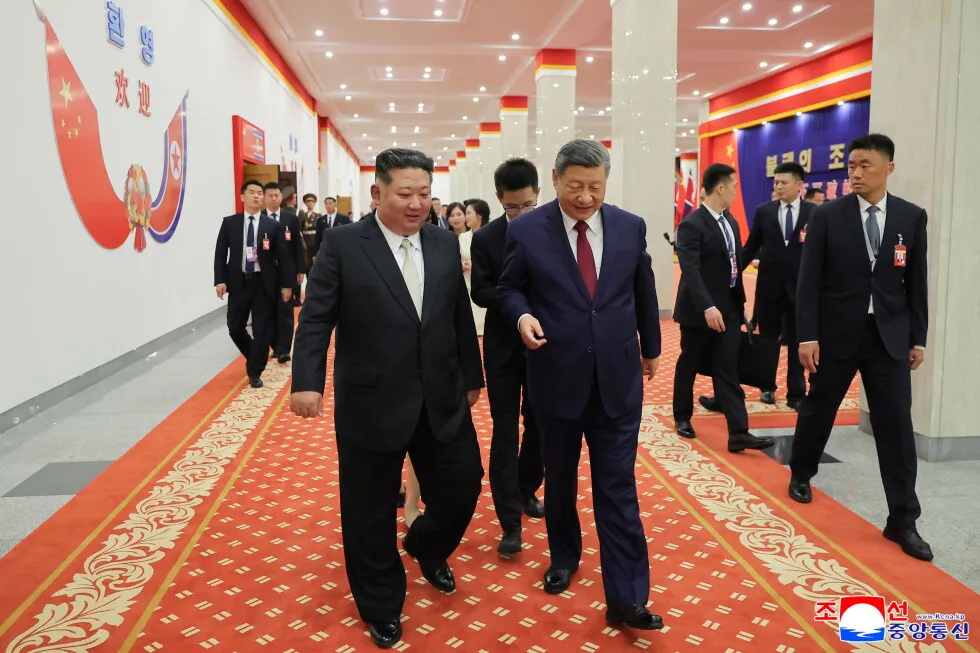
Analysis: Chinese President Xi’s silence on nuclear arms is a gift to North Korea’s Kim Jong Un 1 of 2 | In this photo provided by the North Korean government, North Korean leader Kim Jong Un, left, and Chinese President Xi Jinping, right, walk together after a welcome performance in Pyongyang, Monday, June 8, 2026. Independent journalists were not given access to cover the event depicted in this image distributed by the North Korean government. The content of this image is as provided and cannot be independently verified. Korean language watermark on image as provided by source reads: “KCNA” which is the abbreviation for Korean Central News Agency. (Korean Central News Agency/Korea News Service via AP) 2 of 2 | A TV screen shows an image of Chinese President Xi Jinping, left, and North Korean leader Kim Jong Un, during a news program at a bus terminal in Seoul, South Korea, Tuesday, June 9, 2026. (AP Photo/Ahn Young-joon) By FOSTER KLUG Updated 12:45 PM MESZ, June 9, 2026 Add AP News on Google Add AP News as your preferred source to see more of our stories on Google. Share Share Facebook Copy Link copied Print Email X LinkedIn Bluesky Flipboard Pinterest Reddit Tokyo (AP) — Chinese and North Korean state-run media this week devoted thousands of words to Xi Jinping ‘s summit with Kim Jong Un, but made no mention of a key matter for Washington: the North’s steadfast pursuit of nuclear weapons that could threaten the United States and its allies in Asia. The silence says more than reams of the carefully framed propaganda. Until disarmament talks finally fell apart in 2019, Washington and Beijing were yearslong partners in diplomacy seeking to persuade North Korea to abandon its nuclear ambitions in return for much-needed aid and political recognition. Beijing routinely called for “denuclearization” — a bureaucratic term for nuclear disarmament — and there was hope in Washington, as well as in Seoul and Tokyo, that China would use its perceived influence as Pyongyang’s diplomatic and economic protector to push the North on the nuclear standoff. Xi’s visit to Pyongyang on Monday and Tuesday — his first visit there in seven years — could spell the end of that hope — and signal a significant shift in how he views the North’s nuclear weapons. From Beijing’s perspective, Xi’s silence may be an acknowledgment of how far North Korea’s nuclear program has come since Kim Jong Un took power in 2011 — and also how unlikely it is that diplomacy could get the North to give up the weapons it sees as its largest guarantee against outside interference. Xi and Kim express hopes for greater ties between China and North Korea China’s President Xi returns home after closely watched trip to North Korea Chinese leader Xi Jinping will travel to North Korea next week in first visit since 2019 Xi’s silence on nuclear arms is golden for North Korea The Chinese leader’s last trip to North Korea, in 2019, was starkly different — Xi was quoted in Chinese media as saying his nation would play a constructive role in the denuclearization of the Korean Peninsula. Beijing wants, above all, stability in North Korea and the region. A collapse in Pyongyang could send millions streaming across their long shared border. To that end, China has often avoided directly pushing for the end of North Korea’s nuclear program, according to an analysis by Jiyong Zheng, dean of the Institute of Regional Studies at Tianjin Foreign Studies University in China. Instead, Beijing called for the denuclearization of the entire Korean Peninsula — a careful wording that allowed China to also express a desire for an end to U.S. commitments to use its nuclear arsenal to protect South Korea and the deployment of U.S. nuclear capable bombers near the Korean Peninsula. In recent months, Beijing has signaled it wants to prioritize stabilizing the situation on the peninsula, with denuclearization as a second aim, Zheng wrote. “China is increasingly concluding that a rigid denuclearization-first approach is impractical and may worsen the regional security environment,” he said. For Kim Jong Un, the lack of any public mention or criticism of his nuclear bombs is a win. He has long demanded international recognition for his country as a nuclear weapons state, which could lead to the lifting of U.N. sanctions. For Seoul and Washington, Xi’s silence is bad news When asked on Tuesday whether Seoul should lower its expectations about Beijing after Xi appeared to avoid the nuclear issue in Pyongyang, South Korean Foreign Ministry spokesperson Park Il insisted that China continues to support the nuclear disarmament goal. Similarly, after last month’s summit between U.S. President Donald Trump and Xi, the White House said the two leaders confirmed their shared goal to denuclearize North Korea. China, however, only said the U.S. and Chinese leaders discussed the nuclear issue on the Korean Peninsula. On Sunday, Kim’s sister and senior official, Kim Yo Jong, dismissed as “false information” the U.S. readout of the Xi-Trump meeting. Last week, Kim Jong Un unveiled a new plant to produce nuclear ingredients and vowed to bolster nuclear forces “at an exponential rate.” His sister also said that any U.S. push for the denuclearization of North Korea was an “anachronistic dream.” It may be that China doesn’t want to see North Korea and the U.S. growing too close, said Park Won Gon, a professor at Seoul’s Ewha Womans University, adding that Beijing might prefer to keep the North within its sphere of influence and use that relationship as leverage with the U.S. Xi may be tacitly accepting North Korea’s push for nukes South Korean President Lee Jae Myung told reporters on Monday that North Korea is producing enough nuclear fuel annually for about 10 to 20 bombs and is close to perfecting its intercontinental ballistic missile technology, which could deliver a nuclear bomb to the U.S. mainland. Kim, meanwhile, has stressed that nuclear weapons are an essential part of the North’s national identity. He has enshrined North Korea’s nuclear status in the constitution and dedicated a growing share of resources, industry and bureaucracy toward sustaining it. Some analysts see China’s avoidance of the word “denuclearization” in Xi’s visit this time as a clear change in Beijing’s stance, and a tacit acceptance of North Korea’s nuclear status. This shift could mean that efforts by the U.S., Japan and South Korea to deter the North will become a regular push rather than something seen as more temporary, according to Seong-Hyon Lee, a senior fellow at the George H.W. Bush Foundation for U.S.-China Relations. “Beijing’s silence should not be viewed as a bureaucratic oversight but as a deliberate strategic signal,” Lee said. “By tacitly accepting North Korea’s nuclear status, Beijing strengthens its position as an indispensable stakeholder in any future negotiations.” Even so, China’s acceptance of North Korea’s military ambitions may have limits. While Xi’s visit signals a “strategic embrace of Kim,” it is “not a blank check for North Korea,” said Leif-Eric Easley, also a professor at Ewha Womans University. Beijing wants stability and respect for its regional ambitions, Easley said. “North Korea’s persistent expansion of military capabilities is pushing the limits of what its larger neighbor will tolerate.” Associated Press reporters Kim Tong-hyung and Hyung-jin Kim in Seoul, South Korea, Huizhong Wu in Bangkok, and Simina Mistreanu in Taipei, Taiwan, contributed to this report. EDITOR’S NOTE: Foster Klug, the AP’s news director for the Koreas, Japan, Australia, New Zealand and the South Pacific, has reported on North Korea and traveled there frequently since 2005. FOSTER KLUG Klug is the AP’s news director for the Koreas, Japan, Australia, New Zealand and the South Pacific. He’s covered Asia since 2005 and has reported from across the region, including multiple trips to North Korea. twitter
SRCAssociated Press (AP)
LANGEN
LEANCenter
WORDS1 296
ENT12
TUE · 2026-06-09 · 11:23 GMTBRIEF NSR-2026-0609-82976
NSR-2026-0609-82976Analysis·EN·Diplomatic
Analysis: Chinese President Xi’s silence on nuclear arms is a gift to North Korea’s Kim Jong Un
During a recent summit in Pyongyang, Chinese President Xi Jinping and North Korean leader Kim Jong Un's state media coverage notably omitted any mention of North Korea's nuclear weapons program. This silence marks a significant shift from past joint diplomatic efforts between China and the U.S.
Associated Press (AP)Filed 2026-06-09 · 11:23 GMTLean · CenterRead · 6 min
Associated Press (AP)FIG 01
Reading time
6min
Word count
1 296words
Sources cited
0cited
Entities identified
12entities
Quality score
100%
§ 01
Briefing Summary
AI-generatedNEWSAR · AI
During a recent summit in Pyongyang, Chinese President Xi Jinping and North Korean leader Kim Jong Un's state media coverage notably omitted any mention of North Korea's nuclear weapons program. This silence marks a significant shift from past joint diplomatic efforts between China and the U.S. aimed at denuclearization. Analysts suggest Beijing's silence acknowledges the advancement of North Korea's nuclear capabilities and the unlikelihood of disarmament, prioritizing regional stability instead. For Kim Jong Un, this lack of criticism is a diplomatic gain, while for Seoul and Washington, it signifies a potential acceptance of North Korea's nuclear status by China. This shift may lead to a more sustained deterrence effort by the U.S. and its allies.
Confidence 0.90Claims 5Entities 12
§ 02
Article analysis
Model · rule-basedFraming
Diplomatic
National Security
Tone
Mixed Tone
AI-assessed
CalmNeutralAlarmist
Factuality
0.40 / 1.00
Mixed
LowHigh
Sources cited
0
No named sources
FewMany
§ 03
Key claims
5 extracted01
Until disarmament talks fell apart in 2019, Washington and Beijing were partners in diplomacy seeking to persuade North Korea to abandon its nuclear ambitions.
factual
Confidence
0.90
02
Chinese and North Korean state-run media devoted thousands of words to Xi Jinping's summit with Kim Jong Un but made no mention of North Korea's pursuit of nuclear weapons.
factual
Confidence
0.90
03
From Beijing's perspective, Xi's silence may be an acknowledgment of how unlikely it is that diplomacy could get North Korea to give up its weapons.
factual
Confidence
0.80
04
Xi's silence on nuclear arms is a gift to North Korea's Kim Jong Un.
factual
Confidence
0.80
05
Xi's visit to Pyongyang could signal a significant shift in how he views North Korea's nuclear weapons.
prediction
Confidence
0.70
§ 04
Full report
6 min read · 1 296 words§ 05
Entities
12 identifiedKey playerOppositionContextPositiveNeutralNegative
Locations6
§ 06
Keywords & salience
9 termsnuclear arms
1.00
denuclearization
0.90
xi jinping
0.80
kim jong un
0.80
china
0.70
north korea
0.70
diplomacy
0.60
nuclear weapons
0.50
summit
0.40
§ 07
Topic connections
Interactive graph Network visualization showing 51 related topics
View Full Graph Person Organization Location Event|Click node to navigate|Edge numbers = shared articles