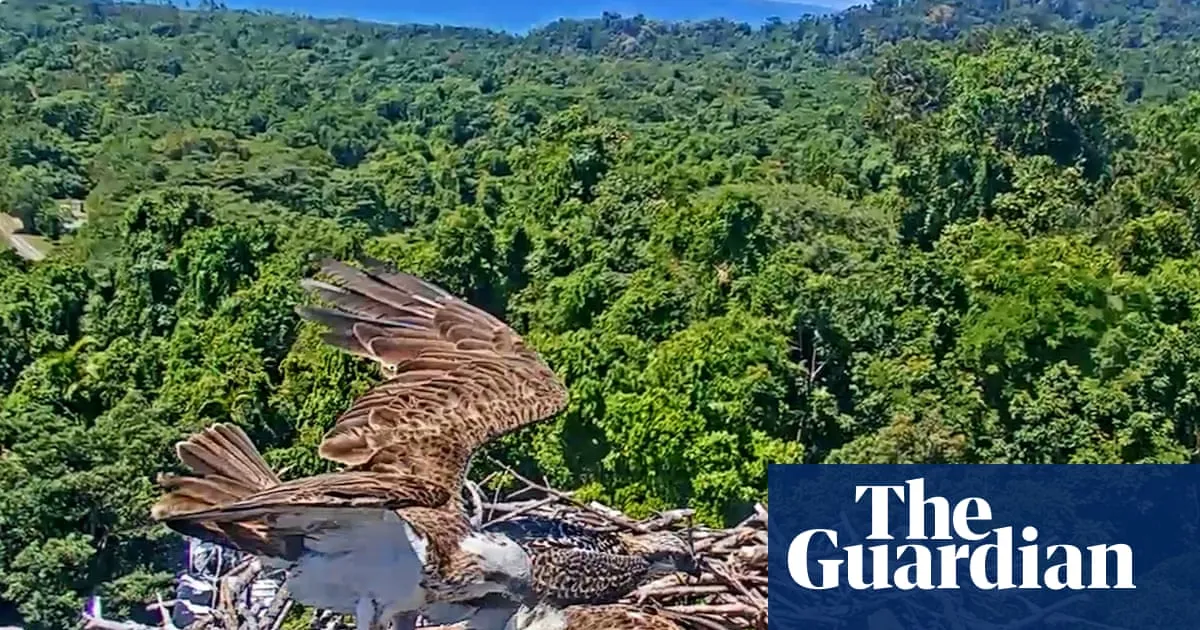
Mating pair of ospreys in the nest atop a crane in Queensland's Daintree rainforest ‘Osprey cam’ streams life of nesting seabirds perched at tip of 55 metre-long Queensland rainforest canopy crane Researchers believe the same pair of birds have been mating and nesting in the unusual spot in the Daintree rainforest for 15 consecutive years Get our breaking news email, free app or daily news podcast It started by chance – but it should have come as no surprise that two ospreys would pick a hi-tech research facility to make their home. James Cook University’s 47-metre tall crane towers over the far-north Queensland rainforest canopy, making it the perfect nesting place for the seabird. Year in, year out, the birds return to nest, regardless of the spot’s challenges. “The crane is constantly moving,” the station manager of the university’s Daintree rainforest Observatory, Johan Larson, said. The jib of the crane is 55 metres long, meaning the nest can move 110 metres from its last position, he said. The canopy crane – designed to give researchers access to the rainforest from above – is the centrepiece of the university’s Daintree rainforest Observatory, a field station nestled in lowland rainforest, featuring everything from a lecture theatre to indoor and outdoor laboratories. Just a kilometre from the coast, the nest is close enough to the ocean for the birds to make a catch and completely safe from ground-based predators. “I think they haven’t missed a single year for the last 15 years, so I think they really like it,” Larson said. Ospreys live for up to 25 years; researchers at the observatory believe the nest has been consistently inhabited by the same breeding pair. A few years ago, someone at the university had the idea of aiming a web camera at the nest. Today “Osprey cam” livestreams the life cycle of the birds world-wide, a 24/7 eye-in-the-sky, watching their movements from cradle to grave. Larson said nature lovers from around the world tune in to watch the animals build a home, hunt and raise offspring, every year. “I think people in general find it fascinating to be able to watch wild animals live, and it’s very unique to be able to see a nest in particular,” he said. Ospreys are small daytime predators that eat almost exclusively fish. Unlike their European or American counterparts, Australian ospreys don’t migrate, so the couple live near the crane all year. Nonetheless, they have to rebuild a nest from scratch each year. Crane maintenance crews clear the remnants of the nest every year – but even if they didn’t, the birds tend to let their constructions fall apart after raising their young. Rebuilding it isn’t a straightforward task, Larson said. “They’ll bring the first stick on top of the metal structure, and then the wind will catch it and it kind of swivels and then falls through the gap. They take a deep breath, go get another stick, try again. “It’s actually pretty quick once they get started. It only takes a few weeks.” “They are very good parents. They tend to, from what we observe, take turns. The female spends more time on the eggs and more time with the chicks when they hatch, and the male, even though they both hunt, he tends to bring in more of the fish,” he said. It’s not unheard of for researchers to stumble across fish that have fallen from the sky, dropped by the mum or dad. Larson said it’s inevitable that the birds will one day die, and perhaps leave the perfect nesting spot to a new pair. “It’s always sad to see an animal die but I guess it is the cycle of life,” he said. “Hopefully another pair will take over. It might even be one of their offspring that takes that spot.” Explore more on these topics Queensland Birds Wildlife Biology Animals news Share Reuse this content
SRCThe Guardian - World News
LANGEN
LEANCenter-Left
WORDS653
ENT7
TUE · 2026-06-09 · 15:00 GMTBRIEF NSR-2026-0609-83034
NSR-2026-0609-83034News Report·EN·Human Interest
‘Osprey cam’ streams life of nesting seabirds perched at tip of 55 metre-long Queensland rainforest canopy crane
A pair of ospreys has been nesting for 15 consecutive years atop a 47-meter tall canopy crane at James Cook University's Daintree Rainforest Observatory in Queensland. This unusual nesting spot, located near the coast, provides safety from predators and proximity to food sources.
Andrew MessengerThe Guardian - World NewsFiled 2026-06-09 · 15:00 GMTLean · Center-LeftRead · 3 min
The Guardian - World NewsFIG 01
Reading time
3min
Word count
653words
Sources cited
1cited
Entities identified
7entities
Quality score
100%
§ 01
Briefing Summary
AI-generatedNEWSAR · AI
A pair of ospreys has been nesting for 15 consecutive years atop a 47-meter tall canopy crane at James Cook University's Daintree Rainforest Observatory in Queensland. This unusual nesting spot, located near the coast, provides safety from predators and proximity to food sources. Researchers believe the same breeding pair returns annually, despite the crane's movement. An "Osprey cam" livestreams the birds' life cycle, attracting global viewers fascinated by observing wild animals. The ospreys, which are non-migratory Australian birds, rebuild their nest each year, a process that takes a few weeks. Researchers observe them as good parents, with the female incubating eggs and caring for chicks, while both hunt, though the male brings in more fish.
Confidence 0.90Sources 1Claims 5Entities 7
§ 02
Article analysis
Model · rule-basedFraming
Human Interest
Environmental
Tone
Measured
AI-assessed
CalmNeutralAlarmist
Factuality
0.80 / 1.00
Factual
LowHigh
Sources cited
1
Limited
FewMany
§ 03
Key claims
5 extracted01
An 'Osprey cam' livestreams the birds' life cycle, attracting global viewers.
factual
Confidence
1.00
02
The crane is part of James Cook University's Daintree Rainforest Observatory, a research facility.
factual
Confidence
1.00
03
The ospreys rebuild their nest from scratch each year, a process that takes a few weeks.
factualJohan Larson
Confidence
0.90
04
Australian ospreys do not migrate and live near the crane year-round.
factual
Confidence
0.90
05
A pair of ospreys have been nesting atop a 55-metre-long crane in Queensland's Daintree rainforest for 15 consecutive years.
factualResearchers
Confidence
0.90
§ 04
Full report
3 min read · 653 words§ 05
Entities
7 identifiedKey playerOppositionContextPositiveNeutralNegative
People1
Organizations2
Locations3
§ 06
Keywords & salience
9 termsosprey cam
1.00
nesting seabirds
0.90
rainforest canopy crane
0.80
daintree rainforest
0.70
ospreys
0.70
wildlife streaming
0.60
breeding pair
0.50
daintree rainforest observatory
0.40
james cook university
0.40
§ 07
Topic connections
Interactive graph Network visualization showing 38 related topics
View Full Graph Person Organization Location Event|Click node to navigate|Edge numbers = shared articles