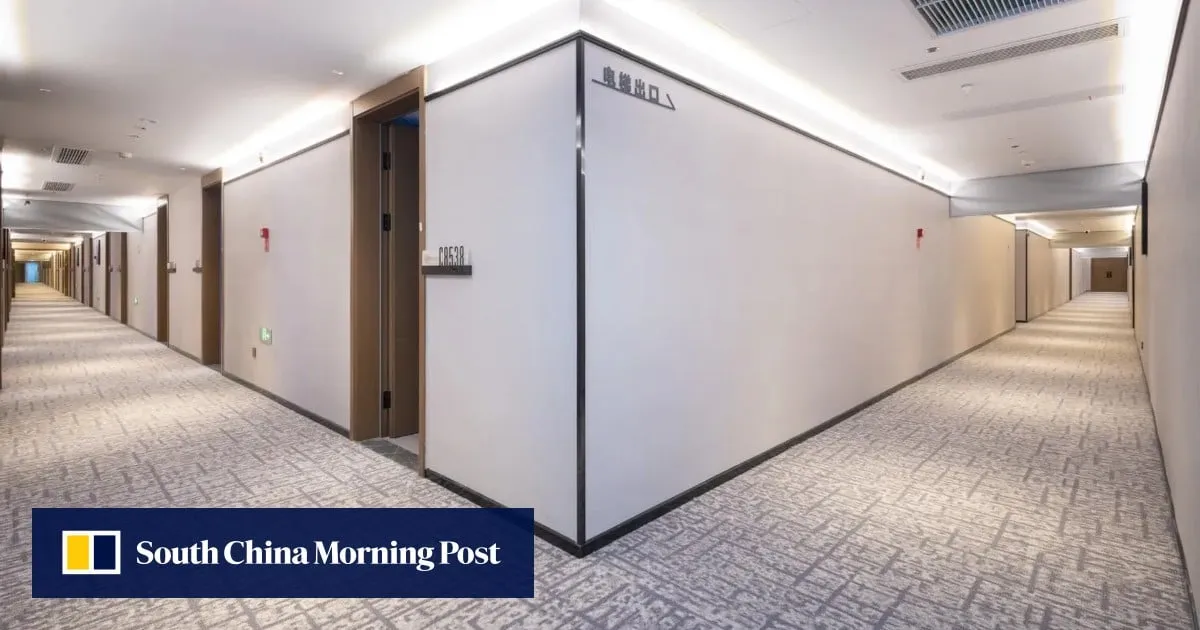
More economy and mid-range hotel operators in China are leasing office buildings for conversion to guest accommodation, and such flexible, mixed-use approaches are expected to increase amid a continued weakening of the office market.In some Chinese cities, the practice of multiple hotel brands co-leasing separate floors within a single building has become more prevalent, fuelled by interest from both property owners and hotel operators.In Hangzhou, the capital of eastern China’s Zhejiang province, a building at West Lake-adjacent Yongjin Plaza now houses some 10 hotels. These include Home Inn and Home Inn Plus – part of the economy chain under Shanghai-headquartered BTG Hotel (Group) – as well as a mix of smaller, lesser-known hotel brands and hostels.They lease different floors alongside diverse businesses like restaurants, photography studios and second-hand luxury stores. Three of the hotels share a ground-floor reception area.“Hotel operators are seeking lower-cost, well-located space, and office landlords are looking to reduce vacancy,” said James Macdonald, head of research for China at Savills, a property consultancy. “This trend is most common in grade B office assets in good locations, especially slightly older buildings where leasing to traditional office tenants has become more challenging.”Macdonald said it was natural for building functions to adapt to changing economic structures, working patterns and urban needs, and the trend could even help stimulate the market.
SRCSouth China Morning Post
LANGEN
LEANCenter-Right
WORDS220
ENT6
SUN · 2026-01-18 · 03:00 GMTBRIEF NSR-2026-0118-8310
NSR-2026-0118-8310News Report·EN·Economic Impact
Hotel conversions gain traction in China’s office market amid high vacancies
In China, hotel operators are increasingly converting office buildings into guest accommodations due to high office vacancy rates and a weaker market. This trend involves economy and mid-range hotels leasing space in office buildings, sometimes with multiple hotel brands co-leasing separate floors within the same building.
Zhu WenqianSouth China Morning PostFiled 2026-01-18 · 03:00 GMTLean · Center-RightRead · 1 min
South China Morning PostFIG 01
Reading time
1min
Word count
220words
Sources cited
1cited
Entities identified
6entities
Quality score
100%
§ 01
Briefing Summary
AI-generatedNEWSAR · AI
In China, hotel operators are increasingly converting office buildings into guest accommodations due to high office vacancy rates and a weaker market. This trend involves economy and mid-range hotels leasing space in office buildings, sometimes with multiple hotel brands co-leasing separate floors within the same building. This is particularly common in Grade B office buildings in desirable locations, where attracting traditional office tenants is difficult. The conversions offer hotel operators lower-cost, well-located spaces, while helping landlords reduce vacancies. Property consultants believe this flexible, mixed-use approach, driven by changing economic structures and urban needs, could stimulate the market. The practice is evident in cities like Hangzhou, where multiple hotels share a building with other businesses.
Confidence 0.90Sources 1Claims 5Entities 6
§ 02
Article analysis
Model · rule-basedFraming
Economic Impact
Tone
Measured
AI-assessed
CalmNeutralAlarmist
Factuality
0.80 / 1.00
Factual
LowHigh
Sources cited
1
Limited
FewMany
§ 03
Key claims
5 extracted01
Office landlords are looking to reduce vacancy.
quoteJames Macdonald, Savills
Confidence
1.00
02
Hotel operators are seeking lower-cost, well-located space.
quoteJames Macdonald, Savills
Confidence
1.00
03
In Hangzhou, Yongjin Plaza houses some 10 hotels.
factual
Confidence
1.00
04
More economy and mid-range hotels in China are leasing office buildings for conversion.
factual
Confidence
0.90
05
This trend is most common in grade B office assets in good locations.
quoteJames Macdonald, Savills
Confidence
0.80
§ 04
Full report
1 min read · 220 words§ 05
Entities
6 identifiedKey playerOppositionContextPositiveNeutralNegative
People1
Organizations1
§ 06
Keywords & salience
8 termshotel conversions
1.00
office market
0.90
office vacancies
0.80
mixed-use
0.70
hotel operators
0.60
property owners
0.50
leasing
0.50
economic structures
0.40
§ 07
Topic connections
Interactive graph Network visualization showing 51 related topics
View Full Graph Person Organization Location Event|Click node to navigate|Edge numbers = shared articles