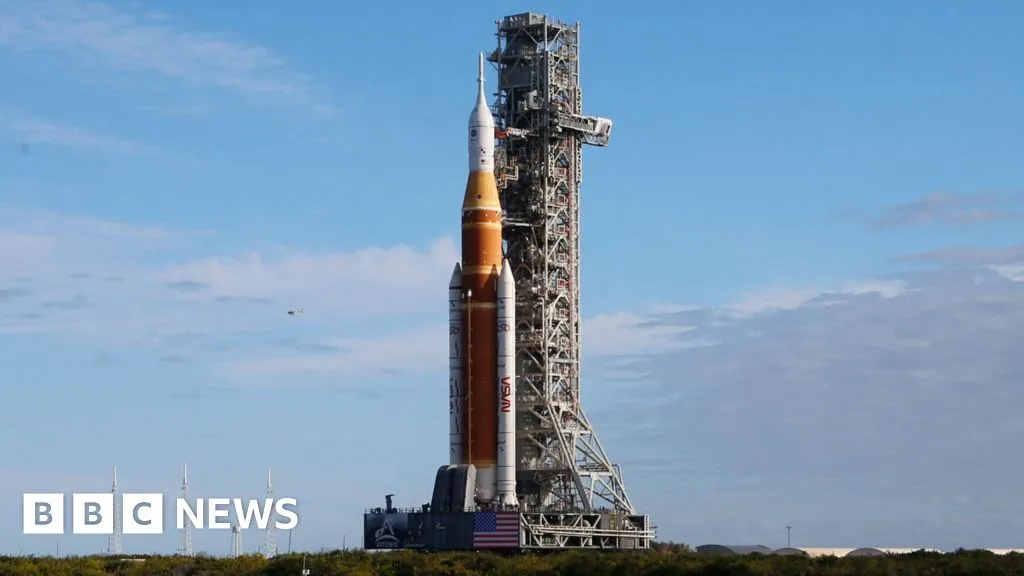
3 hours agoRebecca Morelle, Alison Francis and Kevin ChurchScience team Watch: Timelapse shows Nasa rocket's 12-hour journey to launch padNasa's mega rocket has been moved to the launch pad in Cape Canaveral, Florida, as the final preparations get underway for the first crewed mission to the Moon in more than 50 years.Over almost 12 hours, the 98m-tall Space Launch System was carried vertically from the Vehicle Assembly Building on the 4-mile (6.5km) journey to the pad.Now it is in position, the final tests, checks - and a dress rehearsal - will take place, before the go-ahead is given for the 10-day Artemis II mission that will see four astronauts travel around the Moon.Nasa says the earliest the rocket can blast off is 6 February, but there are also more launch windows later that month, as well as in March and April.ReutersThe Space Launch System (SLS) rocket that will fly the Artemis II mission to the MoonThe rocket began moving at 07:04 local time (12:04 GMT) and arrived at Launch Pad 39B at the Kennedy Space Center at 18:41 local time (23:42 GMT). The rocket was carried by a huge machine called a crawler-transporter, travelling at a top speed of 0.82 mph (1.3 km/h) as it trundled along. Live coverage captured the slow-moving spectacle. Nasa said the rocket will be prepared over the next few days for what it calls a "wet dress rehearsal" - a test for fuel operations and countdown procedures.The Artemis II crew - Nasa's Reid Wiseman, Victor Glover and Christina Koch and Canadian astronaut Jeremy Hansen - were at the Kennedy Space Center watching the rocket as it was moved.In just a few weeks, the four astronauts will be strapped into a spacecraft, perched on the top of the rocket, ready to blast off to the Moon.It will be the first crewed mission to the Moon since Apollo 17 landed on its surface in December 1972. NASAFrom left to right the Artemis crew is Reid Wiseman, Victor Glover, Christina Koch and Jeremy Hansen Nasa said the mission could take its astronauts further into space that anyone has been before. Artemis II is not scheduled to land on the Moon, but will instead lay the groundwork for a future lunar landing led by the Artemis III mission. Nasa said the launch of Artemis III will take place "no earlier than" 2027. But, experts believe 2028 is the earliest possible date.Koch said it was an amazing feeling to see the rocket. "Astronauts are the calmest people on launch day. And I think... it feels that way because we're just so ready to fulfil the mission that we came here to do, that we've trained to do," she said.Hansen said he hoped the mission would inspire the world."The Moon is something that I've taken for granted. I've looked at it my whole life, but then you just glance at it and glance away," he said. "But now I've been staring at it a lot more, and I think others will be joining us and staring at the Moon a lot more as there will be humans flying around the far side and that is just good for humanity." Before Artemis II heads to the Moon, the first two days of their mission will be spent in orbit around the Earth."We're going to be going into an orbit almost right away that is 40,000 miles out - like a fifth of the way of the Moon," Koch told BBC News."We will have the Earth out the window as a single ball, something none of us have seen in that perspective."And then we're going to travel a quarter of a million miles away… we're going to do a lot of science and operations along the way."While they fly around the far side of the Moon, the crew will have three hours dedicated to lunar observation - to gaze, take images and to study its geology, which will help plan and prepare for a future landing at the Moon's south pole.NASAThe European Service Module provides power and propulsions and life support systemsA key part of the Orion spacecraft that the astronauts will be flying in was made in Bremen in Germany.The European Service Module, which sits behind the crew capsule, is the European Space Agency's contribution to the mission and has been built by Airbus."The European Service Module is so important - we basically can't get to the Moon without it," says Sian Cleaver, a spacecraft engineer at Airbus."It provides the propulsion that Orion needs to get us to the Moon."Its large solar arrays will generate all the electrical power for the craft, she adds."We've also got these big tanks full of oxygen and nitrogen, which are mixed to make air, and also water, so that we can provide everything that the astronauts need in the crew module to keep them alive on their journey."Kevin Church/ BBC NewsSian Cleaver from Airbus says the safety of the astronauts is the top priority Inside their cleanroom, the team is busy building more modules for future Artemis missions. Each one takes about 18 months to put together but has taken thousands of engineering hours to design. Everything on board has to work perfectly."We've got to get those astronauts to the Moon and then back again, completely safely," says Cleaver.With the rocket now on launchpad 39B, the Artemis team is working around the clock to get it ready for lift off.The mission has already faced years of delays, and Nasa is under pressure to get the astronauts on their way as soon as possible. However, the US space agency said it would not compromise on safety.John Honeycutt, chair of the Artemis mission management team, said: "I've got one job, and it's the safe return of Reid and Victor and Christina and Jeremy. "We're going to fly when we're ready... crew safety is going to be our number one priority."
SRCBBC News - World
LANGEN
LEANCenter
WORDS982
ENT12
SUN · 2026-01-18 · 01:22 GMTBRIEF NSR-2026-0118-8311
NSR-2026-0118-8311News Report·EN·Technology
Nasa's mega Moon rocket arrives at launch pad for Artemis II mission
NASA's Space Launch System (SLS) rocket, set to carry the Artemis II mission, has arrived at Launch Pad 39B in Cape Canaveral, Florida. The 98-meter-tall rocket was transported from the Vehicle Assembly Building over a 6.5km journey, a process that took nearly 12 hours.
BBC News - WorldFiled 2026-01-18 · 01:22 GMTLean · CenterRead · 4 min
BBC News - WorldFIG 01
Reading time
4min
Word count
982words
Sources cited
3cited
Entities identified
12entities
Quality score
100%
§ 01
Briefing Summary
AI-generatedNEWSAR · AI
NASA's Space Launch System (SLS) rocket, set to carry the Artemis II mission, has arrived at Launch Pad 39B in Cape Canaveral, Florida. The 98-meter-tall rocket was transported from the Vehicle Assembly Building over a 6.5km journey, a process that took nearly 12 hours. This move precedes final tests and a "wet dress rehearsal" in preparation for the Artemis II mission, which will send four astronauts around the Moon. The earliest possible launch date is February 6, with other launch windows available later in February, March, and April. The Artemis II mission, the first crewed mission to the Moon in over 50 years, aims to pave the way for future lunar landings, with Artemis III planned for no earlier than 2027.
Confidence 0.90Sources 3Claims 5Entities 12
§ 02
Article analysis
Model · rule-basedFraming
Technology
Human Interest
Tone
Measured
AI-assessed
CalmNeutralAlarmist
Factuality
0.90 / 1.00
Factual
LowHigh
Sources cited
3
Well sourced
FewMany
§ 03
Key claims
5 extracted01
It will be the first crewed mission to the Moon since Apollo 17 in December 1972.
factualnull
Confidence
1.00
02
The Artemis II mission will see four astronauts travel around the Moon.
factualnull
Confidence
1.00
03
The earliest the rocket can blast off is 6 February.
factualNasa
Confidence
1.00
04
Nasa's mega rocket has been moved to the launch pad in Cape Canaveral, Florida.
factualnull
Confidence
1.00
05
The launch of Artemis III will take place "no earlier than" 2027.
predictionNasa
Confidence
0.80
§ 04
Full report
4 min read · 982 words§ 05
Entities
12 identifiedKey playerOppositionContextPositiveNeutralNegative
People4
Organizations2
Locations4
§ 06
Keywords & salience
8 termsartemis ii mission
1.00
moon mission
0.90
space launch system
0.80
nasa
0.70
rocket launch
0.60
launch pad
0.50
crewed mission
0.50
artemis iii
0.40
§ 07
Topic connections
Interactive graph No topic relationship data available yet. This graph will appear once topic relationships have been computed.