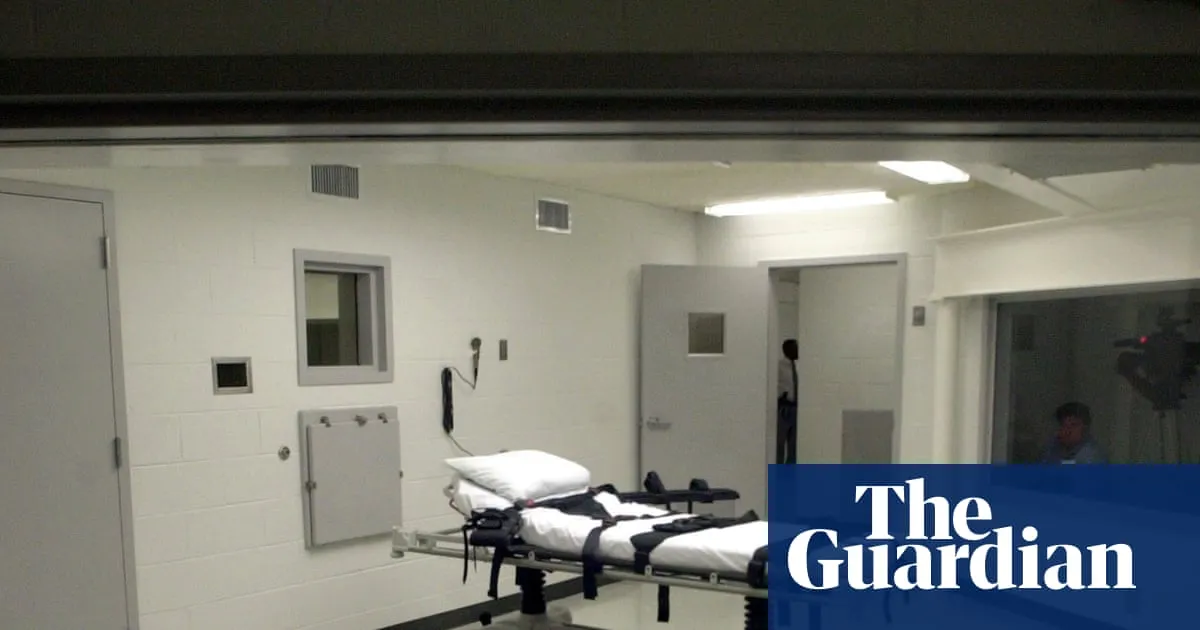
A federal judge on Tuesday permanently blocked Alabama from executing a man with nitrogen gas after declaring the method violates the ban on cruel and unusual punishment. Alabama became the first state in the nation to use the execution method in January 2024, but has faced repeated legal challenges to its use.Emily C Marks, a US district judge, permanently enjoined the state from executing Jeffery Lee by nitrogen gas. Lee was scheduled to be executed Thursday at an Alabama prison.A spokesman for Alabama attorney general Steve Marshall said the state is appealing the decision. The case will likely end up before the US supreme court, which has previously let nitrogen executions proceed.In 2000, a jury sentenced Lee to life without parole for the 1998 murders of Jimmy Ellis and Elaine Thompson. A judge later declined to follow the jury’s recommendation and sentenced Lee to death. In 2017, Kay Ivey, an Alabama governor, signed a bill to ban such cases of judicial override, but the law only applied to future – and not past – cases. Lee’s attorneys have since asked Ivey to grant him clemency and end judicial override retroactively.The case continued in court until last month on 29 May, when Marks ruled that Alabama could execute Lee using nitrogen gas, citing testimony from three medical experts that “air hunger” induced by such an execution did not amount to an unconstitutional level of pain.“For Eighth Amendment purposes, the anxiety evoked by air hunger – lasting not significantly more than one to three minutes – is more an ‘inescapable consequence of death,’ than ‘superadded’ pain well beyond what’s needed to effectuate a death sentence,” Marks wrote.Days later, on 8 June, a three judge panel of 11th circuit court of appeals judges reversed Marks’ order, writing: “Alabama’s nitrogen hypoxia protocol presents a ‘substantial risk of serious harm’ – severe pain over and above death itself’”. The appeals court ordered Marks to consider whether Lee could be executed by his preferred method of firing squad instead.On Tuesday, Marks issued a 26-page ruling, writing that litigation is a constant in death penalty cases and that the state of Alabama can pursue two other authorized execution methods: lethal injection and the electric chair. She said Lee is “not entitled to an injunction barring the state from executing him using one of those methods …”“Were Alabama to adopt firing squad as a method of execution, that method would likely be challenged as well. Indeed, there is likely no method – no matter how humane – that would be immune to constitutional challenge. But the constitution does not guarantee a painless death, and human life cannot be purposefully extinguished without some risk of pain. The court, the condemned, and the state must all confront that sobering reality,” Marks wrote.Reports of the extreme pain induced by “nitrogen hypoxia” emerged after the first such execution occurred in the US in 2024. Kenneth Eugene Smith’s execution by nitrogen gas took 22 minutes, and Lee Hedgepeth, a journalist who witnessed the execution, told the BBC’s Newsday programme: “I’ve been to four previous executions and I’ve never seen a condemned inmate thrash in the way that Kenneth Smith reacted to the nitrogen gas.”A spokeswoman for Lee’s legal team said they did not have an immediate comment.
SRCThe Guardian - World News
LANGEN
LEANCenter-Left
WORDS544
ENT12
TUE · 2026-06-09 · 22:45 GMTBRIEF NSR-2026-0610-83120
NSR-2026-0610-83120News Report·EN·Legal & Judicial
US federal judge blocks Alabama from executing man by nitrogen gas
A federal judge has permanently blocked Alabama from executing Jeffery Lee by nitrogen gas, ruling the method constitutes cruel and unusual punishment. This decision comes after Alabama became the first state to use nitrogen gas for an execution in January 2024, a practice that has faced repeated legal challenges.
Associated PressThe Guardian - World NewsFiled 2026-06-09 · 22:45 GMTLean · Center-LeftRead · 3 min
The Guardian - World NewsFIG 01
Reading time
3min
Word count
544words
Sources cited
5cited
Entities identified
12entities
Quality score
100%
§ 01
Briefing Summary
AI-generatedNEWSAR · AI
A federal judge has permanently blocked Alabama from executing Jeffery Lee by nitrogen gas, ruling the method constitutes cruel and unusual punishment. This decision comes after Alabama became the first state to use nitrogen gas for an execution in January 2024, a practice that has faced repeated legal challenges. U.S. District Judge Emily C. Marks issued the injunction, stating that while the state cannot use nitrogen gas, Lee is not entitled to a halt on his execution if Alabama pursues other authorized methods like lethal injection or the electric chair. The state's attorney general's office announced it is appealing the ruling. Lee was sentenced to death for murders committed in 1998.
Confidence 0.90Sources 5Claims 5Entities 12
§ 02
Article analysis
Model · rule-basedFraming
Legal & Judicial
Human Rights
Tone
Measured
AI-assessed
CalmNeutralAlarmist
Factuality
0.80 / 1.00
Factual
LowHigh
Sources cited
5
Well sourced
FewMany
§ 03
Key claims
5 extracted01
The constitution does not guarantee a painless death, and human life cannot be purposefully extinguished without some risk of pain.
quoteUS district judge Emily C Marks
Confidence
1.00
02
The appeals court previously stated Alabama's nitrogen hypoxia protocol presents a 'substantial risk of serious harm'.
quote11th circuit court of appeals judges
Confidence
1.00
03
The state of Alabama is appealing the decision, and the case may go to the US Supreme Court.
factualSpokesman for Alabama attorney general Steve Marshall
Confidence
1.00
04
Alabama became the first state to use nitrogen gas for executions in January 2024, facing repeated legal challenges.
factual
Confidence
1.00
05
A federal judge permanently blocked Alabama from executing a man by nitrogen gas, ruling it violates the ban on cruel and unusual punishment.
factualUS district judge Emily C Marks
Confidence
1.00
§ 04
Full report
3 min read · 544 words§ 05
Entities
12 identifiedKey playerOppositionContextPositiveNeutralNegative
People4
§ 06
Keywords & salience
8 termsnitrogen gas execution
1.00
cruel and unusual punishment
0.90
death penalty
0.80
judicial override
0.70
eighth amendment
0.60
legal challenges
0.50
appeals court
0.40
firing squad
0.40
§ 07
Topic connections
Interactive graph Network visualization showing 27 related topics
View Full Graph Person Organization Location Event|Click node to navigate|Edge numbers = shared articles