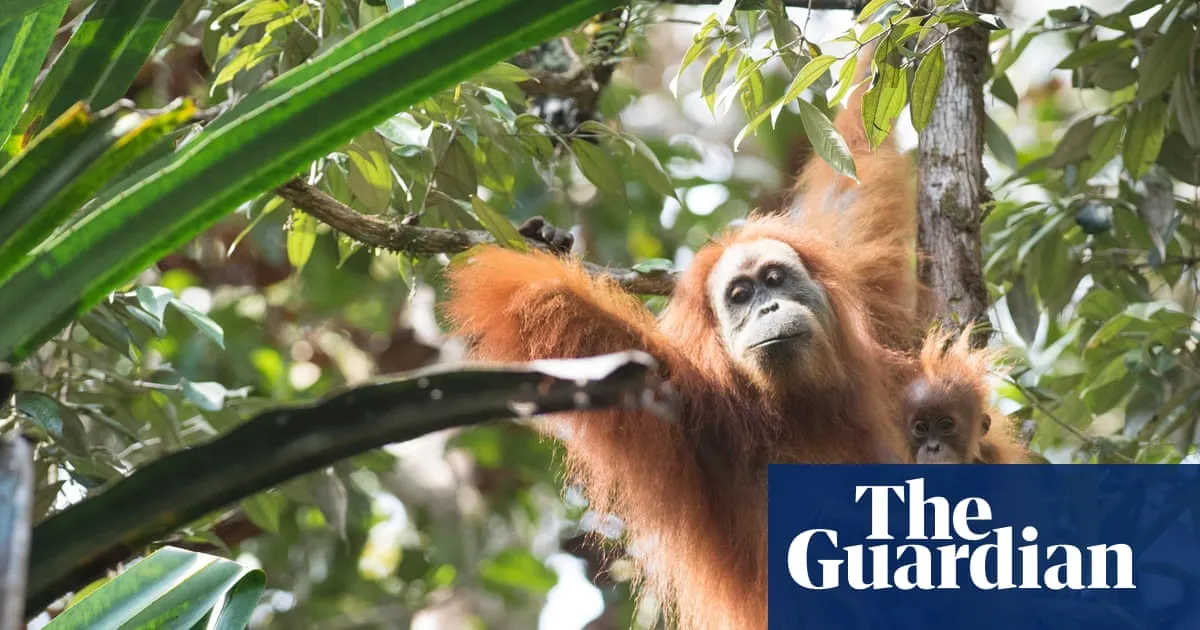
Extreme rainfall and landslides fuelled by the climate crisis killed 7% of the remaining population of the world’s rarest great ape, a study has found, prompting fears for the species’ survival.The research suggests 58 out of the remaining 800 critically endangered Tapanuli orangutans (Pongo tapanuliensis) were killed after more than 1,000mm (39in) of rain fell over four days in Indonesia’s North Sumatra province in November 2025. This equates to 11% of the local population and 7% of the entire species.“It is tragic to lose so many apes in this way. In landscapes where populations are small and fragmented, this type of weather or climate event can have population-level consequences. It is extremely worrying for the future of this ape,” said Prof Serge Wich, a primatologist at Liverpool John Moores University and co-author of the study, published in the journal Current Biology.The scientists overlaid new analysis of satellite imagery with estimates of ape density to work out the impacts of Cyclone Senyar on the orangutan population in its primary habitat in the West Block of the Batang Toru ecosystem, already threatened by mining, palm oil plantations and a large hydropower project.Satellite imagery also revealed that approximately 8,300 hectares (20,510 acres) – 11.7% – of this key forest habitat were wiped out by landslides caused by extreme rainfall. The scientists said human-induced Climate Change caused by the burning of fossil fuels had increased the rainfall intensity by up to 50%.The researchers have called for an immediate moratorium on activities that degrade the remaining orangutans’ habitat, and the expansion of protected areas. Photograph: Nature Picture Library/Alamy“The loss of an estimated 58 Tapanuli orangutans to a single climate-induced landslide event is a devastating demographic shock to the world’s rarest great ape,” said Prof Jatna Supriatna, a conservation biologist at Indonesia" class="entity-link entity-organization" data-entity-id="143959" data-entity-type="organization">Universitas Indonesia. “To prevent the first modern extinction of a great ape species, Indonesia must permanently protect the Batang Toru ecosystem, but our international partners must also meet their global commitments by providing immediate biodiversity-recovery financing.”Previous research has suggested annual losses of 1% of the Tapanuli orangutan population would be sufficient to lead to eventual extinction.The Indonesian government has temporarily paused all major industrial activity in the Batang Toru area to give scientists the opportunity to investigate how best to secure the long-term survival of the Tapanuli orangutan while also assessing the parallel risks posed to human lives.Researchers involved in the study, from Borneo Futures, World Weather Attribution and Liverpool John Moores University, recommended an immediate moratorium on land-use activities that degrade the remaining Tapanuli orangutan habitat, alongside the expansion of protected areas to properly stabilise the population.
SRCThe Guardian - World News
LANGEN
LEANCenter-Left
WORDS433
ENT11
WED · 2026-06-10 · 16:18 GMTBRIEF NSR-2026-0610-83353
NSR-2026-0610-83353News Report·EN·Environmental
Four days of extreme rain in Indonesia killed 7% of world’s rarest great apes, study finds
Extreme rainfall and landslides in North Sumatra, Indonesia, in November 2025 killed 58 critically endangered Tapanuli orangutans, representing 7% of the species' total population. This event, fueled by climate change which intensified rainfall by up to 50%, also destroyed over 8,300 hectares of their forest habitat.
Katie WardThe Guardian - World NewsFiled 2026-06-10 · 16:18 GMTLean · Center-LeftRead · 2 min
The Guardian - World NewsFIG 01
Reading time
2min
Word count
433words
Sources cited
2cited
Entities identified
11entities
Quality score
100%
§ 01
Briefing Summary
AI-generatedNEWSAR · AI
Extreme rainfall and landslides in North Sumatra, Indonesia, in November 2025 killed 58 critically endangered Tapanuli orangutans, representing 7% of the species' total population. This event, fueled by climate change which intensified rainfall by up to 50%, also destroyed over 8,300 hectares of their forest habitat. Scientists attribute this loss to a climate-induced landslide and express grave concerns for the species' survival, as annual losses of just 1% could lead to extinction. Researchers are calling for an immediate moratorium on habitat-degrading activities and the expansion of protected areas. The Indonesian government has temporarily paused industrial activity in the affected region to assess the situation and determine long-term survival strategies for the Tapanuli orangutan.
Confidence 0.90Sources 2Claims 5Entities 11
§ 02
Article analysis
Model · rule-basedFraming
Environmental
Human Interest
Tone
Mixed Tone
AI-assessed
CalmNeutralAlarmist
Factuality
0.80 / 1.00
Factual
LowHigh
Sources cited
2
Limited
FewMany
§ 03
Key claims
5 extracted01
Approximately 8,300 hectares of key forest habitat were wiped out by landslides.
statisticscientists
Confidence
1.00
02
Human-induced climate change increased rainfall intensity by up to 50% during the event.
statisticscientists
Confidence
1.00
03
58 out of 800 critically endangered Tapanuli orangutans were killed by extreme rainfall and landslides in November 2025.
statisticstudy
Confidence
1.00
04
Extreme rainfall killed 7% of the world's rarest great ape population, the Tapanuli orangutan.
statisticstudy
Confidence
1.00
05
Indonesia must permanently protect the Batang Toru ecosystem to prevent the first modern extinction of a great ape species.
predictionProf Jatna Supriatna
Confidence
0.90
§ 04
Full report
2 min read · 433 words§ 05
Entities
11 identifiedKey playerOppositionContextPositiveNeutralNegative
Organizations4
Locations3
§ 06
Keywords & salience
9 termsclimate crisis
1.00
tapanuli orangutan
1.00
extreme rainfall
0.90
species survival
0.80
habitat loss
0.70
landslides
0.60
conservation
0.50
batang toru ecosystem
0.50
fossil fuels
0.40
§ 07
Topic connections
Interactive graph No topic relationship data available yet. This graph will appear once topic relationships have been computed.