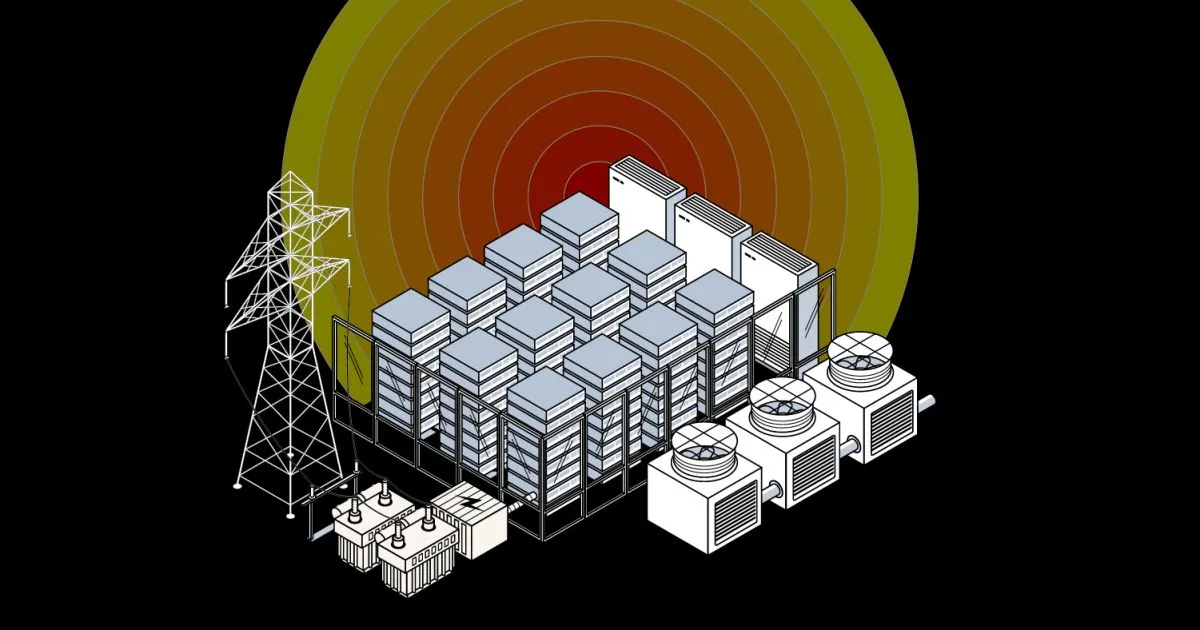
EXPLAINERData centres don’t just use large amounts of water and electricity, they’re heating the environment too, study finds.(Al Jazeera)Published On 11 Jun 2026Tech giants are racing to build the infrastructure that powers Artificial Intelligence.But a growing body of evidence suggests that AI hyperscalers – large-scale cloud service providers like Google, Amazon and Microsoft – are warming the ground around them as well.A study [PDF] by Cambridge-led researchers found that land surface temperatures around AI data centres rise by an average of 2 degrees Celsius (3.6 degrees Fahrenheit), with some areas recording increases as high as 9C (16.2F).Researchers have called this the “data heat island effect”. Al Jazeera explains what that is, where AI data centres are concentrated and the effects on those living near these facilities.How much energy do AI data centres use?Every time someone uses ChatGPT, Gemini or Claude, the request is handled in a data centre, a vast facility full of specialised computers that run 24 hours a day.AI data centres use powerful chips that perform thousands of calculations in parallel and running large models continuously makes them much more energy hungry than typical servers used to browse the web.According to the International Energy Agency (IEA), data centres consumed about 415 terawatt hours (TWh) of electricity in 2024, about 1.5 percent of global supply, growing at about 15 percent a year over the last five years. That figure is projected to nearly double to 945 TWh by 2030.(Al Jazeera)Among the most energy-intensive are hyperscale data centres – the largest facilities of their kind, built by major tech companies to support cloud computing and AI at a global scale. According to IBM, they typically house at least 5,000 servers and occupy a minimum of 10,000sq feet (930sq metres).Hyperscale data centres typically require between 100 and 300 megawatts of electricity to operate (continuously at any given second), enough to power hundreds of thousands of homes.That energy generates enormous amounts of heat, which must be managed through advanced liquid cooling systems that consume vast quantities of water.A report by the UK government’s digital sustainability advisory body found that a single 100-megawatt hyperscale data centre can consume about 2.5 billion litres (660 million gallons) of water a year – equivalent to the annual needs of 80,000 people.Data centre building boomThe global landscape for AI data centre construction is currently experiencing an unprecedented acceleration, with more than 11,600 data centres active worldwide as of June 2026.Most data centres are located in the United States, which has more than 4,300 according to Data Center Map, a crowdsourced database that tracks data centre locations worldwide.Europe is the second-largest hub, led by the United Kingdom with more than 540 facilities, heavily clustered around London, followed by Germany (520+) and France (390+).Across Asia, China (360+) and India (300+) lead the region, while Southeast Asia is expanding rapidly and is one of the fastest‑growing markets for data‑centre capacity and cloud adoption.According to Synergy Research Group, the number of hyperscale data centres worldwide has nearly doubled since 2021, from 700 to 1,297.How much heat does an AI data centre produce?A study by researchers from Cambridge, Nanyang Technological University and others found that land surface temperature around AI data centres rise by an average of 2C (3.6F) after they open, with effects being felt up to 10km (6 miles) away.The phenomenon mirrors the urban heat island effect, where concentrated human activity causes cities to run warmer than surrounding rural areas.(Al Jazeera)Using NASA satellite data, researchers measured land surface temperature globally from 2004 to 2024 and cross-referenced it with more than 11,000 AI data centre locations worldwide.The study focused on 6,733 centres outside densely populated areas, comparing temperatures in the months after each opened against a five-year baseline at the same location.Temperature increases ranged from 0.3C (0.54F) to 9.1C (16.38F).The study found that more than 340 million people living within 10km (6 miles) of a data centre could be affected by the temperature increases – an impact researchers described as having a “remarkable influence on communities and regional welfare” and one that should be part of the global conversation about environmentally sustainable AI.While most data centres are located in industrial areas away from dense population centres, their waste heat can create a localised “data heat island” with the research suggesting this warming can be detected up to 10km (6 miles) away.The resulting temperature increases could place additional pressure on nearby communities by affecting health, energy demand and overall wellbeing.The map below illustrates a 10km (6-mile) radius around four major AI data centres worldwide, showing the areas that could potentially be impacted by this localised warming effect.Global investment bank, Goldman Sachs, says it expects a combined $5.3 trillion of capital expenditure between 2025 to 2030 for the four largest hyperscalers: Microsoft, Amazon, Alphabet and Meta.
SRCAl Jazeera
LANGEN
LEANCenter
WORDS793
ENT12
THU · 2026-06-11 · 06:31 GMTBRIEF NSR-2026-0611-83489
NSR-2026-0611-83489News Report·EN·Environmental
How much heat does an AI data centre produce, and where are they located?
A Cambridge-led study found that AI data centers are causing land surface temperatures around them to rise by an average of 2 degrees Celsius, a phenomenon dubbed the "data heat island effect." These large-scale facilities, operated by tech giants like Google, Amazon, and Microsoft, consume significant electricity and water, generating substantial heat. Globally, over 11,600 data centers are active, with the United States having the most, followed by Europe and Asia.
Marium Ali,Hanna DuggalAl JazeeraFiled 2026-06-11 · 06:31 GMTLean · CenterRead · 4 min
Al JazeeraFIG 01
Reading time
4min
Word count
793words
Sources cited
3cited
Entities identified
12entities
Quality score
100%
§ 01
Briefing Summary
AI-generatedNEWSAR · AI
A Cambridge-led study found that AI data centers are causing land surface temperatures around them to rise by an average of 2 degrees Celsius, a phenomenon dubbed the "data heat island effect." These large-scale facilities, operated by tech giants like Google, Amazon, and Microsoft, consume significant electricity and water, generating substantial heat. Globally, over 11,600 data centers are active, with the United States having the most, followed by Europe and Asia. The study, which analyzed satellite data from 2004-2024, indicates that over 340 million people living within 10km of a data center could be impacted by these localized temperature increases, potentially affecting health and energy demand.
Confidence 0.90Sources 3Claims 5Entities 12
§ 02
Article analysis
Model · rule-basedFraming
Environmental
Technology
Tone
Measured
AI-assessed
CalmNeutralAlarmist
Factuality
0.70 / 1.00
Factual
LowHigh
Sources cited
3
Well sourced
FewMany
§ 03
Key claims
5 extracted01
Data centres consumed about 415 terawatt hours of electricity in 2024, about 1.5 percent of global supply.
statisticInternational Energy Agency (IEA)
Confidence
0.95
02
A single 100-megawatt hyperscale data centre can consume about 2.5 billion litres of water a year.
statisticUK government’s digital sustainability advisory body
Confidence
0.90
03
Land surface temperatures around AI data centres rise by an average of 2 degrees Celsius, with some areas recording increases as high as 9C.
statisticCambridge-led researchers
Confidence
0.90
04
The United States has more than 4,300 data centres.
statisticData Center Map
Confidence
0.85
05
More than 11,600 data centres were active worldwide as of June 2026.
statisticAl Jazeera
Confidence
0.85
§ 04
Full report
4 min read · 793 words§ 05
Entities
12 identifiedKey playerOppositionContextPositiveNeutralNegative
People1
Organizations8
§ 06
Keywords & salience
10 termsai data centres
1.00
data heat island effect
0.90
artificial intelligence
0.80
energy consumption
0.70
environmental impact
0.70
hyperscale data centres
0.60
land surface temperatures
0.50
water usage
0.50
cloud computing
0.40
cooling systems
0.40
§ 07
Topic connections
Interactive graph Network visualization showing 51 related topics
View Full Graph Person Organization Location Event|Click node to navigate|Edge numbers = shared articles