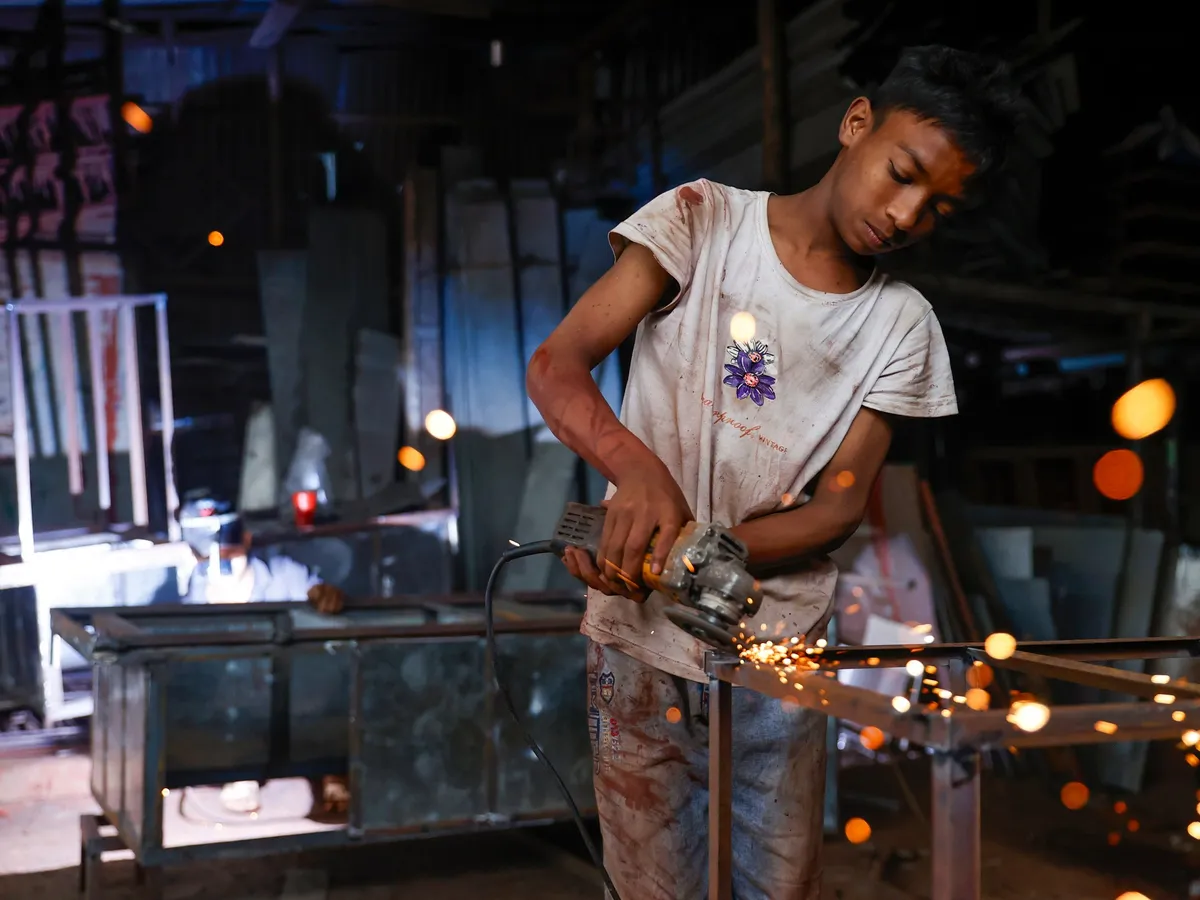
EXPLAINEROn World Day Against child labour, Al Jazeera takes a look at the latest numbers on child labour worldwide.Fourteen years old Riam works at a metal workshop without proper safety equipment in the Rayerbazar area, April 29, 2026 [Syed Mahamudur Rahman/NurPhoto via Getty]Published On 12 Jun 2026There are approximately 2.4 billion minors around the world who are aged below 18 years.Nearly 138 million of these children – about one in 17 – are engaged in child labour, including 54 million in hazardous work that endangers their health and safety, according to estimates by the International Labour Organization (ILO) and UNICEF.On World Day Against child labour, Al Jazeera takes a look at the latest numbers on child labour, the industries where it is most prevalent and the countries and regions bearing the heaviest burdens.Children doing hazardous jobsIn 2015, the United Nations set a goal to end child labour worldwide by 2025. That deadline has now passed. Although the total number of children in child labour has declined, two in five of those children still work in hazardous jobs that often involve heavy physical labour, exposure to toxic chemicals, dangerous machinery, long hours, or unsafe environments.Of the 54 million in hazardous work: 10.3 million (about 1 in 5) are aged 5-11 12.8 million (about 1 in 4) are aged 12-14 30.8 million (about 4 in 7) are aged 15-17 UNICEF and the ILO warn that such work can cause injury, illness and lasting damage to a child’s physical and mental development. Many of the children doing these jobs are also missing out on school, trapping families in cycles of poverty that can span generations.Child worker at weekly market, Had Draa, Morocco [File: Godong/Universal Images Group via Getty]child labour in different industriesAgriculture remains the world’s largest employer of children, accounting for 61 percent of all child labour cases. That means roughly 84 million children are working on farms, fisheries, forests and livestock production.Children carry heavy sacks across fields, spray crops with pesticides, descend into mines, work with sharp tools and machinery and spend long hours in extreme heat. Much of the world’s dangerous child labour is concentrated in the sector.In many rural communities, work starts before sunrise and competes directly with schooling.Children in service sector jobs, such as domestic work, retail and hospitality, account for 27 percent of child labour cases, while 13 percent work in industry, including mining, manufacturing and construction.child labour rates around the worldFrom cocoa fields in West Africa to rice farms in South Asia, Agriculture involves child labour the most worldwide because it is often informal, family-based and difficult to regulate.Lucia Soleti, acting UNICEF deputy representative of programmes in Ghana, told Al Jazeera that child labour remains widespread in West Africa, driven by poverty, limited access to social services and climate and economic shocks.She explained how in Ghana, more than 1.1 million children aged between five and 17 are affected, mostly in Agriculture, but also in mining, fishing and domestic work.“It deprives children of education, exposes them to hazardous conditions and perpetuates intergenerational poverty,” Soleti said.Child workers at a building site in Benin [File: Godong/Universal Images Group via Getty]Sub-Saharan Africa remains the centre of the crisis, with 87 million children engaged in child labour, more than the rest of the world combined. Population growth, conflict and economic instability have offset many of the gains made in recent years.While Asia and the Pacific have recorded the sharpest reductions, child labour remains embedded in global supply chains that produce food, clothing, minerals and consumer goods sold around the world.Mona Aika, acting chief of child protection at UNICEF in Nigeria, said, child labour in the country cannot be addressed through training or enforcement alone.“The slow reduction in sub-Saharan Africa is linked to multiple structural factors such as poverty, limited access to quality education, weak social protection, rural livelihoods dependent on family labour, conflict, displacement, climate shocks, population growth, informality of work and limited enforcement capacity,” Aika told Al Jazeera“It requires stronger child protection systems, social protection, education access, livelihoods support for families, community prevention, referral pathways and sustained government-led action,” says Aika.
SRCAl Jazeera
LANGEN
LEANCenter
WORDS680
ENT12
FRI · 2026-06-12 · 09:01 GMTBRIEF NSR-2026-0612-83840
NSR-2026-0612-83840News Report·EN·Human Rights
One in 17 children is working: Here are the industries driving child labour
Approximately 138 million children worldwide, or one in seventeen, are engaged in child labour, with 54 million performing hazardous work that endangers their health and safety. This situation persists despite the United Nations' goal to end child labour by 2025.
Alia ChughtaiAl JazeeraFiled 2026-06-12 · 09:01 GMTLean · CenterRead · 3 min
Al JazeeraFIG 01
Reading time
3min
Word count
680words
Sources cited
2cited
Entities identified
12entities
Quality score
100%
§ 01
Briefing Summary
AI-generatedNEWSAR · AI
Approximately 138 million children worldwide, or one in seventeen, are engaged in child labour, with 54 million performing hazardous work that endangers their health and safety. This situation persists despite the United Nations' goal to end child labour by 2025. Agriculture is the largest sector employing children, accounting for 61 percent of cases, followed by the service sector (27 percent) and industry (13 percent). Sub-Saharan Africa bears the heaviest burden, with 87 million children in child labour, driven by poverty, conflict, and economic instability. Child labour deprives children of education, perpetuates poverty, and can cause lasting physical and mental damage.
Confidence 0.90Sources 2Claims 5Entities 12
§ 02
Article analysis
Model · rule-basedFraming
Human Rights
Social Justice
Tone
Measured
AI-assessed
CalmNeutralAlarmist
Factuality
0.90 / 1.00
Factual
LowHigh
Sources cited
2
Limited
FewMany
§ 03
Key claims
5 extracted01
Child labour is driven by poverty, limited access to social services, and climate/economic shocks in West Africa.
factualLucia Soleti (UNICEF)
Confidence
1.00
02
Children in hazardous jobs face risks of injury, illness, and lasting physical and mental damage.
factualUNICEF and ILO
Confidence
1.00
03
Agriculture accounts for 61% of all child labour cases globally.
statistic
Confidence
1.00
04
The UN's goal to end child labour by 2025 has passed without being met.
factual
Confidence
1.00
05
Approximately 138 million children worldwide are engaged in child labour, with 54 million in hazardous work.
statisticILO and UNICEF
Confidence
1.00
§ 04
Full report
3 min read · 680 words§ 05
Entities
12 identifiedKey playerOppositionContextPositiveNeutralNegative
People1
Organizations5
Locations1
§ 06
Keywords & salience
9 termschild labour
1.00
hazardous work
0.90
agriculture
0.80
ilo
0.70
unicef
0.70
poverty
0.60
world day against child labour
0.50
industry
0.40
service sector
0.40
§ 07
Topic connections
Interactive graph No topic relationship data available yet. This graph will appear once topic relationships have been computed.