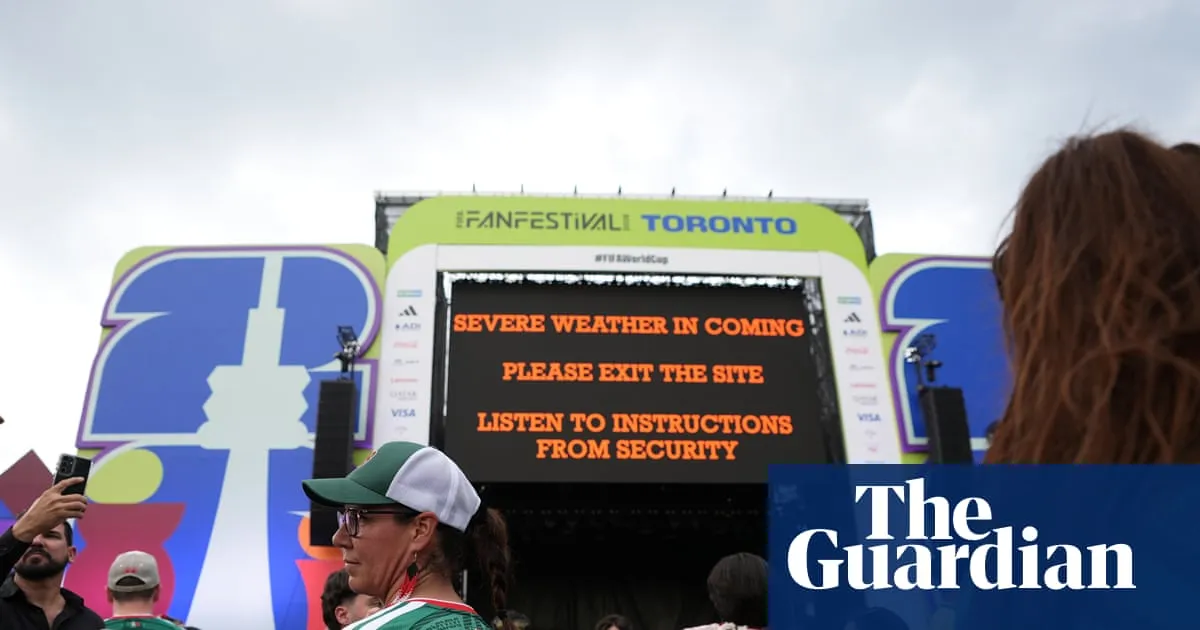
With the 2026 World Cup now under way, all 48 teams face a common opposition: summer weather across North America. Matches will be played in 16 cities, from southern Mexico to Canada, with a range of weather risks possible at each venue.Thunderstorms disrupted play before the tournament had even begun. England’s warm-up against Costa Rica in Orlando was delayed by about an hour after storms brought lightning and heavy rain that waterlogged the pitch. Safety regulations at US venues mean play is suspended when lightning is recorded within roughly 8 miles of a stadium, not resuming until 30 minutes after the last strike.The risk of thunderstorms is greatest across the central, eastern and south-eastern US. Among the host cities, Miami and Houston are the most lightning-prone, although Houston’s stadium has a retractable roof. The greatest risk of severe storms over the coming days, however, lies further north-east: scattered storms capable of strong gusts and isolated large hail are possible across the north-eastern US and south-eastern Canada, placing Friday’s Canada v Bosnia and Herzegovina match in Toronto and Saturday’s Boston and New York fixtures at slight risk.The weather hazards likely to pose the broadest challenge to players and spectators are heat and humidity. Temperatures in Monterrey, Mexico can be high in themselves, while the humidity of the south-eastern US is likely to produce the greatest heat strain, even at lower temperatures. Fifa assesses heat-stress risk using wet bulb globe temperature (WBGT), an index combining temperature, humidity, solar radiation, and wind. Many exercise physiologists regard 28C WBGT as the level at which high-exertion play becomes unsafe; Fifa’s own threshold for considering action is 32C. A 2025 study projected that 14 of the 16 host cities will exceed 28C at least some of the time, though several stadiums have roofs and air-conditioning that can mitigate the heat.Tropical storms may also be a risk during the World Cup. Because the tournament falls in the early part of the Atlantic season, most development is likely over the warm waters of the Gulf of Mexico, the Bay of Campeche, and the western Caribbean, rather than the still-cool open Atlantic, meaning that Mexican venues, Houston and Miami are at the greatest risk. The National Hurricane Center ismonitoring a low-pressure area over the Bay of Campeche, giving it a small chance of tropical cyclone formation before landfall into eastern Mexico at the weekend.Mexico City has additional challenges from its altitude. At about 2,240 metres above sea level, its thinner air means reduced oxygen availability, accelerating fatigue and slowing recovery for the players. The thinner air also offers less resistance, which can alter the flight of the ball.Canada’s venues will probably stay comparatively cool throughout the tournament with the lowest risk of disruptive storms. The uneven distribution of disruptive or health-affecting conditions has raised questions of competitive fairness.
SRCThe Guardian - World News
LANGEN
LEANCenter-Left
WORDS469
ENT12
FRI · 2026-06-12 · 08:40 GMTBRIEF NSR-2026-0612-83843
NSR-2026-0612-83843News Report·EN·Public Health
Weather tracker: heat, humidity and thunderstorms a danger at World Cup
The 2026 World Cup, held across 16 cities in North America, presents significant weather challenges for players and fans. Thunderstorms have already caused delays, with play suspended in the US if lightning is within eight miles of a stadium.
Brendan Wood for MetDeskThe Guardian - World NewsFiled 2026-06-12 · 08:40 GMTLean · Center-LeftRead · 2 min
The Guardian - World NewsFIG 01
Reading time
2min
Word count
469words
Sources cited
3cited
Entities identified
12entities
Quality score
100%
§ 01
Briefing Summary
AI-generatedNEWSAR · AI
The 2026 World Cup, held across 16 cities in North America, presents significant weather challenges for players and fans. Thunderstorms have already caused delays, with play suspended in the US if lightning is within eight miles of a stadium. Heat and humidity are major concerns, particularly in the southeastern US and Mexico, with FIFA using the wet bulb globe temperature index to assess risk. Tropical storms are also a possibility, with Mexican venues, Houston, and Miami at higher risk. Mexico City faces unique challenges due to its high altitude, affecting player fatigue and ball trajectory. Canada's venues are expected to be cooler with less storm risk, raising questions about competitive fairness due to the uneven distribution of weather conditions.
Confidence 0.90Sources 3Claims 5Entities 12
§ 02
Article analysis
Model · rule-basedFraming
Public Health
Environmental
Tone
Measured
AI-assessed
CalmNeutralAlarmist
Factuality
0.80 / 1.00
Factual
LowHigh
Sources cited
3
Well sourced
FewMany
§ 03
Key claims
5 extracted01
Mexico City's altitude presents challenges due to thinner air, affecting player fatigue and ball flight.
factual
Confidence
1.00
02
A 2025 study projected that 14 of the 16 host cities will exceed 28C WBGT at least some of the time.
statistic2025 study
Confidence
1.00
03
Thunderstorms disrupted play before the 2026 World Cup began, delaying England's warm-up match against Costa Rica.
factual
Confidence
1.00
04
Miami and Houston are the most lightning-prone host cities, though Houston has a retractable roof.
factual
Confidence
0.90
05
Tropical storms may pose a risk, with Mexican venues, Houston, and Miami at the greatest risk.
prediction
Confidence
0.80
§ 04
Full report
2 min read · 469 words§ 05
Entities
12 identifiedKey playerOppositionContextPositiveNeutralNegative
Locations11
§ 06
Keywords & salience
10 termsweather risks
1.00
world cup
1.00
thunderstorms
0.90
heat and humidity
0.90
north america
0.70
tropical storms
0.60
heat strain
0.60
lightning
0.50
wet bulb globe temperature
0.50
fifa
0.40
§ 07
Topic connections
Interactive graph No topic relationship data available yet. This graph will appear once topic relationships have been computed.