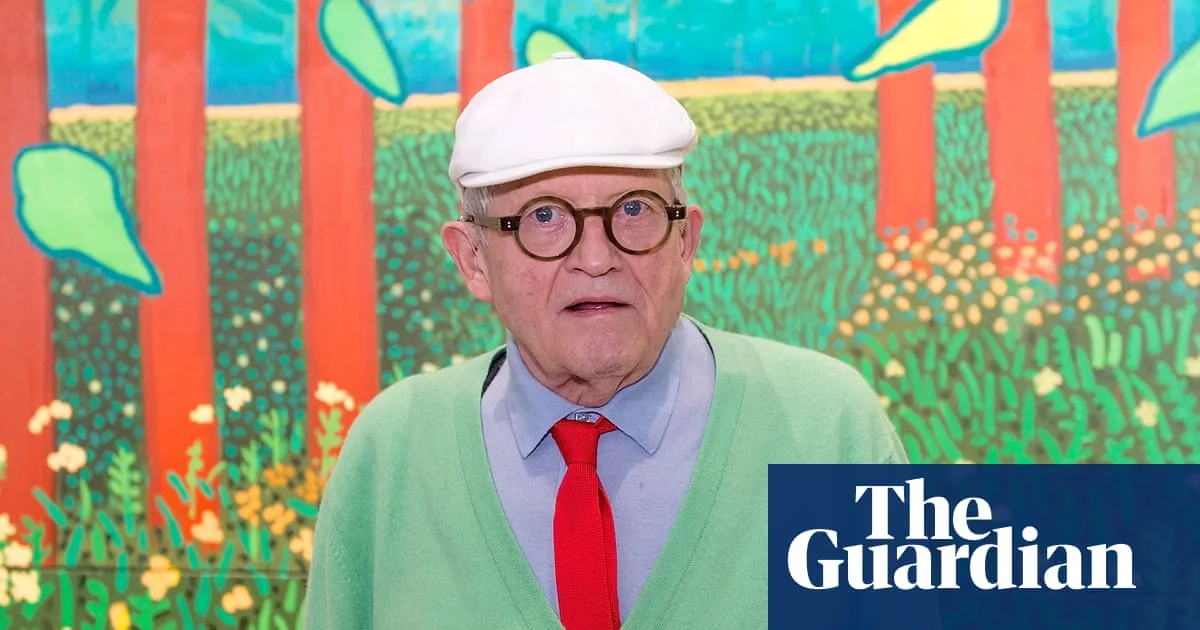
David Hockney, the iconic British painter who cast a revolutionary gaze across 20th-century art, has died aged 88.He made his name as a pop artist during the swinging 60s and was perhaps best known for his paintings of swimming pools that helped define the Los Angeles aesthetic. Works such as A Bigger Splash and Portrait of an Artist (Pool With Two Figures) depicted hedonistic scenes of love, lust and loss taking place below the city’s sun-soaked skies.But Hockney’s six-decade career cannot be defined by a single era. He produced perspective-shifting portraits using photo-collage, experimented with abstract landscape painting and, in later life, investigated the possibilities of creating artworks out of emerging 3D technology.David Hockney in 1966. Photograph: Paul Popper/Popperfoto/Getty ImagesBorn in Bradford in 1937, Hockney was the fourth of five children in what he described as a “radical working-class family”. His parents encouraged their son’s early artistic promise. He studied art at Bradford College and sold his first painting – a portrait of his father – for £10 at the Yorkshire Artists Exhibition in 1957.As a conscientious objector, he completed his two years of national service as a hospital orderly before enrolling at London’s Royal College of Art in 1959. He swiftly gained a reputation as a unique talent, albeit one with a rebellious streak. His refusal to paint a life drawing of a female model almost stopped him from graduating – pointedly, he submitted Life Drawing for a Diploma, which depicted a muscular male figure from an American physique magazine. Hockney also declined to write an essay required for the final examination, believing he should be assessed solely on his artworks. The RCA, aware of the talent it was fostering, bent its rules so it could award him the diploma.It was the start of a career in which Hockney had no qualms about challenging conservative society. His 1961 painting We Two Boys Together Clinging, named after a Walt Whitman poem, was an early indicator of that. Works that followed, such as 1962’s Cleaning Teeth, Early Evening (10pm) W11, with its phallic Colgate tubes and chains, would depict gay life with an honesty and openness that was almost completely at odds with a Britain in which homosexuality remained a criminal offence until 1967.With his signature bleach-blond hair, round, thick-rimmed spectacles and cigarette dangling from his lip, Hockney became a figure on the 60s party circuit in London and the US. He partied with Andy Warhol, Ossie Clark and Dennis Hopper, earning himself a reputation as a playboy and a flâneur. Yet while he indulged in the pleasure-filled life of a drug-taking bohemian, he never lost sight of his strong Yorkshire work ethic. Even after a stroke in 2012, which temporarily impaired his speech, he continued working.Record breaker … Hockney’s Portrait of an Artist (Pool With Two Figures) hanging in Tate Britain in 2017. Photograph: Will Oliver/EPAAfter moving to LA in the mid-60s, his more mature and restrained works garnered acclaim for their ability to transport deep and complex emotions on to the canvas. Man in Shower in Beverly Hills (1964) found the artist hitting his stride as he developed towards a more realist style. In November 2018, Hockney’s 1972 masterpiece, Portrait of an Artist (Pool With Two Figures), sold for $90.3m (£70.2m) at Christie’s, a world record for a living artist at the time. The work, inspired by Hockney’s breakup with his lover, enraptured critics, including the Guardian’s Jonathan Jones, who described it that same year as “a calm distillation of love and sorrow”.While working on one of his LA paintings, Hockney took a series of reference photographs on a Polaroid camera and accidentally stumbled on the next stage of his career: photocollage, or “joiners” as he would term them. Through assembling multiple photographs together, Hockney could explore his fascination with perspective. The portraits he created of his mother and the British art dealer John Kasmin exhibited a strong cubist influence that drew comparisons with his idol, Picasso.In later years, Hockney experimented in many new areas including set and costume design for operas and ballets. Developing technology fascinated the artist: as his career evolved, his art made use of the photocopier, the fax machine, the printer and the iPad – the latter allowing him to create reams of digital paintings that he would excitedly email friends and acquaintances. But his technological interests always came back to one thing: “I’m really only interested in technology that is about pictures,” he told Interview magazine in 2013. “I’m interested in anything that makes a picture.”An avid smoker all his life, Hockney maintained that cigarettes had been beneficial to his mental health. Writing in the Guardian in 2007 he called the UK’s imminent smoking ban “the most grotesque piece of social engineering”.He had moved back to Yorkshire from Los Angeles in 2005, but in 2013 tragedy struck when his 23-year-old assistant Dominic Elliott was found dead at his Bridlington home. Elliott had been found to have consumed household drain cleaner after taking a range of recreational drugs including ecstasy and cocaine. A coroner ruled that Elliott had died as a result of misadventure. Hockney said that for a period he had considered giving up art altogether, as he was unable to draw in the wake of Elliott’s death.Hockney is believed to have turned down a knighthood on several occasions and once declined an invitation to paint a portrait of the queen. His iconoclasm found its way into the 2001 book Secret Knowledge: Rediscovering the Lost Techniques of the Old Masters, in which he challenged much established thinking regarding how the great paintings of the past may have been created. It managed to both enrage and enrapture critics and art historians.“Teaching people to draw is teaching people to look,” he told the Yorkshire Post in 2018. And his art undeniably had a profound effect on the way we viewed the 20th century – not that he would necessarily have seen it that way.“I don’t reflect too much,” he told the Guardian’s Simon Hattenstone in 2015. “I live now. It’s always now.”
SRCThe Guardian - World News
LANGEN
LEANCenter-Left
WORDS1 006
ENT9
FRI · 2026-06-12 · 09:52 GMTBRIEF NSR-2026-0612-83869
NSR-2026-0612-83869News Report·EN·Human Interest
David Hockney, revolutionary British artist, dies aged 88
British painter David Hockney, known for his revolutionary contributions to 20th-century art, has died at the age of 88. Born in Bradford in 1937, Hockney rose to prominence in the 1960s as a pop artist, gaining particular fame for his iconic swimming pool paintings that defined the Los Angeles aesthetic.
Tim JonzeThe Guardian - World NewsFiled 2026-06-12 · 09:52 GMTLean · Center-LeftRead · 5 min
The Guardian - World NewsFIG 01
Reading time
5min
Word count
1 006words
Sources cited
0cited
Entities identified
9entities
Quality score
100%
§ 01
Briefing Summary
AI-generatedNEWSAR · AI
British painter David Hockney, known for his revolutionary contributions to 20th-century art, has died at the age of 88. Born in Bradford in 1937, Hockney rose to prominence in the 1960s as a pop artist, gaining particular fame for his iconic swimming pool paintings that defined the Los Angeles aesthetic. His extensive career also included perspective-shifting photo-collages, abstract landscapes, and explorations of emerging 3D technology. Hockney challenged conservative society throughout his life, depicting gay life with unprecedented honesty and pushing artistic boundaries. He continued to work prolifically, even after a stroke in 2012, and his art evolved to incorporate technologies like the iPad.
Confidence 0.90Claims 5Entities 9
§ 02
Article analysis
Model · rule-basedFraming
Human Interest
Technology
Tone
Measured
AI-assessed
CalmNeutralAlarmist
Factuality
0.70 / 1.00
Factual
LowHigh
Sources cited
0
No named sources
FewMany
§ 03
Key claims
5 extracted01
Hockney continued working even after a stroke in 2012 that impaired his speech.
factual
Confidence
1.00
02
Hockney's early works depicted gay life with an honesty at odds with Britain where homosexuality was criminalized until 1967.
factual
Confidence
1.00
03
Hockney's six-decade career included perspective-shifting portraits using photo-collage and experiments with 3D technology.
factual
Confidence
1.00
04
Hockney was known for his paintings of swimming pools that defined the Los Angeles aesthetic.
factual
Confidence
1.00
05
David Hockney, the iconic British painter, has died aged 88.
factual
Confidence
1.00
§ 04
Full report
5 min read · 1 006 words§ 05
Entities
9 identifiedKey playerOppositionContextPositiveNeutralNegative
Organizations1
§ 06
Keywords & salience
10 termsdavid hockney
1.00
british artist
0.90
pop art
0.80
swimming pools
0.70
los angeles aesthetic
0.60
landscape painting
0.50
photo-collage
0.50
gay life
0.40
royal college of art
0.40
3d technology
0.40
§ 07
Topic connections
Interactive graph No topic relationship data available yet. This graph will appear once topic relationships have been computed.